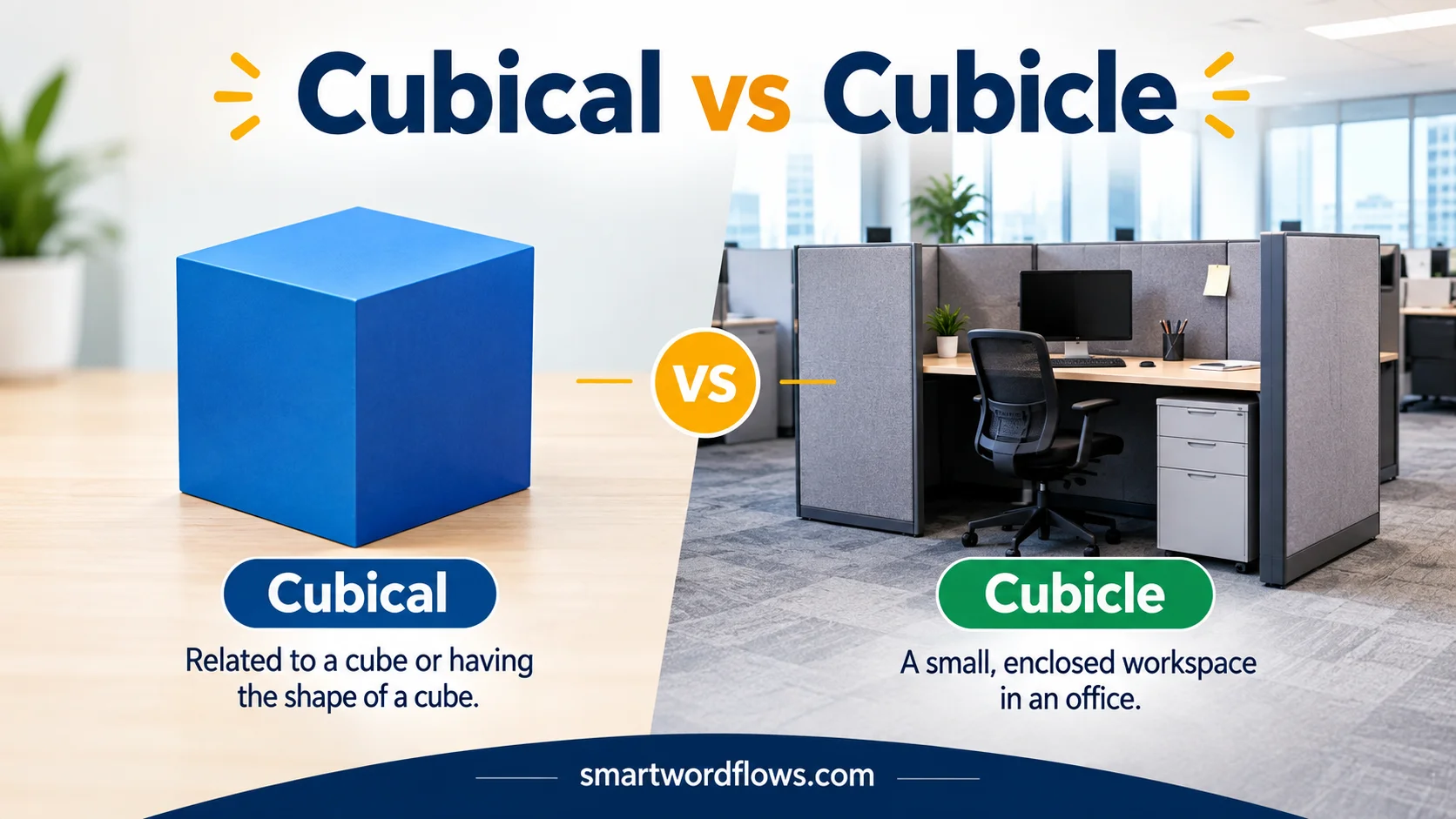

Cubical vs Cubicle can be confusing because both words look and sound similar, but their meanings are quite different. Cubical is an adjective that describes something shaped like a cube, with three dimensions and six sides. Cubicle, on the other hand, is a noun for a small enclosed space, often found in an office, bathroom, or other partitioned area. Understanding this difference helps you choose the correct word and avoid common spelling mistakes in everyday writing.
The easiest way to remember the difference is to connect cubical with shape and cubicle with a space. A cubical object may have a cube-like form, while a cubicle is a small area separated by partitions. For example, an office worker may sit inside a cubicle, while a box may have a cubical design. Interestingly, something can even be a cubical cubicle if the enclosed space itself has a cube-like shape.
Quick Answer
Cubical and cubicle are both correct English words, but they serve different purposes.
- Cubical is an adjective meaning cube-shaped or resembling a cube.
- Cubicle is a noun meaning a small enclosed or partitioned space.
- Cubical commonly describes shape, form, or appearance.
- Cubicle commonly refers to office workspaces, changing compartments, or other small separated areas.
Quick examples
- Cubical: The building has a cubical design.
- Cubicle: She works in an office cubicle.
A simple memory trick can help:
Cubical = cube-like shape
Cubicle = small compartment
So if you’re talking about what something looks like, choose cubical. If you’re talking about a small divided space, choose cubicle.
Comparison Overview
| Feature | Cubical | Cubicle |
| Part of speech | Adjective | Noun |
| Main meaning | Cube-shaped or cube-like | Small enclosed or partitioned space |
| Related word | Cube | Compartment |
| Main function | Describes something | Names something |
| Common context | Geometry, architecture, design, objects | Offices, changing rooms, small enclosures |
| Example | The room has a cubical shape. | He works in a cubicle. |
| Plural form | Usually not pluralized as an adjective | Cubicles |
| Common confusion | Used instead of “cubicle” | Used instead of “cubical” |
The most important distinction is grammatical as well as semantic. Cubical describes, whereas cubicle identifies.
For instance, in the sentence “The structure has a cubical form,” the word cubical tells you something about the structure. In “The employee entered the cubicle,” the word cubicle identifies a physical space.
Main Differences Between Cubical vs Cubicle
The difference between cubical vs cubicle becomes clear when you look at their meanings, grammatical roles, and everyday contexts.
Difference in Meaning
Cubical means having the shape or general form of a cube. A cube has six square faces of equal size. Something doesn’t necessarily need to be a mathematically perfect cube to receive the descriptive label cubical. The word can also describe something that generally resembles a cube.
Cubicle means a small room, compartment, or separated area. Modern English frequently uses it for partitioned office workspaces.
Consider these two sentences:
- The laboratory contains a cubical chamber.
- The employee sits inside a cubicle.
The first sentence describes the chamber’s shape. The second identifies a physical workspace.
Difference in Part of Speech
Another major distinction is grammar.
Cubical functions primarily as an adjective. It modifies a noun.
Examples include:
- cubical structure
- cubical room
- cubical object
- cubical design
- cubical container
Cubicle functions as a noun.
Examples include:
- office cubicle
- private cubicle
- bathroom cubicle
- changing cubicle
- individual cubicle
This grammatical difference provides a useful shortcut. If the word needs to describe a noun, cubical may fit. If the word itself names a space or compartment, cubicle is usually the correct choice.
Difference in Usage
Use cubical when you want to talk about shape.
The architect designed a cubical structure.
Use cubicle when you want to talk about a separated space.
The architect added several small cubicles inside the building.
The words may appear in the same sentence without being interchangeable:
The office contained several cubicles inside a cubical building.
Here, cubical describes the building’s form. Cubicles identifies the individual workspaces.
Difference in Context
The contexts surrounding these words also differ.
You might encounter cubical in:
- Geometry
- Architecture
- Engineering
- Industrial design
- Product descriptions
- Scientific writing
- Shape-based descriptions
You might encounter cubicle in:
- Offices
- Schools
- Public facilities
- Changing rooms
- Bathrooms
- Medical settings
- Small private compartments
The distinction isn’t absolute in every specialized context. Still, these are the most common uses readers will encounter.
What Does Cubical Mean?
Cubical is an adjective that describes something shaped like a cube or resembling one.
The word comes from cube, which refers to a three-dimensional solid with six equal square faces. In everyday writing, however, cubical doesn’t always mean that every measurement is mathematically identical.
For example, an architect might describe a building as having a cubical appearance even if the building isn’t a perfect geometric cube.
Cubical Definition in Simple English
A simple definition is:
Cubical means having the shape or general appearance of a cube.
The word answers questions such as:
- What shape is it?
- What does it resemble?
- What form does it have?
Examples of Cubical
Here are several natural examples:
- The sculpture has a cubical form.
- The designer created a cubical container.
- The building has a simple cubical appearance.
- The experiment used a cubical chamber.
- The toy consists of several cubical blocks.
In each example, cubical describes another noun.
Cubical in Geometry
In mathematical contexts, cubical can relate directly to cubes and three-dimensional geometry.
A cube has:
- 6 square faces
- 12 edges
- 8 vertices
- Equal edge lengths
- Equal square faces
So when a mathematical or technical description calls an object cubical, it generally draws attention to its cube-like form.
genui{“learning_viz”:{“type_id”:”VOLUME_CUBE”,”initial_values”:{“sideLength”:3},”locale_override”:”en-US”}}
For example, if a cube has a side length of 3 units, its volume is 27 cubic units. The adjective cubical describes the shape rather than naming the object itself.
Cubical vs Cube-Shaped
Cubical and cube-shaped often communicate nearly the same basic idea.
Compare:
- The sculpture has a cubical design.
- The sculpture is cube-shaped.
Both sentences tell the reader that the sculpture resembles a cube.
However, cube-shaped can sound more direct and conversational. Cubical may sound more compact or technical depending on the sentence.
For everyday writing, either can work when the intended meaning is clear.
What Does Cubicle Mean?
A cubicle is a small space or compartment that is separated from surrounding areas. The separation often comes from walls, screens, partitions, or panels.
The word has become especially familiar because of the modern office cubicle.
Cubicle Definition in Simple English
A simple definition is:
A cubicle is a small enclosed or partitioned space.
Unlike cubical, the word cubicle doesn’t primarily describe shape. It identifies the space itself.
For example:
Maria works in a cubicle.
Here, cubicle refers to the workspace where Maria works.
Office Cubicle
The office is probably the most familiar setting for the word cubicle.
An office cubicle usually consists of:
- A desk
- A chair
- Partition panels
- Storage space
- Computer equipment
- Personal work items
Cubicles allow organizations to divide a larger room into individual work areas without constructing permanent walls for every employee.
For example:
The company arranged twelve cubicles across the open office.
Notice that the word refers to the separated work areas rather than the desks alone.
Other Uses of Cubicle
The word isn’t limited to offices.
You may also see cubicle used for:
Changing cubicle:
A small private area where someone changes clothes.
Bathroom cubicle:
An enclosed section containing a toilet in a shared restroom.
Shower cubicle:
A small enclosed area designed for showering.
Study cubicle:
A separated desk or study area in a library or educational facility.
These uses share the same basic idea: a small space separated from a larger surrounding area.
Cubical vs Cubicle Examples
Seeing the words side by side makes the distinction much easier.
| Cubical | Cubicle |
| The machine has a cubical shape. | The worker sits in a cubicle. |
| The designer created a cubical container. | She decorated her office cubicle. |
| The building has a cubical appearance. | Each employee has an individual cubicle. |
| Scientists examined the cubical structure. | He entered the changing cubicle. |
| The sculpture has a cubical form. | The restroom has several cubicles. |
The key difference remains consistent. Cubical describes form, while cubicle names a space.
Is Cubical a Correct Word?
Yes. Cubical is a legitimate English adjective.
It isn’t a misspelling of cubicle. The two words have different meanings and grammatical functions.
For example:
The house has a cubical shape.
This sentence uses cubical correctly because the writer is describing the house’s shape.
Another example:
The artist created a cubical sculpture.
Again, cubical describes the sculpture’s form.
When Should You Use Cubical?
Choose cubical when the sentence focuses on:
- Shape
- Form
- Structure
- Appearance
- Geometry
- Cube-like characteristics
If you can replace the word with cube-shaped without changing the basic meaning, cubical may be appropriate.
For example:
The object has a cubical shape.
You could also write:
The object is cube-shaped.
Both communicate the same general idea.
Read More: Until vs Untill: Which Spelling Is Correct and What’s the Difference?
Is Cubicle a Correct Word?
Yes. Cubicle is also a standard English word.
It functions as a noun and usually refers to a small separated space.
For example:
James moved to a new cubicle.
The word cubicle names the physical area where James works.
When Should You Use Cubicle?
Use cubicle when you mean:
- A small office workspace
- A changing compartment
- A bathroom compartment
- A shower enclosure
- A small study area
- Another separated or enclosed space
The important point is that cubicle refers to the space itself.
Why Do People Confuse Cubical and Cubicle?
The confusion isn’t surprising. The words share several letters and both connect to the concept of a cube.
Their endings create the main difference:
- Cubical
- Cubicle
The similar spelling can make your eyes skim over the final letters. When you’re typing quickly, it’s easy to select the wrong form.
Their Relationship to “Cube”
Both words have a historical connection to cube.
A cubical object resembles a cube. A cubicle originally referred to a small room or compartment. The similarity in appearance between the words doesn’t mean their modern meanings overlap completely.
This is an important lesson in vocabulary. Two words can share a root while developing different meanings and grammatical functions.
A Simple Memory Trick
Remember these two associations:
Cubical → cube-like
Cubicle → compartment
If you’re describing the shape, think cubical.
If you’re naming the space, think cubicle.
That small distinction can prevent most spelling and usage mistakes.
Common Mistakes With Cubical and Cubicle
Using Cubical for an Office Workspace
One of the most common mistakes occurs when people write office cubical when they mean an office workspace.
In standard usage, the usual term is:
office cubicle
For example:
Incorrect in the intended sense:
I left my notebook in my office cubical.
Correct:
I left my notebook in my office cubicle.
The reason is simple. You’re naming a workspace rather than describing its shape.
Using Cubicle to Describe Shape
The opposite mistake happens when someone wants to describe something as cube-shaped.
For example:
The machine has a cubicle shape.
If the intended meaning is that the machine resembles a cube, cubical is the natural choice:
The machine has a cubical shape.
You could also say:
The machine is cube-shaped.
Treating Them as Spelling Variants
Another mistake is assuming cubical and cubicle are different spellings for the same word.
They aren’t.
Consider:
The object is cubical.
This describes its shape.
Now compare:
The object is inside a cubicle.
This identifies the space around it.
Changing one word for the other can completely alter the sentence.
Cubical vs Cube-Shaped
The phrase cube-shaped is particularly useful because it makes the meaning immediately obvious.
| Expression | Meaning | Style |
| Cubical | Having a cube-like shape | Concise, sometimes technical |
| Cube-shaped | Shaped like a cube | Direct and easy to understand |
| Cuboid | A rectangular box-like solid | Geometric and technical |
There’s an important geometric distinction here.
A cube has equal edge lengths. A cuboid has rectangular faces and doesn’t need equal edge lengths. Therefore, calling something cubical can suggest a stronger resemblance to a cube than simply describing a general box-like form.
For example:
The storage unit is cubical.
This suggests a cube-like form.
The storage unit is rectangular.
This describes a different geometric characteristic.
When Cube-Shaped Is Better
For general readers, cube-shaped may sometimes be easier to understand.
For example:
The gift box is cube-shaped.
The meaning requires no interpretation.
In more formal descriptions, however, cubical may be more concise:
The chamber has a cubical structure.
Both expressions have their place.
Cubicle in the Workplace
The office cubicle deserves special attention because it represents the most familiar modern use of the word.
A cubicle typically divides an open office into smaller work areas. Partition panels can provide visual separation without creating permanent rooms.
A typical workstation might include:
- A desk surface
- Computer monitor
- Keyboard and mouse
- Office chair
- Storage drawers
- Partition walls
- Personal items
The cubicle itself isn’t necessarily a complete room. Its defining feature is the separation of a small workspace from the surrounding office.
Cubicle vs Office
A cubicle isn’t necessarily the same as an office.
An office may have permanent walls, a door, and a private room layout. A cubicle usually occupies part of a larger shared area and uses partitions to define the workspace.
For example:
Sarah has a private office.
This suggests a separate room.
Sarah has a cubicle.
This usually suggests a partitioned workstation within a larger office area.
That difference matters when describing workplace layouts accurately.
Cubical vs Cubicle: Grammar Guide
Grammar provides another reliable way to distinguish the two.
Cubical as an Adjective
Because cubical functions as an adjective, it normally modifies a noun.
Examples:
- a cubical structure
- a cubical room
- a cubical object
- a cubical building
- a cubical design
You can also use it after a linking verb:
The structure looks cubical.
Here, cubical still describes the structure.
Cubicle as a Noun
Because cubicle functions as a noun, it can appear as the subject or object of a sentence.
Examples:
The cubicle is empty.
She entered the cubicle.
Several cubicles line the office.
His cubicle is near the window.
The plural form is cubicles.
A Practical Case Study: Choosing the Right Word
Imagine you’re describing a modern office building.
The exterior consists of a large cube-like structure. Inside, employees work at separated stations.
You could write:
The building has a cubical exterior with dozens of office cubicles inside.
This sentence uses both words correctly.
Why?
Cubical describes the building’s shape.
Cubicles identifies the individual workspaces.
Now imagine replacing the words:
The building has a cubicle exterior with dozens of office cubicals inside.
The sentence becomes confusing because the words no longer match their intended grammatical roles.
This example shows why understanding meaning is more useful than memorizing spelling alone.
How to Remember Cubical vs Cubicle
A quick memory system can make this distinction almost automatic.
Think “Shape” for Cubical
If the sentence answers “What shape is it?”, consider cubical.
Examples:
- cubical building
- cubical box
- cubical sculpture
- cubical structure
Think “Space” for Cubicle
If the sentence answers “What small space is it?”, consider cubicle.
Examples:
- office cubicle
- shower cubicle
- changing cubicle
- bathroom cubicle
The Two-Word Rule
Remember:
Cubical = shape
Cubicle = space
It’s short enough to remember and broad enough to handle most everyday situations.
Cubical vs Cubicle in Everyday Sentences
Here are additional examples that show how the words work naturally.
Examples With Cubical
- The architect designed a cubical building.
- The package has a nearly cubical shape.
- A cubical structure occupied the center of the room.
- The sculpture has a distinctly cubical appearance.
- The experiment involved a cubical container.
Examples With Cubicle
- I spend most of my workday in a cubicle.
- Her new cubicle has more storage space.
- The office replaced several old cubicles.
- He stepped into the changing cubicle.
- The library provides individual study cubicles.
Examples Using Both Words
- The cubical building contains hundreds of office cubicles.
- The designer placed a cubical display beside each cubicle.
- The room has a cubical layout with several private cubicles.
- A cubical structure stands behind the row of cubicles.
These examples demonstrate that the two words can appear together without having the same meaning.
FAQs :
Is cubical a correct word?
Yes, cubical is a correct English word. It is an adjective used to describe something that has the shape or characteristics of a cube. For example, “The room has a cubical design.”
Is cubicle a correct word?
Yes, cubicle is a correct word and a noun. It usually refers to a small, enclosed or partitioned space, especially in an office, bathroom, or workplace.
What is the main difference between cubical and cubicle?
The main difference is their meaning and grammatical use. Cubical describes the shape of something, while cubicle refers to a small enclosed space. Remember: cubical relates to shape, while cubicle relates to space.
Can a cubicle be cubical?
Yes. A cubicle can be cubical if the enclosed space is approximately shaped like a cube. For example, a small office cubicle with equal dimensions could reasonably be described as cubical.
Which is correct: cubical or cubicle?
Both cubical and cubicle are correct, but they are used in different situations. Use cubical when describing something cube-shaped and cubicle when referring to a small partitioned or enclosed space.
Conclusion :
Understanding cubical vs cubicle becomes easy when you remember their core meanings. Cubical describes something related to the shape of a cube, while cubicle refers to a small enclosed or partitioned space. Although their spelling and pronunciation are similar, they cannot normally be used interchangeably. Keep this simple distinction in mind, and you can use both words accurately and confidently in your writing.