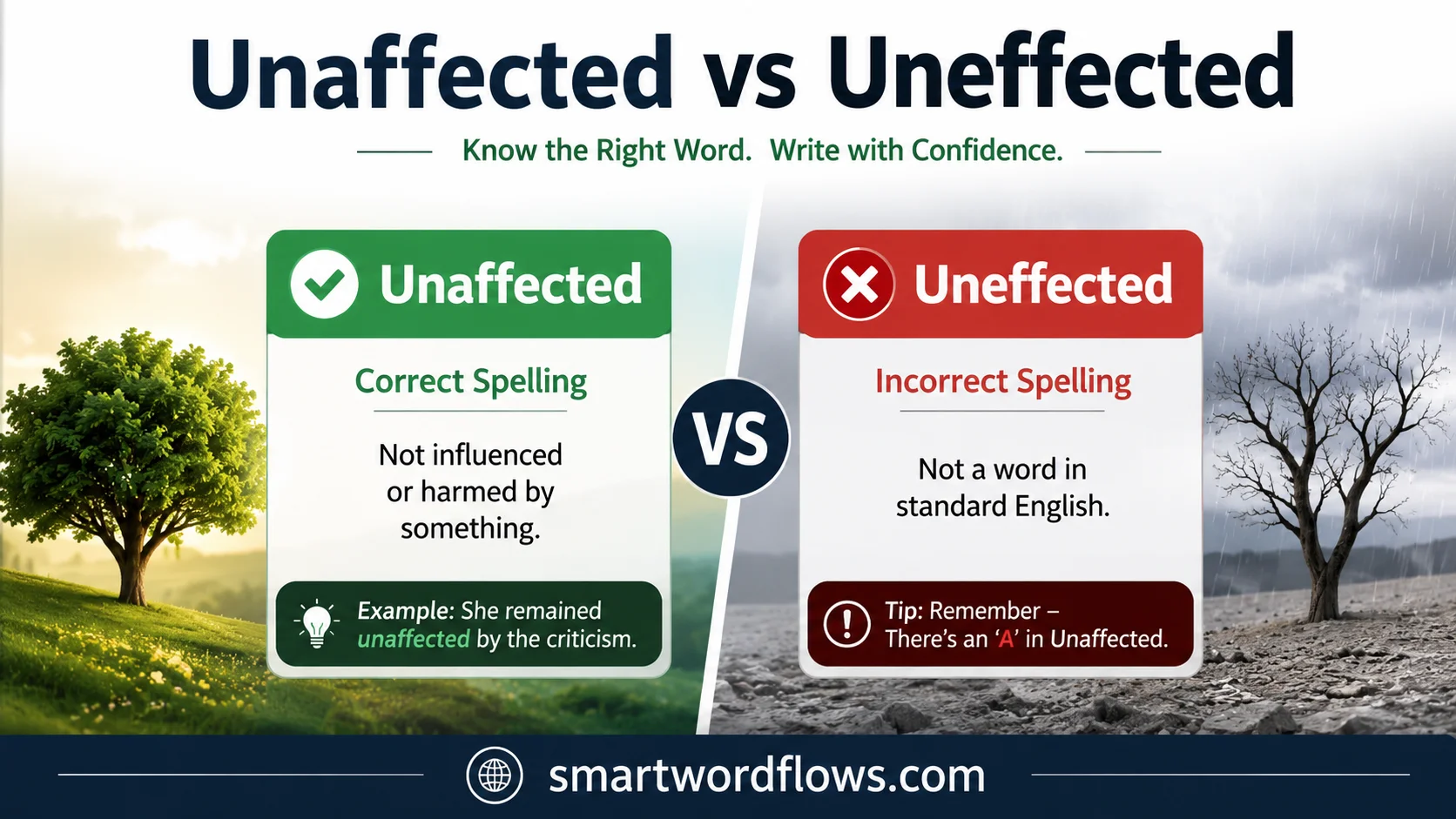

Unaffected vs Uneffected can confuse writers, English learners, and native speakers because both words look similar. The correct spelling is unaffected, while uneffected is generally a spelling mistake in standard English. If you wonder which word to use in a sentence, remember that unaffected means not changed, influenced, or harmed. This simple definition helps avoid common mistakes and improves your writing in everyday and professional situations.
Understanding the difference between these words makes correct usage easier. Use unaffected in an email, essay, or professional document when something remains unchanged. Learning its meaning, pronunciation, and common examples can build confidence and prevent grammar errors. Memory tips and real-life examples also make the correct form easier to remember, so you can write correctly without second-guessing yourself.
Quick Answer
Unaffected is the correct word.
Uneffected is not standard English and should not be used in formal or everyday writing.
That is the simplest answer. If you mean that something was not influenced, changed, damaged, or emotionally moved, use unaffected. The spelling with an extra e is a mistake, even though it appears often in search queries and casual writing.
Comparison Overview
Here is the clearest way to look at the two forms:
| Word | Correct? | Meaning | Use It? |
| Unaffected | Yes | Not changed, influenced, or harmed | Yes |
| Uneffected | No | Not a standard English word | No |
The table tells the full story. Unaffected is the real word you need. Uneffected is a spelling error that should be corrected before you publish, submit, or send anything important.
Main Differences Between Unaffected vs Uneffected
The main difference is simple, but the reason behind the mistake is worth understanding.
Unaffected comes from the verb affect. When something does not receive influence or change from another thing, it is unaffected.
Uneffected looks like it should mean the same thing, but English does not use that spelling as a standard form. It is not the accepted opposite of effected in the way many people assume.
Here is the practical rule:
- Use affected when something is influenced.
- Use unaffected when something is not influenced.
- Do not use uneffected.
This is one of those spelling traps that can fool even strong writers. The word seems logical, but English does not always reward logic. Sometimes it rewards convention.
What Unaffected Means
The word unaffected means not influenced, not changed, not harmed, or not emotionally moved by something.
That definition may sound broad, but the word appears in several common situations. You might use it to describe:
- a person who stays calm under pressure
- a business that does not suffer from a market shift
- a place that avoids damage after a storm
- a result that remains the same despite outside forces
A simple example helps:
- The new policy left the main office unaffected.
That sentence means the policy did not create a change in the main office. Nothing strange. Nothing complicated. Just a clear statement that something stayed the same.
Unaffected in everyday writing
You will often see the word in news reports, business writing, school essays, and general conversation. It works well because it is precise without being stiff.
Examples:
- The town remained unaffected by the flood.
- Her confidence stayed unaffected after the criticism.
- The backup system was unaffected by the power failure.
- Several employees were unaffected by the schedule change.
Each sentence says the same basic thing in a different setting. Something happened, but the subject did not change because of it.
What Uneffected Means
The short answer is this: uneffected is not a standard English word.
You may see it in online writing, draft notes, or informal messages, but that does not make it correct. Dictionaries and style guides do not treat it as the right form for formal use.
Why do people make this mistake?
Because the spelling feels tempting. Writers see affected and think they need to add un- to create the opposite. Then an extra e sneaks in, probably because effected is also a real word. That mix creates confusion.
So the error usually comes from two things at once:
- confusion between affect and effect
- confusion between affected and effected
That is why the mistake is so common. It is not random. It is a collision of similar-looking words.
A useful way to think about it
If you want to say something was not influenced, do not invent a new spelling. Go back to the root idea:
- affected means influenced
- unaffected means not influenced
That is the pair that matters.
Unaffected vs Uneffected in Real Sentences
One of the best ways to learn a word is to see it in action. The difference becomes obvious when you place the words into real sentences.
Correct examples with unaffected
- The outage left the office unaffected.
- She remained unaffected by the gossip.
- The equipment was unaffected by the temperature drop.
- The final decision left most of the team unaffected.
- Their travel plans were unaffected by the delay.
Incorrect examples with uneffected
- The outage left the office uneffected.
- She remained uneffected by the gossip.
- The equipment was uneffected by the temperature drop.
Those examples look close, but the incorrect spelling stands out once you know what to watch for.
Corrected versions
- The outage left the office unaffected.
- She remained unaffected by the gossip.
- The equipment was unaffected by the temperature drop.
That is the version you should use.
A Closer Look at Affected and Effected
A lot of the confusion around unaffected comes from the words affected and effected. These two words are related in spelling, but they do not behave the same way.
Affected
Affected usually means influenced, changed, or impacted.
Examples:
- The storm affected traffic.
- The bad news affected her mood.
- The policy affected small businesses.
Effected
Effected means brought about, caused, or made happen.
Examples:
- The new manager effected major changes.
- The agreement effected a shift in company policy.
- The bill effected several important reforms.
Here is the key point: unaffected is built from affected, not from effected. That is why the correct opposite is unaffected, not uneffected.
How to Use Unaffected Correctly
The word unaffected is flexible, but it is not random. It usually fits one of a few patterns.
Unaffected in business and professional writing
In business writing, unaffected is useful when you need to say that something stayed steady despite outside pressure.
Examples:
- Revenue remained unaffected during the transition.
- The main office was unaffected by the network outage.
- Production stayed unaffected after the software update.
This kind of wording sounds clean and professional. It avoids drama and sticks to the facts.
Unaffected in emotional situations
The word can also describe a person who does not show emotional change.
Examples:
- He looked unaffected by the insult.
- She stayed unaffected during the tense conversation.
- The speaker seemed unaffected by the criticism.
In this sense, the word describes calmness, distance, or emotional control. It does not always mean the person feels nothing. Sometimes it simply means they do not show a reaction.
Unaffected in physical or practical situations
You can also use unaffected for physical things.
Examples:
- The bridge was unaffected by the rain.
- The documents remained unaffected by the fire.
- The lower floors were unaffected by the leak.
These sentences work because they clearly show that something stayed the same after an event.
Common Mistakes People Make
Even careful writers slip up here. That is normal. The words look close enough to create trouble.
Mistake 1: Adding an extra letter
Many writers write uneffected because it feels like the opposite of effected.
That is the wrong move.
Correct:
- The results were unaffected.
Incorrect:
- The results were uneffected.
Mistake 2: Mixing up affect and effect
This is one of the oldest grammar headaches in English. The two words are related, but they do different jobs.
A simple rule:
- affect is usually a verb
- effect is usually a noun
That rule is helpful, even though English loves exceptions.
Examples:
- The news may affect his decision.
- The news had an effect on his decision.
That distinction matters because it helps you choose the right base word before adding prefixes or endings.
Mistake 3: Using the wrong form in formal writing
If you are writing an email, essay, report, or article, the wrong spelling can hurt your credibility.
That does not mean one small typo ruins your work. It does mean patterns matter. Readers notice repeated errors. They often judge the writing quality by the smallest mistakes first.
Read More: Copys or Copies: Which Is Correct?
Memory Trick for Remembering the Correct Word
A good memory trick can save you time.
Think of it this way:
- affected means influenced
- unaffected means not influenced
So, if something is not affected, it is unaffected.
Do not add a new letter. Do not create a new spelling. Just attach un- to the correct word and keep the structure clean.
Here is a quick reminder phrase:
“Not affected equals unaffected.”
That line is simple enough to recall when you are writing fast.
Unaffected vs Uneffected in Different Contexts
The meaning stays the same, but the setting changes how the word feels.
In academic writing
Use unaffected to show that a subject, sample, result, or group did not change.
Example:
- The control group remained unaffected by the variable.
In journalism
News writing uses unaffected to report facts without extra emotion.
Example:
- The airport remained unaffected by the brief outage.
In marketing or business reports
The word helps show stability.
Example:
- Customer demand stayed unaffected despite the seasonal slowdown.
In personal writing
You can use it to describe emotional steadiness or a lack of response.
Example:
- She seemed unaffected by the awkward silence.
Each context uses the same core idea. Something remained unchanged or unimpressed by outside pressure.
Table of Correct Usage
Here is a practical table you can use as a quick reference.
| Situation | Correct Sentence | Why It Works |
| Weather impact | The village remained unaffected by the storm. | It shows no change or damage |
| Emotional response | He appeared unaffected by the insult. | It shows no visible reaction |
| Business change | Sales were unaffected by the delay. | It shows stability |
| Technical issue | The backup server was unaffected. | It shows the system stayed intact |
| Academic context | The sample remained unaffected by the treatment. | It shows no influence |
A table like this makes the pattern easier to remember. Once you see it in several settings, the correct form starts to feel automatic.
A Small Case Study on Clear Word Choice
Imagine two writers report the same event.
Writer A
“The team was uneffected by the change in schedule.”
Writer B
“The team was unaffected by the change in schedule.”
Both writers may mean the same thing. But only Writer B uses standard English.
Now imagine a hiring manager, editor, or teacher reading both lines. The second version looks cleaner and more trustworthy. The first one creates doubt, even if the rest of the work is good.
That is how a small spelling choice can shape the reader’s view of your writing. One correct word can make a sentence feel smooth. One wrong word can make it feel shaky.
Synonyms and Similar Words for Unaffected
Sometimes you want variation. Maybe you are writing a paragraph and do not want to repeat unaffected too often. In that case, these words may help depending on your meaning.
- unchanged
- unharmed
- untouched
- stable
- steady
- resistant
- immune
- insensitive when you mean emotionally unresponsive, but use this carefully because it can sound harsh
These are not perfect substitutes in every case. That is important. A synonym should match the exact meaning you need.
For example:
- unchanged focuses on the fact that nothing altered.
- unharmed focuses on safety or damage.
- untouched suggests nothing was disturbed.
- immune suggests protection from impact or illness.
Picking the wrong near-synonym can distort your sentence. So use them with care.
Why This Difference Matters
At first glance, this may look like a tiny spelling issue. In real writing, it is more than that.
Correct word choice helps you:
- communicate clearly
- avoid confusion
- sound more professional
- build trust with readers
- make your writing easier to read
That is especially important when your audience is skimming. Readers do not stop to admire an awkward spelling. They simply notice something feels off and keep moving.
Clean writing removes friction. That is the goal.
FAQs:
1. Is “unaffected” the correct spelling?
Yes, unaffected is the correct and standard English spelling.
2. Is “uneffected” a real word?
Uneffected is generally considered a spelling mistake in standard English. Use unaffected instead.
3. What does “unaffected” mean?
Unaffected means not changed, influenced, or harmed by something.
4. How can I remember the correct spelling?
Remember that the correct form is unaffected. Using it in real sentences can help you remember the spelling.
5. Can I use “unaffected” in professional writing?
Yes. Unaffected is appropriate for emails, essays, reports, and other professional documents.
Conclusion
Unaffected is the correct spelling, while uneffected is generally incorrect in standard English. Remembering this simple difference can help you avoid spelling mistakes and write with greater confidence. Whenever you are unsure, choose unaffected.