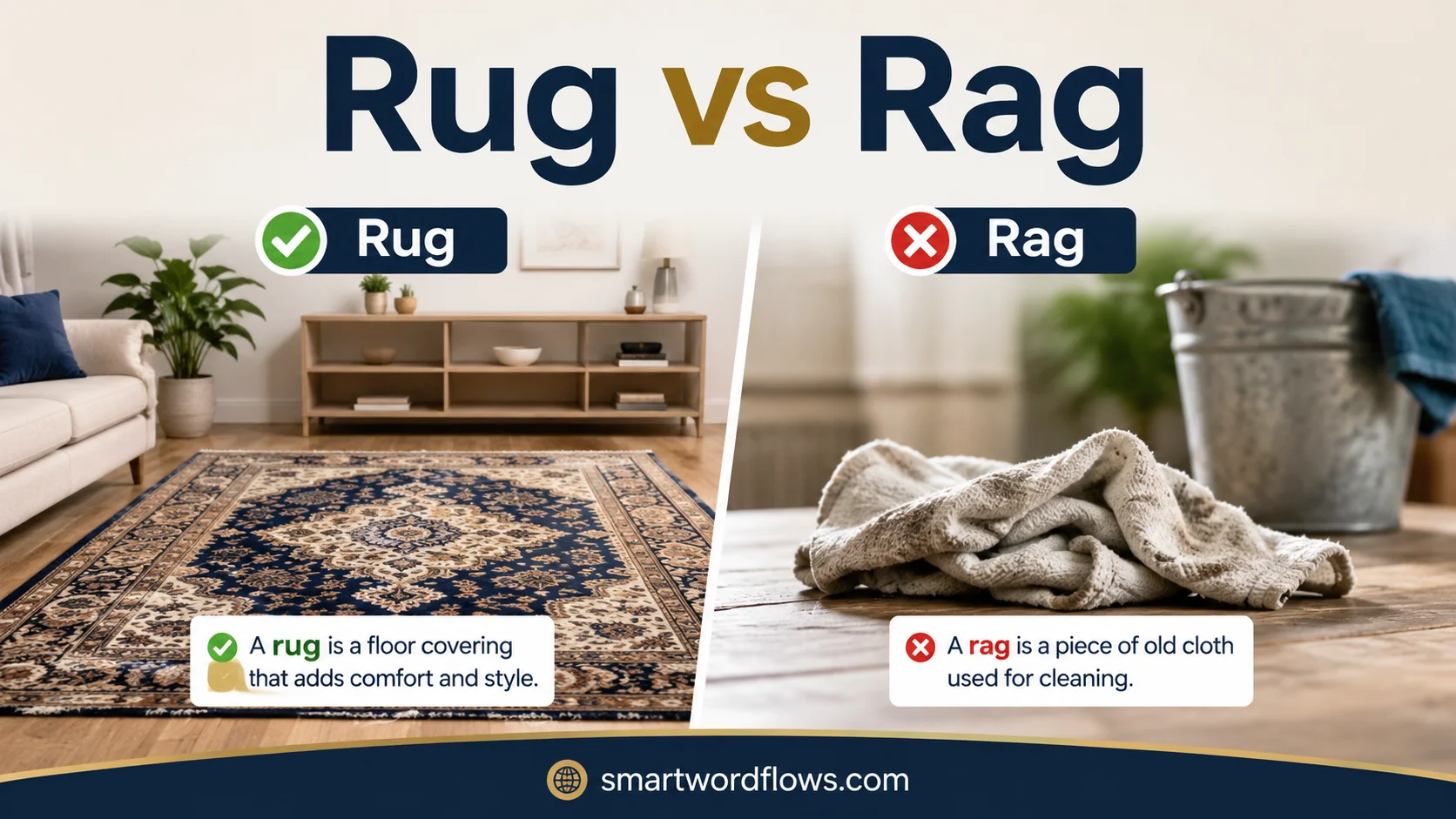

Rug vs Rag is easy to understand when you know their different purposes. A rug is a floor covering that adds comfort, warmth, insulation, style, and decoration to a living room or other space. A rag is usually an old piece of cloth or cleaning cloth used to clean, wipe, polish, and absorb spills. Although both are made from fabric or cloth, they have completely different uses in everyday household life.
The main difference becomes clear through their usage and context. Rugs are chosen for durability, maintenance, cost, and long-term value, while rags are useful for cleaning around the kitchen sink, cleaning bucket, and other surfaces. Choosing the wrong option can waste money, create extra maintenance, or damage floors. Learning these common mistakes, simple tricks, and real-world uses makes everyday English, writing, and conversations easier..
Quick Answer
A rug is a floor covering, usually made for comfort or decoration. A rag is a piece of cloth, often old or worn, used for cleaning or wiping.
In short:
- Rug = something you put on the floor
- Rag = something you use to clean
Comparison Overview
Before getting deep into the details, here is the fast side-by-side view of rug vs rag.
| Feature | Rug | Rag |
| Main meaning | A floor covering | A piece of cloth for cleaning |
| Common use | Home décor, warmth, comfort | Wiping, polishing, cleaning |
| Typical condition | Usually made to last and look good | Often old, worn, or leftover fabric |
| Where you find it | Bedrooms, living rooms, offices, halls | Kitchens, garages, workshops, cleaning closets |
| Main purpose | Style and comfort | Practical cleaning |
| Sound and feel | Decorative, polished, useful | Plain, rough, utility-based |
A rug is usually something you choose for a space. A rag is usually something you grab to get a job done.
Main Differences Between Rug vs Rag
The biggest difference between rug vs rag is not just appearance. It is purpose.
A rug is designed to sit on the floor. It may soften a room, add color, protect the floor, or make a space feel finished. A rag, on the other hand, is a cloth used to wipe, scrub, polish, or absorb spills. It is usually not meant to be shown off.
That is why the two words are not interchangeable. If you say, “I bought a beautiful rag for the living room,” people will stop and look at you strangely. The correct word is rug. If you say, “I used a rug to clean the counter,” that also sounds wrong. In that case, rag is the correct word.
The simplest way to remember it is this:
- A rug belongs in a room.
- A rag belongs in a cleaning task.
What Is a Rug?
A rug is a piece of material, usually woven or manufactured, that covers part of a floor. Rugs can be small or large. They can be thick or thin. They can be plain, patterned, modern, traditional, soft, rough, expensive, or budget-friendly. But their main job is still the same: they sit on the floor.
Rugs are not just decoration. They also do practical work. A rug can make a cold room feel warmer. It can reduce noise. It can protect flooring from scratches. It can even help define a space in an open-plan home.
People use rugs in all kinds of places:
- Living rooms
- Bedrooms
- Hallways
- Dining spaces
- Offices
- Entryways
A rug often acts like the finishing touch in a room. Without one, a space can feel bare. With one, it feels grounded.
Rug Meaning in Everyday Life
When people say “rug,” they usually mean a decorative floor covering. The word often brings to mind interior design, comfort, and style. It is a word linked to home life, furniture, and layout.
For example:
- “The rug makes the room feel warmer.”
- “She chose a patterned rug for the bedroom.”
- “That rug pulls the whole space together.”
That last idea is a big one. A rug can make a room feel complete the same way a frame can make a picture look finished.
Types of Rugs
Rugs come in many forms. Here are a few common types:
- Area rugs: Larger rugs used to cover part of a room
- Runner rugs: Long, narrow rugs used in hallways or stairs
- Accent rugs: Small rugs used for style or comfort
- Outdoor rugs: Rugs made to handle patios or porches
- Rag rugs: Rugs made from strips of old fabric
That last type is important because it connects both words. More on that later.
What Is a Rag?
A rag is a piece of cloth, often old, worn, torn, or repurposed, used for cleaning, wiping, or polishing. It is usually not considered a decorative item. It is a practical tool.
You might use a rag to:
- Wipe a spilled drink
- Clean a dusty shelf
- Polish a table
- Dry a surface
- Remove grease or dirt
- Clean tools or equipment
A rag can come from an old towel, an old shirt, or some leftover fabric cut into pieces. People often keep a stack of rags in a garage, under the sink, or near a workbench. They are useful, cheap, and easy to replace.
Rag Meaning in Everyday Life
The word “rag” sounds rougher and more utilitarian than “rug.” That is not an accident. The two words live in different language spaces.
For example:
- “He grabbed a rag to clean the window.”
- “She used an old rag to wipe the paintbrush.”
- “Keep a rag near the sink for spills.”
A rag is a helper, not a decoration.
Other Meanings of Rag
Most people use “rag” to mean a cloth, but the word can also have other meanings depending on context. For example, in some settings, “rag” can describe something worn out or shabby. It can also appear in phrases like “to rag on someone,” which means to tease or criticize them.
In this article, though, we are focusing on the fabric meaning, because that is where the rug vs rag confusion usually starts.
Rug vs Rag in Simple Language
Here is the easiest way to understand the difference:
A rug is something you put on the floor because it looks good, feels good, or both.
A rag is something you use to clean because it is useful.
That is the heart of it.
You do not usually place a rag in the center of a living room unless you want it there for some very unusual reason. You also do not use a rug to wipe grease off a counter. The purpose changes everything.
Rug vs Rag: Are They Made From the Same Material?
Sometimes, yes. Both can be made from fabric. But that does not make them the same thing.
A rug might be made from:
- Wool
- Cotton
- Jute
- Nylon
- Polyester
- Silk blends
- Recycled fibers
A rag is often made from:
- Old clothing
- Cotton scraps
- Towels
- T-shirts
- Fabric remnants
So, a rug and a rag may share material, but not function. That difference matters more than the cloth itself.
Think of it this way: a piece of paper can be folded into many things, but its purpose changes depending on how it is used. Fabric works the same way.
Can a Rag Become a Rug?
Yes, sometimes. But only in a specific way.
If old fabric pieces are cut into strips and woven, braided, or stitched together, they can become a rag rug. That is a real and traditional type of rug. In that case, the rags are the raw material, and the finished item is a rug.
That means a rag can help create a rug, but it does not automatically become one by itself.
Rag Rug Explained
A rag rug is a rug made from strips of old cloth. These rugs were common in households that reused materials instead of throwing them away. People turned worn-out fabric into something useful and beautiful.
That is part of what makes rag rugs interesting. They sit right at the intersection of practicality and creativity. Old cloth becomes floor décor. Waste becomes function.
Why People Confuse Rug and Rag
The confusion is understandable. The words are short. They sound similar. They both involve fabric. And they both can appear in household settings.
But once you pay attention to purpose, the difference becomes clear.
People confuse them because:
- Both words are one syllable
- Both relate to cloth
- Both can appear in home settings
- Both are common enough to hear in everyday speech
Still, they serve very different roles.
A rug is usually a finished product. A rag is usually a leftover piece or a cleaning cloth.
Read More: Togather vs Together: Which Is the Correct Word to Use?
Rug vs Rag: Key Usage Differences
Here is a more practical breakdown of when each word fits best.
Use “rug” when you are talking about:
- Home décor
- Floor coverings
- Interior design
- Comfort underfoot
- A decorative textile item
Examples:
- “We bought a new rug for the dining room.”
- “The rug adds color to the space.”
- “She vacuumed the rug before guests arrived.”
Use “rag” when you are talking about:
- Cleaning
- Wiping
- Polishing
- Old cloth
- Workshop or kitchen cleanup
Examples:
- “He used a rag to clean the sink.”
- “She kept a rag in the garage.”
- “The mechanic wiped his hands with a rag.”
The Difference in Tone
Words carry tone, and this pair is a good example.
“Rug” sounds soft, polished, and home-focused. It fits into conversations about style, design, and comfort.
“Rag” sounds practical, rougher, and more casual. It fits into workspaces, cleaning tasks, and old-cloth reuse.
That does not mean one word is better than the other. It just means they belong to different situations.
A Quick Memory Trick
Here is a simple way to remember rug vs rag:
- Rug starts with R, like room
- Rug stays on the floor in a room
- Rag is for removing grime
You can also think of it like this:
- Rug = “the thing you admire”
- Rag = “the thing you use and wear out”
Tiny trick. Big help.
Real-Life Examples of Rug vs Rag
Let’s look at some everyday sentences. This makes the difference easier to lock in.
Correct Rug Examples
- “The rug near the sofa ties the whole room together.”
- “My grandmother has a handmade rug in her hallway.”
- “They chose a soft rug for the nursery.”
- “The rug protected the wooden floor.”
Correct Rag Examples
- “I need a rag to clean this mess.”
- “He used an old rag to wipe the window.”
- “Keep a rag by the paint cans.”
- “She turned worn-out shirts into cleaning rags.”
Incorrect Uses
- “I wiped the table with a rug.”
This is wrong. Use rag. - “She bought a rag for the bedroom floor.”
This is wrong. Use rug.
Table: Rug vs Rag at a Glance
| Point | Rug | Rag |
| Main role | Covers a floor | Cleans or wipes surfaces |
| Common setting | Home, office, décor | Kitchen, garage, workshop |
| Appearance | Often attractive and finished | Often plain and worn |
| Value | Decorative and functional | Practical and disposable |
| Typical size | Small to large | Small pieces of cloth |
| Main association | Design, comfort, warmth | Cleaning, repair, reuse |
Case Study: The Living Room Mix-Up
A homeowner once told a friend, “I need to clean the rag in the living room.” The friend looked confused because a rag is not something you usually display in a living room. What they meant was, “I need to clean the rug in the living room.”
That tiny mistake changed the image completely.
The corrected sentence made sense because the living room usually contains a rug, not a rag. The lesson is simple: when you are talking about a floor covering, use rug. When you are talking about a cleaning cloth, use rag.
This kind of mix-up happens all the time in writing. It is small, but it can make the difference between clear communication and awkward wording.
Case Study: The Garage Cleanup
In another common example, someone might say, “Pass me the rug so I can clean the oil spill.” That sounds wrong. In a garage, for cleanup work, you want a rag.
The reason is practical. A rag can soak up mess, wipe tools, and handle dirty work. A rug cannot do that job well, and most people would never use one that way.
This example shows how context matters. A room might need a rug. A toolbox might need a rag.
Similarities Between Rug and Rag
Even though they are different, they do share a few things.
Both:
- Involve fabric
- Can be made from natural or synthetic fibers
- Are common in everyday life
- Show up in household settings
- Can be reused in some form
That said, the overlap ends pretty quickly. Their purpose still separates them.
Common Mistakes to Avoid
People usually make three kinds of mistakes with rug vs rag.
Mistake with meaning
Using one word when the other is needed.
Mistake with context
Talking about décor but using a cleaning word, or vice versa.
Mistake with plural form
Remember that both words can become plural:
- rugs
- rags
The plural does not change the basic meaning. It just means more than one.
A Helpful Quote on Word Choice
A clear writer once said, “The right word in the right place makes the whole sentence breathe.”
That idea fits this topic well. Choosing rug instead of rag or the other way around might seem small, but it makes your meaning clear immediately.
Vocabulary Tip for Learners
If you are learning English, this pair is a good example of why context matters more than just sound. Similar words can still have completely different jobs.
A smart habit is to ask:
- Is this about the floor?
- Is this about cleaning?
- Is this about decoration?
- Is this about a used cloth?
Once you answer that, the right word usually appears on its own.
Why This Difference Matters in Writing
Clear writing depends on accurate word choice. Using rug and rag correctly helps you:
- Sound more precise
- Avoid confusion
- Improve vocabulary use
- Communicate more naturally
- Keep your writing professional and clear
This is true in blog writing, email writing, school writing, and daily conversation. A small word choice can change the whole sentence.
Rug vs Rag in One Sentence Each
If you want the simplest possible summary:
- A rug is a decorative floor covering.
- A rag is a cloth used for cleaning.
That is the cleanest version of the answer.
FAQs:
1. What is the difference between a rug and a rag?
A rug is mainly used as a floor covering for comfort, warmth, and decoration, while a rag is usually used for cleaning.
2. Can a rug be used for cleaning?
Usually, no. A rug is designed for the floor, while a rag is made for wiping, polishing, and cleaning surfaces.
3. What is a rag used for?
A rag can be used to clean, wipe, polish, and absorb spills from furniture, floors, and other household surfaces.
4. Why do people confuse rug and rag?
People often confuse them because the words rhyme and both can refer to items made from cloth or fabric, but their purposes are different.
5. How can I remember rug vs rag?
Remember it simply: a rug belongs on the floor for comfort and style, while a rag helps you clean and wipe things.
Conclusion
Understanding Rug vs Rag is simple once you remember their main purposes. A rug adds comfort, warmth, style, and decoration to a space, while a rag is mainly used for cleaning, wiping, polishing, and absorbing spills. Knowing this small difference can help you avoid common mistakes in everyday English and choose the correct word in your writing and conversations.