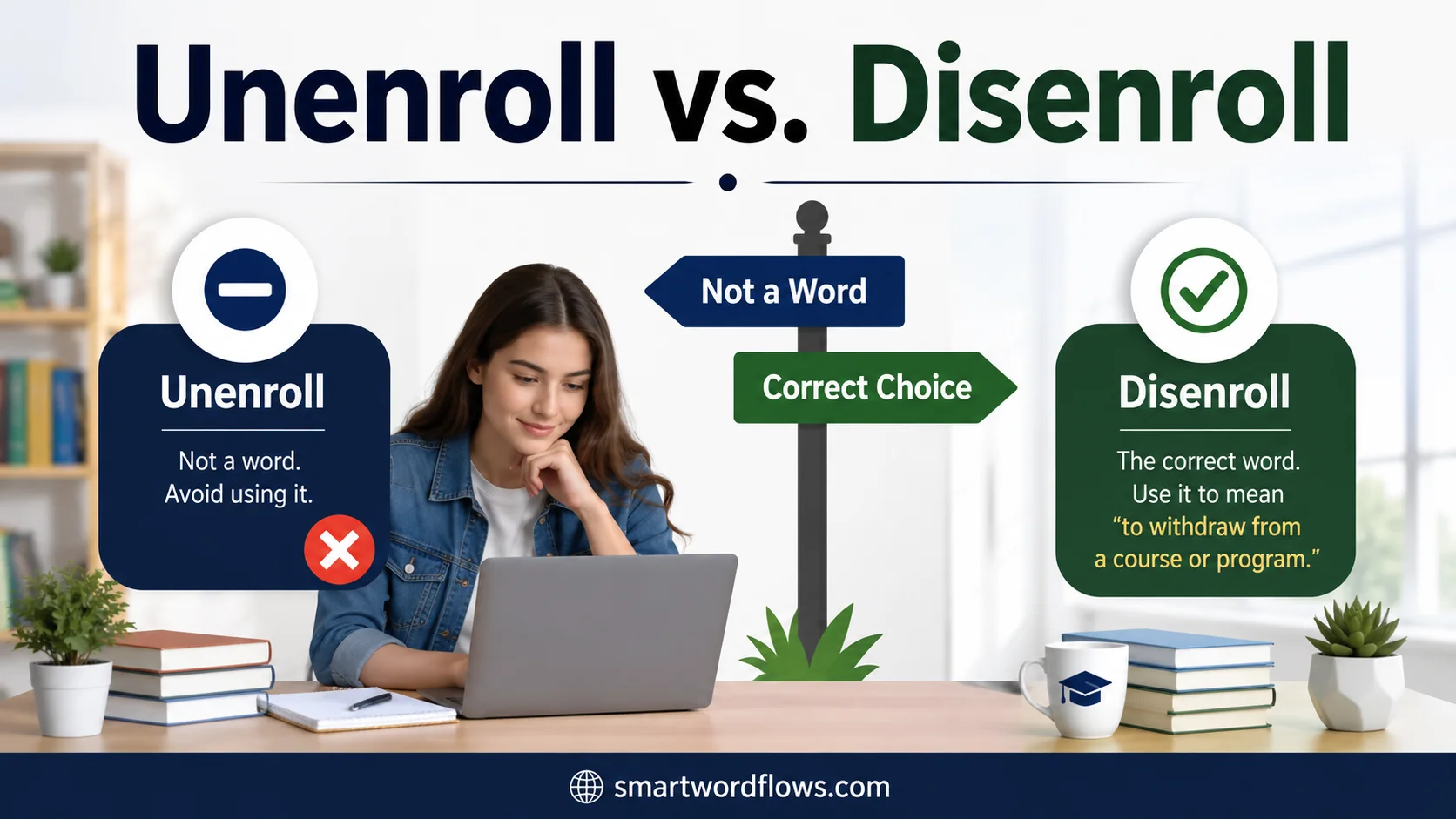

Unenroll vs. Disenroll is a common grammar question because both words describe leaving or being removed from a school, course, college, or program. Many people think they mean exactly the same thing, but their usage can vary depending on the region and situation. Understanding the difference helps you choose the right word in academic, educational, and professional writing, making your communication more accurate and natural.
Although unenroll and disenroll are often used interchangeably, they are not always preferred in the same contexts. Some dictionaries recognize both terms, while certain spell checkers may flag one as uncommon. In this guide, you’ll discover their meanings, differences, correct usage, and examples so you can confidently use the right word in every situation without confusion.
Quick Answer
Both unenroll and disenroll are correct English verbs that mean to remove someone from enrollment. However, they differ in typical usage.
- Unenroll usually appears in education and online learning. For example, a student may unenroll from a college course or an online class.
- Disenroll appears more often in health insurance, Medicare, Medicaid, and government programs where it refers to ending a person’s enrollment in a plan or service.
- In everyday conversation, unenroll often sounds more natural. In official healthcare or administrative documents, disenroll is usually the preferred term.
Comparison Overview
| Feature | Unenroll | Disenroll |
| Basic meaning | Remove from enrollment | Remove from enrollment |
| Dictionary status | Correct English word | Correct English word |
| Common setting | Schools, colleges, online courses | Healthcare, insurance, government programs |
| Everyday usage | More common | Less common outside official contexts |
| Formal administrative use | Sometimes | Very common |
| Common in American English | Yes | Yes |
| Common in British English | Less common; “withdraw” is often preferred | Rare |
Main Differences Between Unenroll vs. Disenroll
Although the two words share nearly the same definition, their context makes the difference.
Unenroll Is More Common in Education
Educational institutions often use unenroll when a student voluntarily leaves a class, course, or academic program.
Examples include:
- Unenrolling from a university course
- Leaving an online certification program
- Removing a child from a homeschool platform
- Canceling enrollment in a training program
Disenroll Is Common in Healthcare and Government Programs
Healthcare organizations frequently use disenroll because it describes officially ending someone’s participation in a health plan or government benefit.
Common examples include:
- Disenrolling from Medicare
- Disenrolling from Medicaid
- Disenrolling from an employer health insurance plan
- Disenrolling from a government assistance program
The Meaning Is Nearly Identical
From a grammatical standpoint, both verbs mean to end enrollment. The biggest distinction lies in the industry that uses the word.
| Situation | Better Choice |
| School class | Unenroll |
| Online course | Unenroll |
| College program | Unenroll |
| Medicare plan | Disenroll |
| Medicaid coverage | Disenroll |
| Employer health insurance | Disenroll |
What Does “Unenroll” Mean?
Definition
Unenroll means to remove yourself or another person from an educational course, program, membership, or online service after enrollment has already occurred.
The word combines:
- Un- = reverse an action
- Enroll = register or sign up
Together, the word literally means to reverse enrollment.
When Should You Use “Unenroll”?
You will most often see unenroll in educational settings and digital learning platforms.
Common situations include:
- Leaving a school
- Dropping a college class
- Canceling an online course
- Removing a child from a learning platform
- Ending participation in a training program
Examples of “Unenroll”
- I decided to unenroll from the photography class before the semester began.
- She had to unenroll her son after moving to another city.
- You can unenroll from the course through your student dashboard.
- Many learners unenroll when they no longer need the certification.
- Students may unenroll before the deadline without academic penalties.
Why Schools Prefer “Unenroll”
Educational institutions focus on student registration. Because of that, unenroll sounds straightforward and intuitive. It simply indicates that a student is no longer registered for a course or program.
Read More: Protestors or Protesters: Which Spelling Is Actually Correct?
What Does “Disenroll” Mean?
Definition
Disenroll means to officially terminate someone’s enrollment in a program, service, insurance plan, or government benefit.
The prefix dis- often indicates separation, removal, or reversal. In administrative language, it signals that a person is no longer part of a specific system.
When Should You Use “Disenroll”?
The word commonly appears in official documents involving:
- Medicare
- Medicaid
- Health insurance
- Employer benefits
- Government assistance
- Public service programs
Because these organizations manage eligibility and compliance, they often use disenroll instead of unenroll.
Examples of “Disenroll”
- The insurance company may disenroll members who no longer qualify.
- You must submit a request to disenroll from the Medicare Advantage plan.
- Employees can disenroll during the annual benefits enrollment period.
- The agency automatically disenrolled participants who became ineligible.
- Members should contact customer service before choosing to disenroll.
Why Government Agencies Prefer “Disenroll”
Government programs usually involve legal eligibility, regulations, and administrative records. The word disenroll has become the standard term because it clearly describes the official removal of a participant from a managed program.
FAQs :
1. What is the difference between unenroll and disenroll?
Both words describe leaving or being removed from a course, school, or program. The difference is mainly based on regional or institutional preference rather than meaning.
2. Is disenroll a real English word?
Yes. Disenroll is recognized by many dictionaries and is commonly used in education, healthcare, and government systems, although some spell checkers may still flag it.
3. Is unenroll or disenroll more common?
It depends on the country and organization. Some schools and online platforms prefer unenroll, while others officially use disenroll.
4. Can I use unenroll and disenroll interchangeably?
In most situations, yes. Since both words have nearly the same meaning, they can usually be used interchangeably unless an institution has a preferred term.
5. Which word should I use in formal writing?
Use the term required by your school, organization, or style guide. If no preference is given, either unenroll or disenroll is generally acceptable as long as you use it consistently throughout your writing.
Conclusion :
Both unenroll and disenroll refer to the process of leaving or being removed from a school, course, or program, and they often mean the same thing. The main difference is their preferred usage in different regions, organizations, or educational systems. Understanding the context will help you choose the most appropriate term and write with greater clarity. When in doubt, follow the terminology used by your school, institution, or style guide to ensure consistency.