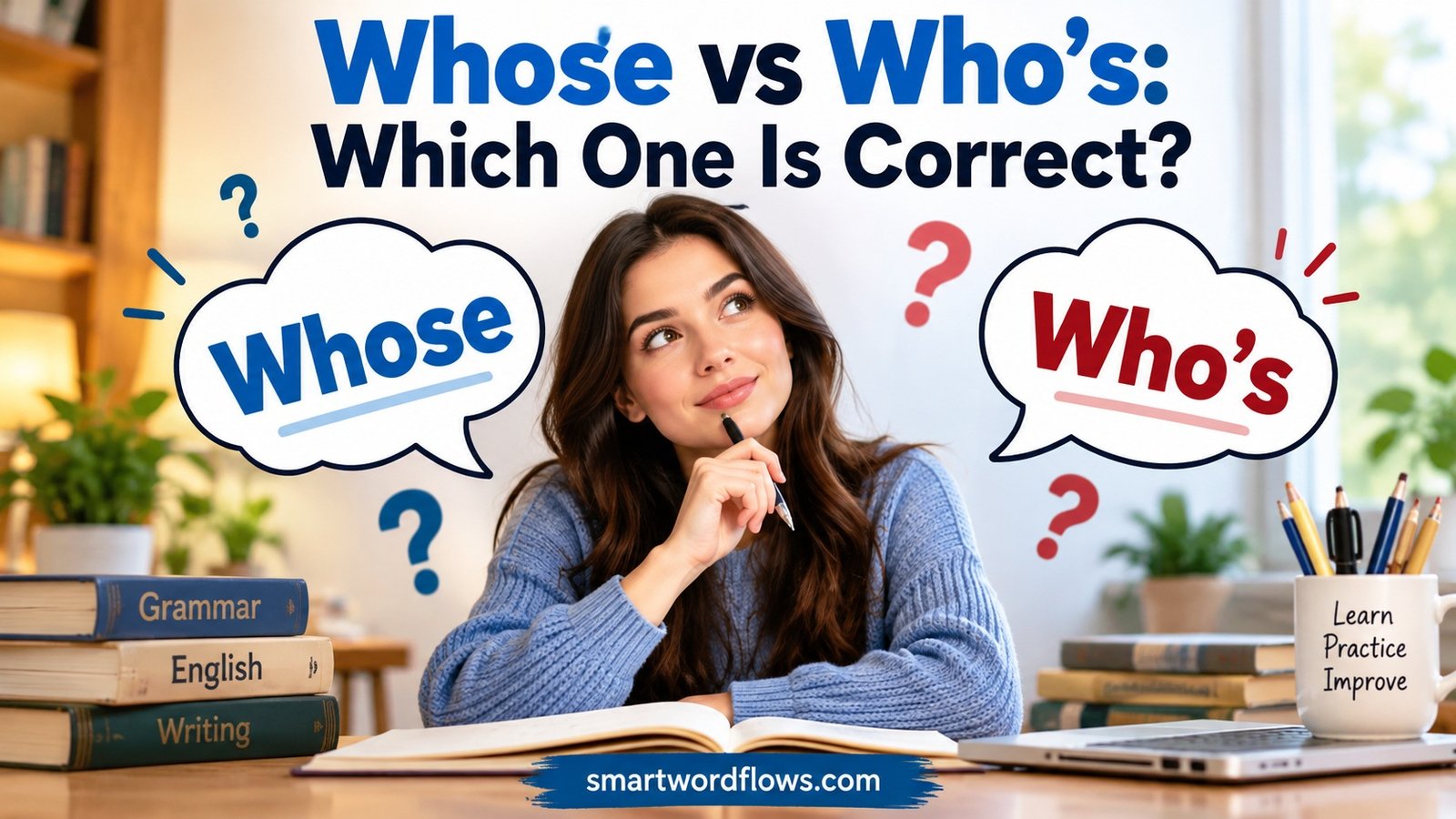

Whose vs Who’s: Which One Is Correct? This guide explains the grammar, meaning, usage, spelling, and word choice behind these two forms in English. Even experienced writers may hesitate because both words sound exactly the same to your ears. To choose the right word, you need to understand what each one actually means. Whose relates to possession or ownership, while who’s is a contraction short for who is or who has. Their pronunciation is identical, so they are homophones, but their meaning, usage, and spelling are different. This difference matters when people search for the correct choice in English writing.
A quick fix is the expansion test. Replace who’s with who is or who has and check whether the sentence still makes sense. For example, “Who’s coming?” becomes “Who is coming?” while “Who’s finished?” becomes “Who has finished?” If neither expansion works, whose is usually correct: “Whose book is this?” shows that the book belongs to someone. This simple trick helps you remember the distinction every time instead of having to guess from the context. In my experience, proofreading and editing make this test especially useful, because spell check may not catch the error. Both forms are a real word, so the mistake can easily slide through.
This confusion is one of the most common stumbling blocks in professional writing and business writing. A client email, report, or other written language can remain understandable for comprehension, but careful readers may notice an incorrect word choice. On the page, whose and who’s have completely different jobs, even though they are spoken aloud in the same way. Its, it’s, and its’ can cause similar confusion, and learning this correction can improve clarity, correctness, and communication. With regular use and attention to context, you can keep the distinction straight, avoid mixing the forms, and prevent these words from trip[ping] up even confident writers.
Quick Answer: Whose vs Who’s
Whose is the correct word when you’re talking about possession or asking who something belongs to.
Who’s is a contraction that means either who is or who has.
| Word | Meaning | Main Function | Example |
| Whose | Belonging to whom | Shows possession | Whose phone is this? |
| Who’s | Who is | Contraction | Who’s calling you? |
| Who’s | Who has | Contraction | Who’s finished the report? |
A simple rule can settle most cases:
If you can replace “who’s” with “who is” or “who has,” use who’s. If you’re asking about possession, use whose.
Consider these examples:
- Whose car is parked outside? → asks about ownership.
- Who’s parked outside? → Who is parked outside?
- Who’s taken my notebook? → Who has taken my notebook?
Both whose and who’s are correct English words. The important thing is choosing the one that matches your intended meaning.
Comparison Overview
At first glance, whose and who’s seem like spelling variations. They aren’t. They have different grammatical structures and meanings.
| Feature | Whose | Who’s |
| Word type | Possessive determiner or pronoun | Contraction |
| Meaning | Belonging to whom | Who is / who has |
| Shows possession | Yes | No |
| Contains an apostrophe | No | Yes |
| Example | Whose coat is this? | Who’s wearing the coat? |
| Can expand to “who is”? | No | Yes |
| Can expand to “who has”? | No | Yes |
The easiest way to remember the difference is to focus on the apostrophe.
In who’s, the apostrophe indicates that letters have been removed. Who is becomes who’s, while who has can also become who’s.
The word whose, however, isn’t a shortened version of anything. It is a possessive form related to who.
That makes the two words fundamentally different.
What Does “Whose” Mean?
Whose is used to ask or state who owns something or who something is connected with.
It functions as a possessive form of who. In many sentences, it appears directly before a noun.
For example:
- Whose book is on the table?
- Whose house are you visiting?
- Whose idea was this?
- Whose responsibility is it?
- Whose keys are these?
In each example, whose identifies the person connected to the noun that follows it.
How to Use Whose in a Sentence
The most common structure is:
whose + noun
Here are some natural examples:
- Whose bag is on the chair?
- Whose computer are you using?
- Whose decision changed the plan?
- Whose name appears on the document?
- Whose car is blocking the driveway?
You can also use whose without immediately following it with a noun.
For example:
- Whose is this?
- Whose are these?
- I don’t know whose it is.
- She couldn’t remember whose they were.
In these sentences, the possessed object is understood from the context.
Does Whose Always Mean Ownership?
Not necessarily.
Whose can describe more than literal ownership. It can indicate a relationship, association, responsibility, or connection.
For example:
Whose idea was it?
An idea isn’t necessarily something a person legally owns. The question asks who came up with the idea.
Similarly:
Whose responsibility is this?
The sentence asks who is responsible for something rather than who owns it.
You might also see whose in descriptions of people or things:
The company hired an engineer whose experience matched the project’s needs.
Here, whose connects the engineer with their experience. It doesn’t describe ownership in the ordinary sense.
What Does “Who’s” Mean?
Who’s is a contraction. It combines who with either is or has.
This gives who’s two possible meanings:
- who is
- who has
The surrounding sentence tells you which meaning applies.
Who’s = Who Is
This is the most familiar use of who’s.
For example:
- Who’s at the door?
- Who’s calling?
- Who’s ready?
- Who’s responsible for this?
- Who’s coming to dinner?
Try expanding the contraction:
- Who’s at the door? → Who is at the door?
- Who’s calling? → Who is calling?
- Who’s responsible? → Who is responsible?
The expanded version still makes grammatical sense. That’s a strong sign that who’s is correct.
Who’s = Who Has
Who’s can also mean who has, particularly when it appears with a past participle.
Consider these sentences:
- Who’s finished the assignment?
- Who’s taken my pen?
- Who’s seen this movie?
- Who’s forgotten the password?
- Who’s been to New York?
Expand the contraction:
- Who’s finished? → Who has finished?
- Who’s taken my pen? → Who has taken my pen?
- Who’s seen this movie? → Who has seen this movie?
The sentence remains grammatical.
Context does the rest of the work.
Main Differences Between Whose vs Who’s
The biggest difference between whose vs who’s comes down to possession versus contraction.
Whose Shows Possession
Use whose when you want to ask who something belongs to or who has a particular connection to it.
Examples include:
- Whose wallet is this?
- Whose opinion matters here?
- Whose office are we using?
- Whose responsibility is it?
- Whose photograph appears on the wall?
A useful mental question is:
“Who does this belong to?”
If that meaning fits, whose is usually the right choice.
Who’s Is a Contraction
Use who’s when you mean who is or who has.
Examples:
- Who’s coming?
- Who’s your manager?
- Who’s waiting outside?
- Who’s finished the task?
- Who’s already left?
The apostrophe tells you that who’s contains missing letters.
For example:
who is → who’s
The apostrophe replaces the missing i in is.
Likewise:
who has → who’s
The apostrophe represents omitted letters from the contraction.
The Apostrophe Test
When you’re unsure, expand who’s.
Ask yourself:
Can I replace “who’s” with “who is” or “who has”?
If yes, who’s is correct.
If the sentence asks about possession, use whose.
For example:
Who’s coming to the party?
Replace it:
Who is coming to the party?
It works.
Now try:
Whose coat is this?
Replacing it with who is produces:
Who is coat is this?
That doesn’t work. The sentence needs whose because it asks who the coat belongs to.
Whose vs Who’s Examples
Seeing the two forms side by side makes the distinction much easier.
Correct Examples With Whose
Here are several natural examples of whose:
- Whose phone is ringing?
- Whose shoes are these?
- Whose car did you borrow?
- Whose idea was that?
- Whose name is on the contract?
- Do you know whose bag this is?
- I wonder whose house we’re visiting.
- The student whose laptop broke asked for help.
Notice that whose always carries a possessive or relational meaning.
Correct Examples With Who’s
Now compare examples using who’s:
- Who’s calling me?
- Who’s at the front desk?
- Who’s responsible for the project?
- Who’s coming with us?
- Who’s your new teacher?
- Who’s finished the assignment?
- Who’s taken my notebook?
- Who’s been working on this project?
Here, who’s means either who is or who has.
Side-by-Side Examples
| Meaning | Correct Sentence | Expanded Form |
| Possession | Whose book is this? | — |
| Identity | Who’s reading the book? | Who is reading the book? |
| Possession | Whose keys are these? | — |
| Identity | Who’s holding the keys? | Who is holding the keys? |
| Completed action | Who’s taken the keys? | Who has taken the keys? |
The trick is to look beyond the spelling. Meaning determines the correct word.
Common Mistakes With Whose and Who’s
Because the words sound alike in most varieties of English, mistakes happen frequently.
Using Who’s to Show Possession
A common error looks like this:
Incorrect: Who’s jacket is this?
The writer may assume that the apostrophe should indicate possession. That logic works with some nouns, such as Sarah’s jacket, but it doesn’t work with who.
The correct sentence is:
Correct: Whose jacket is this?
English has a few possessive forms that don’t follow the simple apostrophe pattern. Whose is one of them.
Using Whose Instead of Who’s
The opposite mistake is just as common.
Incorrect: Whose coming to dinner?
Correct: Who’s coming to dinner?
Why?
Because the intended sentence means:
Who is coming to dinner?
The writer isn’t asking who owns dinner. The writer is asking about a person’s identity.
Assuming Apostrophes Always Show Possession
This mistake comes from a useful but incomplete grammar rule.
Apostrophes can show possession:
- Sarah’s phone
- the dog’s collar
- the company’s office
However, apostrophes also form contractions:
- don’t = do not
- can’t = cannot
- they’re = they are
- it’s = it is
- who’s = who is / who has
So the apostrophe in who’s does not mean possession.
That’s an important distinction.
How to Remember the Difference Between Whose and Who’s
You don’t need to memorize a complicated grammar chart. Two quick tests handle most situations.
Use “Who Is” or “Who Has” as a Test
Take the sentence and expand who’s.
For example:
Who’s responsible for the report?
Try:
Who is responsible for the report?
It works. Therefore, who’s is correct.
Now consider:
Whose report is on the desk?
Try inserting who is:
Who is report is on the desk?
That fails immediately.
Use whose.
Think “Whose = Belongs to Whom”
A simple memory trick is:
Whose = belonging to whom
For example:
- Whose phone? → Who does the phone belong to?
- Whose car? → Who owns or uses the car?
- Whose idea? → Who came up with the idea?
Then remember:
Who’s = who is / who has
That gives you a two-part shortcut:
Whose asks about possession. Who’s expands to who is or who has.
A Simple Decision Guide
Start by asking what the sentence means.
Are you asking about possession or connection?
→ Use whose.
Do you mean “who is” or “who has”?
→ Use who’s.
This approach works better than trying to remember where the apostrophe “looks right.”
Read More: Affend vs Offend: Which Spelling Is Correct?
Whose vs Who’s in Questions
Both words frequently appear in questions. That’s one reason they can be confusing.
Compare these two sentences:
Whose jacket is this?
Who’s wearing this jacket?
The first question asks about the jacket’s owner or associated person.
The second asks about the person wearing it.
The nouns and verbs around the words provide useful clues.
Consider another pair:
Whose computer are you using?
Who’s using the computer?
The first sentence asks about the computer’s owner or associated person.
The second asks about the person performing the action.
A tiny spelling difference creates two completely different questions.
Whose vs Who’s in Formal and Informal Writing
Both whose and who’s belong to standard English. Neither word is automatically informal or incorrect.
However, contractions can sometimes sound more conversational.
For example:
Who’s responsible for the report?
This sounds natural in everyday communication.
In a formal document, you might instead write:
Who is responsible for the report?
That doesn’t make who’s grammatically wrong. It simply gives the sentence a slightly more formal tone.
The same principle applies to who’s meaning who has:
Who’s completed the assessment?
A formal writer may choose:
Who has completed the assessment?
Meanwhile, whose remains whose whether the writing is casual or formal.
You can’t replace it with who is simply because you’re writing formally.
Whose vs Who’s in Different Sentence Structures
Understanding where each word appears can make the difference easier to spot.
Whose Before a Noun
This is one of the most common structures.
Examples:
- Whose book is this?
- Whose car did you see?
- Whose office is upstairs?
- Whose decision was final?
The structure is often:
whose + noun
Whose at the End of a Sentence
Whose can also appear without a noun immediately after it.
For example:
- Whose is this?
- Whose are those?
- Do you know whose it is?
The noun or object remains understood from context.
Who’s With an Adjective or Noun
When who’s means who is, it can appear before a variety of complements:
- Who’s ready?
- Who’s responsible?
- Who’s your teacher?
- Who’s at the door?
In each case, replacing who’s with who is works.
Who’s With a Past Participle
When who’s means who has, it commonly appears with a past participle:
- Who’s finished?
- Who’s taken it?
- Who’s seen the message?
- Who’s forgotten the appointment?
This pattern can help you identify the intended meaning quickly.
Whose vs Who’s: Grammar Rules You Need to Know
A few grammar principles explain why these words behave differently.
Whose Is a Possessive Form
Whose is the possessive form associated with who.
It can function before a noun:
Whose book is this?
It can also function independently:
Whose is this?
It may also connect a person to information or a characteristic:
She met a writer whose books had won several awards.
Who’s Is a Contraction
Who’s combines who with is or has.
Examples:
- who + is → who’s
- who + has → who’s
The apostrophe marks the contraction.
Why Whose Doesn’t Have an Apostrophe
This is where many writers get caught.
People often learn that apostrophes indicate possession. That’s true for many nouns:
- John’s car
- the teacher’s desk
- the dog’s leash
However, possessive pronouns and possessive forms don’t all use apostrophes.
Consider:
- my
- your
- his
- her
- our
- their
- whose
None requires an apostrophe to indicate possession.
This is why whose is correct rather than who’s when possession is intended.
Whose vs Who’s vs Whom
These three words can appear in the same general area of grammar, but they perform different jobs.
Who generally functions as a subject:
Who called you?
Whom traditionally functions as an object:
Whom did you call?
Whose expresses possession or association:
Whose phone did you use?
Meanwhile, who’s isn’t another form of who. It’s a contraction.
| Word | Main Role | Example |
| Who | Subject | Who called? |
| Whom | Object | Whom did you call? |
| Whose | Possession | Whose phone is this? |
| Who’s | Contraction | Who’s calling? |
The distinction becomes much easier once you treat who’s as two words joined together rather than as a possessive form.
Whose vs Who’s in Real-World Writing
These words appear constantly in everyday communication.
In Everyday Conversation
You might hear:
Whose keys are these?
Then:
Who’s driving?
The first asks about ownership or association. The second asks about the person performing an action.
In School and Academic Writing
Academic writing often uses whose to establish relationships between people and their work.
For example:
The researcher whose findings influenced the study published a new paper.
Here, whose connects the researcher with the findings.
You may also see who’s in questions:
Who’s responsible for collecting the data?
If the sentence needs a more formal tone, the writer can use who is instead.
In Business and Professional Writing
Professional communication regularly uses both forms.
Examples include:
- Whose account is this?
- Whose approval is required?
- Who’s managing the project?
- Who’s responsible for the final review?
- Who’s approved the request?
A spelling mistake in a short email can make the sentence look careless even when the meaning remains understandable.
In Digital Communication
Text messages, social posts, and online comments create another source of confusion.
People often type quickly and rely on sound rather than grammar. Since whose and who’s generally sound alike, the error can slip through unnoticed.
For example:
Who’s laptop did you use?
The correct version is:
Whose laptop did you use?
The pronunciation doesn’t rescue the spelling. The grammatical meaning does.
A Closer Look at the Apostrophe in Who’s
The apostrophe deserves special attention because it causes much of the confusion.
An apostrophe can serve several grammatical purposes. One major use is forming contractions.
Examples include:
- I am → I’m
- you are → you’re
- they are → they’re
- we are → we’re
- who is → who’s
The apostrophe shows that letters have been omitted.
Therefore, the apostrophe in who’s doesn’t mean “this belongs to someone.”
Instead, it tells you that who is or who has has been shortened.
This distinction also explains why whose doesn’t need an apostrophe.
Case Study: How One Apostrophe Changes the Meaning
Consider a workplace conversation.
Whose report is on the manager’s desk?
The speaker wants to identify the person associated with the report.
Now change the sentence:
Who’s reviewing the report?
The speaker wants to identify the person performing the review.
The two questions may appear in the same conversation. Yet they ask for completely different information.
Another example:
Whose phone is ringing?
This asks who the phone belongs to.
Who’s calling?
This asks who is making the call.
The spelling difference isn’t cosmetic. It changes the grammar and meaning of the sentence.
Common Whose vs Who’s Mistakes at a Glance
| Incorrect | Correct | Reason |
| Who’s book is this? | Whose book is this? | The sentence asks about possession. |
| Whose coming today? | Who’s coming today? | The meaning is “Who is coming?” |
| Who’s car did you borrow? | Whose car did you borrow? | The sentence asks whose car it is. |
| Whose responsible for this? | Who’s responsible for this? | The meaning is “Who is responsible?” |
| Who’s phone is ringing? | Whose phone is ringing? | The phone is associated with someone. |
| Whose finished the task? | Who’s finished the task? | The meaning is “Who has finished?” |
These errors often happen because writers hear the words rather than analyze their grammatical role.
When proofreading, look for the word before or after the term. Then test its meaning.
Quick Tips for Choosing Whose or Who’s
When you’re editing a sentence, use these checks:
- Does it show possession? Choose whose.
- Can you replace it with “who is”? Choose who’s.
- Can you replace it with “who has”? Choose who’s.
- Is a noun directly following the word? Check whether you’re asking about ownership.
- Does the apostrophe seem to be showing possession? Stop and test the sentence.
- Does the sentence sound like a question about someone’s identity or action? Who’s may be appropriate.
The replacement test is especially useful because it works quickly.
Frequently Asked Questions About Whose vs Who’s
Is “whose” or “who’s” correct?
Both are correct, but they have different meanings.
Use whose for possession or association.
Use who’s for who is or who has.
Is “who’s” possessive?
No. Who’s is a contraction of who is or who has.
The possessive form is whose.
Is “whose” short for “who is”?
No. Whose isn’t a contraction of who is.
Who’s is the contraction that can mean who is.
Can “who’s” mean “who has”?
Yes.
For example:
Who’s finished the assignment?
This means:
Who has finished the assignment?
Can “whose” be used for things?
Yes. Whose can refer to people, animals, organizations, and things in contexts where possession or association is relevant.
For example:
The company whose products became popular expanded overseas.
Why doesn’t “whose” have an apostrophe?
Because whose is already a possessive form. Its possession doesn’t require an apostrophe.
The apostrophe in who’s serves a different purpose. It marks a contraction.
How can I quickly tell whether to use “whose” or “who’s”?
Use the substitution test.
If you mean who is or who has, choose who’s.
If you’re asking who something belongs to or describing a relationship, choose whose.
conclusion
Understanding the difference between “whose” and “who’s” can help you avoid common grammar mistakes in everyday writing. Whose is a possessive word used to ask or show who something belongs to, such as “Whose book is this?” or “the student whose bag was lost.” Who’s, on the other hand, is a contraction of “who is” or “who has.” For example, “Who’s coming to the meeting?” means “Who is coming?” Knowing this simple distinction makes your sentences clearer and more accurate.
A useful trick is to replace “who’s” with “who is” or “who has.” If the sentence still makes sense, who’s is correct. If not, you likely need whose. With regular practice, you’ll quickly recognize the difference and use both forms confidently in formal and informal writing.



1 thought on “Whose vs Who’s: Which One Is Correct?”