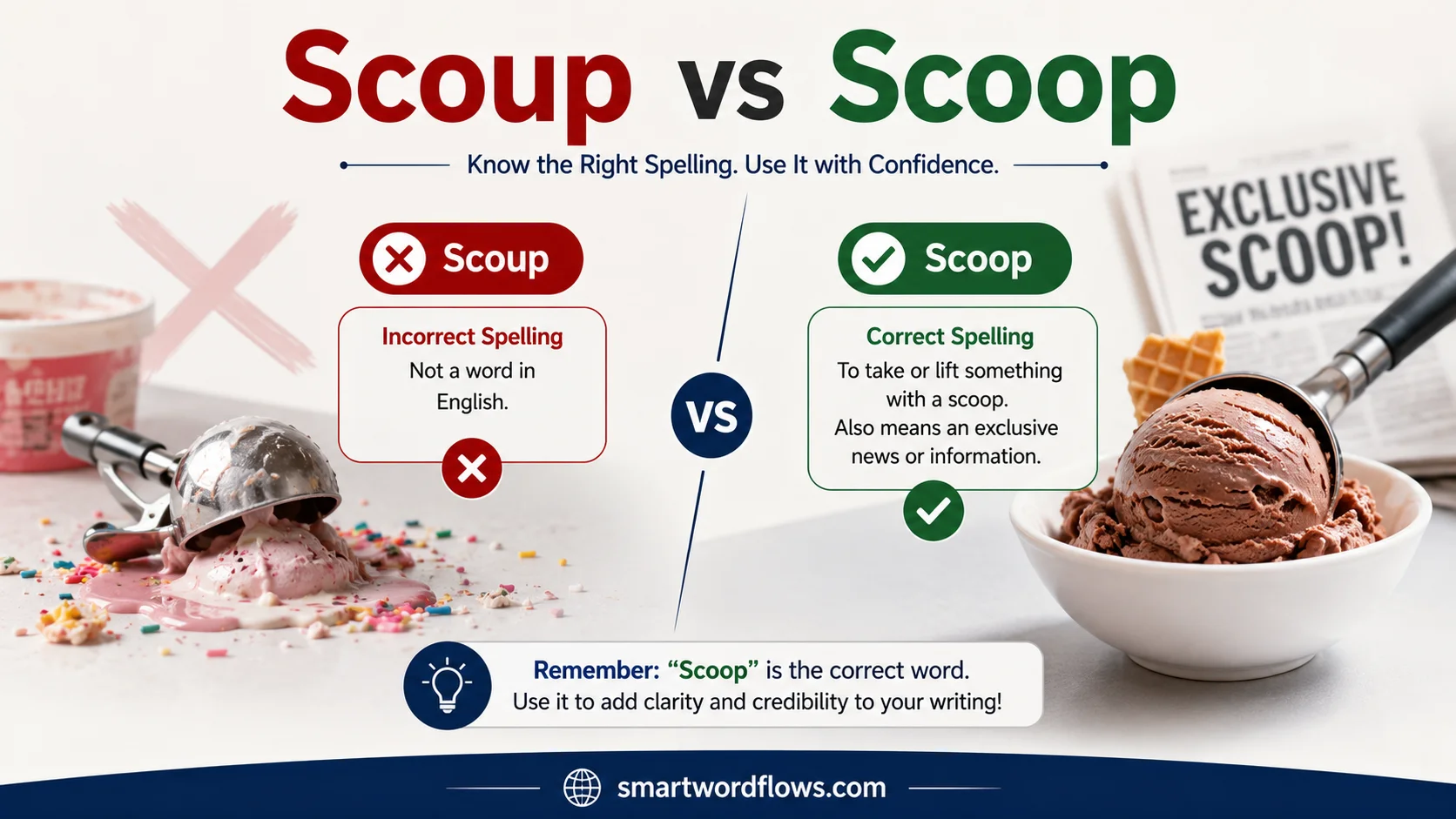

Many people search for scoup when typing, but scoop is the proper word in the English language. Scoup vs Scoop is a common spelling confusion because both words sound similar when spoken quickly. If you are wondering which word to use, remember that scoup is not a real word in standard English. This simple typing slip can cause mistakes in emails, reports, and everyday writing. Knowing the correct spelling helps improve confidence, accuracy, and professionalism. The scoop vs scoup difference is easy to understand once you know which form is correct.
Scoop has several useful meanings in English. It can mean to take something up or out with a scoop-shaped object or utensil. It can also mean a spoonful of a substance, such as food. In news writing, a scoop is a news story that a journalist has obtained before anyone else. Many people who come across scoup may think it is an alternate spelling, but it is wrong. Understanding the meaning, usage, and context of scoop helps you write sentences clearly and communicate with precision.
Quick Answer
Scoop is the correct standard English spelling. Scoup is generally a misspelling when someone intends to write scoop.
The word scoop works as both a noun and a verb. As a noun, it can mean a utensil, a quantity held by that utensil, or an important piece of news. As a verb, it can mean to pick something up, remove something with a scoop-like motion, or report a news story before another publication.
| Spelling | Standard English word? | Main meaning | Correct choice? |
| Scoop | Yes | Tool, amount, action, news story | Yes |
| Scoup | Generally no | Usually intended as scoop | No |
| Scooped | Yes | Past tense of scoop | Yes |
| Scooping | Yes | Present participle of scoop | Yes |
Cambridge Dictionary gives scoop the pronunciation /skuːp/ and defines it as a tool with a deep bowl-shaped end, the amount held by that tool, and a news story published before competitors.
So, if you’re writing a sentence such as “I need a scoop of ice cream,” don’t write “I need a scoup of ice cream.”
Comparison Overview
The difference between scoup vs scoop is primarily a matter of spelling and standard usage. They aren’t two ordinary English words with different meanings.
| Feature | Scoop | Scoup |
| Standard spelling | Yes | No, in ordinary English usage |
| Pronunciation | /skuːp/ | Usually intended to represent /skuːp/ |
| Part of speech | Noun and verb | Usually a misspelling |
| Tool meaning | Yes | No |
| Food quantity meaning | Yes | No |
| News meaning | Yes | No |
| Verb meaning | Yes | No |
| Common in dictionaries | Yes | Not as the ordinary spelling of scoop |
| Recommended in formal writing | Yes | No |
The important point is simple: don’t treat “scoup” and “scoop” as competing spellings. In normal English writing, scoop is the established word.
For example:
Correct: She added one scoop of flour.
Incorrect: She added one scoup of flour.
The second sentence doesn’t express a different meaning. It simply uses the wrong spelling.
Main Differences Between Scoup vs Scoop
The biggest difference is that scoop has recognized meanings and grammatical uses, while scoup generally doesn’t function as the standard spelling of those meanings.
Scoop Is the Standard Spelling
English dictionaries consistently list scoop as an established noun and verb. Merriam-Webster defines the noun in several ways, including a large ladle, a deep shovel-like implement, a utensil for dipping food, an amount held by a scoop, and information of immediate interest. It also lists scoop as a verb meaning to take something out or pick something up with a scoop or similar motion.
Cambridge gives similar meanings and specifically identifies the tool, the quantity it holds, and the journalism sense.
That gives you a useful rule:
When you mean the ordinary English word, spell it S-C-O-O-P.
Scoup Is Usually a Spelling Error
People can write scoup because the word’s pronunciation doesn’t reveal its spelling very clearly. When you hear /skuːp/, nothing about the sound itself tells you whether the middle should contain oo or another combination of letters.
This happens with many English words. Pronunciation and spelling don’t always line up neatly.
However, once the correct written form is known, there is no reason to use scoup in ordinary writing.
Scoop Has Several Meanings
Another major difference is semantic range. Scoop isn’t limited to ice cream or kitchen tools.
It can refer to:
- A physical tool
- An amount held by that tool
- The action of picking something up
- The act of removing material
- An exclusive news story
- Important or interesting information
- Certain specialized objects or shapes
Merriam-Webster even records scoop as a noun for a rounded neckline and as a specialized medical term for a spoon-shaped surgical instrument.
That broad range is one reason scoop is worth learning as a complete vocabulary word rather than simply memorizing its spelling.
What Does “Scoop” Mean?
Scoop has both noun and verb uses. Its meaning depends on the sentence around it.
Scoop as a Noun: A Tool
The most concrete meaning refers to a tool with a deep, curved, bowl-like end.
You might use a scoop to lift:
- Ice cream
- Flour
- Sugar
- Pet food
- Soil
- Sand
- Snow
- Powder
- Grains
For example:
She used a measuring scoop to add flour to the bowl.
Cambridge describes this type of scoop as a tool with a deep bowl-shaped end used to dig out and move soft substances or powders.
An ice cream scoop is probably the most familiar example. Its curved shape lets you remove a rounded portion of ice cream efficiently.
Scoop as a Noun: An Amount
Scoop can also describe the amount that a scoop holds.
Consider these examples:
- Add one scoop of protein powder.
- He ordered two scoops of chocolate ice cream.
- Give the dog one scoop of food.
Here, scoop doesn’t describe the utensil itself. It describes the quantity measured or served by that utensil.
This distinction matters because the same word can refer to both the container-like tool and its contents.
Scoop as a Noun: Exclusive News
The journalism meaning is quite different from the physical meaning, yet the underlying idea is surprisingly easy to understand.
A scoop is important information or a news story that a publication reports ahead of competitors. Cambridge defines this sense as a story discovered and published by one newspaper before others.
For example:
The reporter got a major scoop about the company’s expansion.
In journalism, getting a scoop means gaining information that others haven’t reported yet. The word therefore carries an idea of being first.
Merriam-Webster also includes the meaning of information that is of immediate interest.
Scoop as a Verb
As a verb, scoop describes an action.
You can scoop something by lifting or removing it with a curved tool or a similar motion.
Examples include:
- She scooped the ice cream into a cup.
- He scooped the soil into the pot.
- The child scooped up the toys.
- They scooped the snow from the steps.
Cambridge defines the verb as removing something from a container using a spoon, curved hands, or a similar action.
The action doesn’t always require an actual scoop. Your hands can also make a scooping motion.
What Does “Scoup” Mean?
In ordinary standard English, scoup isn’t the spelling you should use when you mean scoop.
If someone writes:
“I bought a scoup for the ice cream.”
the intended word is almost certainly scoop.
Likewise:
“The reporter got a scoup.”
should normally be:
“The reporter got a scoop.”
There are specialized contexts in which Scoup can appear as a name, acronym, project title, or technical term. For example, scientific literature contains technical names using Scoup. That doesn’t make scoup an alternative spelling of the everyday English word scoop. A technical proper name must be judged in its own context.
For normal English writing, however, the distinction remains clear:
scoop = standard English word
scoup = usually a misspelling of scoop
Why Do People Write “Scoup” Instead of “Scoop”?
The confusion makes sense once pronunciation enters the picture.
Both forms may look as though they could represent the same sound. English spelling often contains combinations that learners can’t predict from pronunciation alone.
The word scoop contains the letter combination oo, as in:
- food
- moon
- room
- spoon
- school
The pronunciation of scoop is /skuːp/. Cambridge lists that pronunciation for both British and American English.
Because the sound comes quickly in ordinary speech, a writer who hasn’t memorized the spelling may produce a phonetic guess such as scoup.
This is especially likely when someone has encountered the word mainly through conversation rather than reading.
A Simple Spelling Trick
Remember:
S-C-OO-P
The double O sits right in the middle.
You can connect the spelling with familiar oo words:
spoon → scoop
Both words can describe utensils used to move or serve something.
That association isn’t a grammatical rule. It’s simply a useful memory aid.
Scoop in Different Contexts
Understanding context makes the word much easier to remember.
Scoop in Food and Cooking
Food-related usage is extremely common.
Examples:
- Scoop the ice cream into the cone.
- Add one scoop of sugar.
- She used a scoop to measure the flour.
- He served two scoops of mashed potatoes.
In these sentences, scoop can function as either a noun or verb.
Scoop in Gardening and Cleaning
The word also works when you’re moving loose material.
Examples:
- Scoop the soil into the planter.
- He scooped the leaves into a bag.
- She scooped the snow from the sidewalk.
- The worker scooped sand into the container.
The common idea is lifting or removing something with a curved or sweeping motion.
Scoop in Journalism
Journalists use scoop when one reporter or publication gets important information before competitors.
Example:
The newspaper published an exclusive scoop about the investigation.
As a verb:
The rival newspaper scooped the story.
Cambridge specifically recognizes this journalistic verb use, explaining that a newspaper can scoop another when it discovers and publishes an important story first.
Scoop in Everyday Conversation
You may also hear:
“What’s the scoop?”
This informal expression means something like “What’s the latest information?” or “What’s going on?”
For example:
“What’s the scoop on the new manager?”
Here, nobody is talking about ice cream. The word has shifted from its physical sense to information.
Scoup vs Scoop in a Sentence
Seeing the words side by side makes the difference much easier to remember.
| Incorrect sentence | Correct sentence |
| I need a scoup of ice cream. | I need a scoop of ice cream. |
| She bought a scoup for the garden. | She bought a scoop for the garden. |
| Add one scoup of powder. | Add one scoop of powder. |
| The reporter got a scoup. | The reporter got a scoop. |
| He scouped the soil into the pot. | He scooped the soil into the pot. |
| She is scouping the ice cream. | She is scooping the ice cream. |
Notice something important here: the spelling problem can affect the entire word family.
The correct forms are:
- scoop
- scoops
- scooped
- scooping
- scooper
- scoopful
Merriam-Webster lists these related forms and gives scooped and scooping as forms of the verb.
Common Phrases and Expressions With “Scoop”
Learning common combinations can make the correct spelling stick.
A Scoop of Ice Cream
This refers to a portion of ice cream.
Example:
She ordered a scoop of vanilla ice cream.
Scoop Up
Scoop up means to pick something up quickly or with a sweeping motion.
Example:
She scooped up the scattered papers.
Merriam-Webster specifically lists scoop up among the verb’s uses.
Scoop Out
Scoop out means to remove something from inside an object or container.
Example:
Scoop out the seeds before serving the melon.
Get the Scoop
Get the scoop means to obtain information, especially information that isn’t yet widely known.
Example:
Call me when you get the scoop on the new schedule.
The Inside Scoop
The inside scoop means special or detailed information about a situation.
Example:
She gave us the inside scoop on the upcoming changes.
This usage is informal, but it remains widely understandable.
Scoop vs Shovel
Although scoop and shovel overlap, they aren’t always interchangeable.
A shovel usually has a longer handle and is designed for moving larger quantities of materials such as soil, snow, gravel, or sand.
A scoop can be smaller and more specialized. It often has a bowl-shaped end designed to hold a particular quantity.
For example:
- Use a shovel to move a pile of soil.
- Use a scoop to measure pet food.
- Use an ice cream scoop to serve ice cream.
The distinction depends on the design and the task.
Read More: Encode vs. Incode Correct Usage: Which One Should You Use?
Scoop vs Spoon
A spoon generally has a smaller bowl and is designed for eating, stirring, serving, or measuring small quantities.
A scoop usually has a deeper or more specialized bowl and is designed to lift a larger portion of a substance.
That’s why ice cream scoop sounds natural while ice cream spoon describes a different kind of utensil.
Still, the boundary isn’t absolute. Some scoops resemble large spoons, and dictionary definitions acknowledge this overlap. Merriam-Webster lists spoon among the synonyms of scoop in certain contexts.
Scoop vs Collect
The verbs scoop and collect can overlap, but they emphasize different things.
Collect focuses on gathering something.
Scoop focuses more strongly on the physical action of lifting, removing, or gathering something with a curved or sweeping movement.
Compare:
She collected the leaves.
This simply tells us that she gathered them.
She scooped the leaves into a bag.
This gives a clearer picture of the physical movement.
The second sentence feels more visual. You can almost see the motion.
Is “Scoup” Ever Correct?
For ordinary English, no, not when you mean the word scoop.
If you’re writing about ice cream, measuring powder, moving soil, or getting exclusive news, use scoop.
However, context matters when a capitalized or specialized form appears. A term called Scoup could theoretically be a proper name, acronym, software name, research project, product, or organization. Such a use doesn’t change the standard spelling of the everyday English noun and verb.
This distinction prevents an easy mistake: a specialized name called “Scoup” doesn’t make “scoup” an alternative spelling of “scoop.”
How to Remember the Correct Spelling of Scoop
If scoup vs scoop keeps causing trouble, use a simple visual memory trick.
Remember the Double O
Write it mentally as:
S C OO P
The two O’s form the center of the word.
Connect Scoop With Spoon
Both scoop and spoon can refer to tools used for lifting or serving food.
That association can help you remember the oo pattern.
Remember “Scoop of Ice Cream”
The phrase “scoop of ice cream” is so familiar that it makes a useful spelling anchor.
Instead of memorizing scoop in isolation, remember the complete phrase:
a scoop of ice cream
Then reuse the spelling in other contexts.
Common Mistakes With Scoop
Spelling scoup isn’t the only mistake writers can make.
Mistake: Writing Scoup
Incorrect:
He bought a scoup for the dog food.
Correct:
He bought a scoop for the dog food.
Mistake: Assuming Scoop Only Means Ice Cream
The word has much broader uses.
A scoop can refer to:
- A tool
- A quantity
- A physical action
- News information
- An exclusive report
Merriam-Webster records several noun and verb senses, which shows how much semantic ground this small word covers.
Mistake: Confusing a Scoop With a Scoopful
A scoop can mean the tool or the amount it holds.
A scoopful specifically refers to the quantity contained in a scoop.
For example:
She added one scoop of flour.
She added a scoopful of flour.
Both can make sense, although their emphasis differs slightly.
Mistake: Using Scoop as a Universal Synonym for Shovel
A scoop and shovel may perform similar actions, but their designs and typical uses differ.
Precise writing benefits from choosing the word that matches the object you’re actually describing.
Examples of Scoop in Sentences
Here are examples covering the major meanings of scoop:
- She used a scoop to serve the ice cream.
- Add one scoop of powder to the bottle.
- He scooped the soil into the flowerpot.
- The reporter landed an exclusive scoop.
- Please scoop the rice into the bowl.
- She scooped up the spilled cereal.
- Can you give me the inside scoop?
- The worker scooped the snow from the walkway.
- The package includes a measuring scoop.
- The journalist’s scoop attracted national attention.
- He scooped the seeds out of the pumpkin.
- The child scooped water from the bucket.
- The newspaper was scooped by a rival publication.
- She scooped up the toys from the floor.
- What’s the scoop on the new project?
These examples demonstrate why context matters. The same word can move naturally from the kitchen to the garden to a newsroom.
A Closer Look at the Word “Scoop”
The history of scoop also explains why the word has developed such a broad range of meanings.
Merriam-Webster gives the noun’s first known use as the 14th century and traces its etymology through Middle English scope to Middle Dutch schope.
The physical sense comes first in the word’s practical history. A scoop is something that helps you take something out or lift it. From there, English developed related figurative uses.
The journalism sense is especially interesting because it preserves the underlying idea of getting something first. A reporter who gets a scoop has effectively dug up information before anyone else.
That connection gives the word a memorable conceptual thread:
scoop something out → uncover something → obtain information → report it first
You don’t need to know the historical development to use the word correctly. Still, understanding the relationship between meanings makes vocabulary easier to remember.
A Practical Case Study: Choosing Between Scoup and Scoop
Imagine you’re proofreading three sentences for a school newsletter:
The reporter got a scoup about the new community center.
The volunteers used a scoup to move soil.
Each student received one scoup of ice cream.
All three contain the same spelling problem.
The corrected version is:
The reporter got a scoop about the new community center.
The volunteers used a scoop to move soil.
Each student received one scoop of ice cream.
The meanings change from journalism to gardening to food, but the spelling stays exactly the same.
That’s the key lesson. The context changes the meaning of “scoop,” not its spelling.
Scoup vs Scoop: Correct Usage at a Glance
| Question | Correct answer |
| Which spelling is correct? | Scoop |
| Is scoup the standard spelling? | No |
| Can scoop be a noun? | Yes |
| Can scoop be a verb? | Yes |
| Can scoop refer to food? | Yes |
| Can scoop refer to a tool? | Yes |
| Can scoop refer to an amount? | Yes |
| Can scoop refer to news? | Yes |
| Can scoop mean to pick something up? | Yes |
| Is scooped correct? | Yes |
| Is scooping correct? | Yes |
| Should you use scoup in normal English? | No |
FAQs:
1. Is “scoup” a correct English word?
No. Scoup is not a standard English word. The correct spelling is scoop.
2. What is the difference between scoup and scoop?
The main difference is that scoop is the correct English word, while scoup is a spelling mistake.
3. What does “scoop” mean?
Scoop can mean to take something up with a utensil, a spoonful of something, or an exclusive news story.
4. Why do people write “scoup” instead of “scoop”?
The mistake often happens because both words sound similar, especially when they are spoken quickly or typed without checking the spelling.
5. How can I remember the correct spelling?
Remember that the correct form is always scoop. Using it regularly in sentences can help you avoid this common spelling mistake.
Conclusion
The correct word is scoop, not scoup. Scoop has several meanings, including taking something up with a utensil, a spoonful of a substance, or an exclusive news story. Remembering the correct spelling will help you write with greater accuracy, confidence, and professionalism.