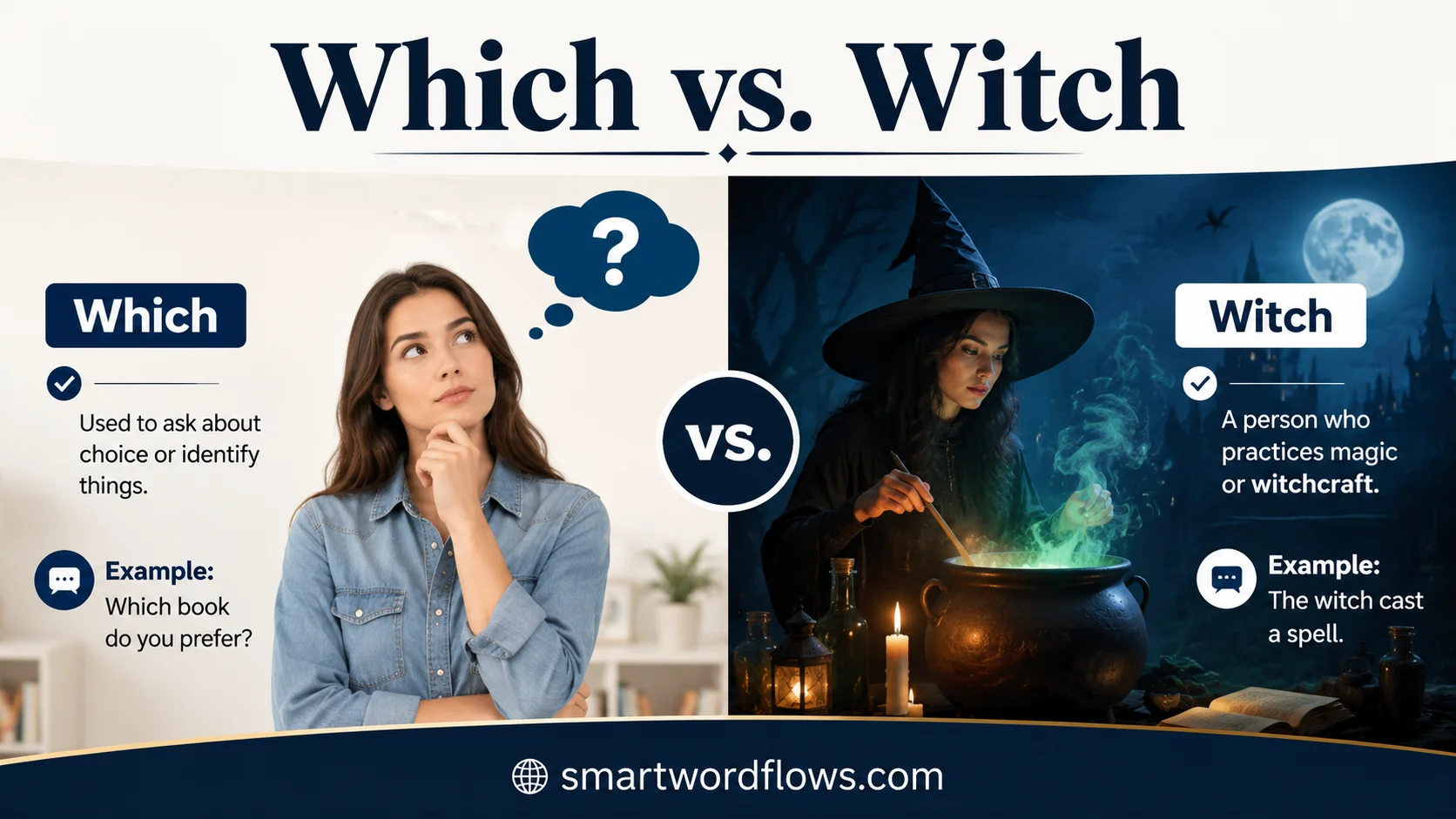

When comparing Which vs. Witch vs. Wich, it’s important to understand their meanings, spelling, and proper usage. Which is commonly used as a pronoun or adjective when selecting or identifying something. Witch is a noun that describes a person associated with magic or witchcraft. Meanwhile, Wich is generally an incorrect spelling in standard English. Learning this simple distinction helps you avoid spelling mistakes and choose the correct word confidently in everyday and professional writing.
These homophones can cause confusion because which and witch usually have the same pronunciation but completely different meanings. Their correct use depends on context, grammar, and sentence structure. For example, “Which book do you want?” asks about a choice, while “The witch lived in the forest” describes a magical character. Understanding their definitions, pronunciation, word differences, and usage improves English accuracy and makes your writing clearer, more natural, and easier to understand.
Quick Answer
Here is the fastest way to remember the difference between which, witch, and wich:
- Which = used to ask about or identify a choice, person, thing, or option.
- Witch = a person associated with magic or witchcraft.
- Wich = usually an incorrect spelling in standard modern English.
For example:
- Which movie do you want to watch?
- The witch flew on a broom.
- ❌ Wich movie do you want to watch?
If you are choosing, use which. If you are talking about magic, use witch. If you wrote wich, check the sentence again.
Comparison Overview
The easiest way to understand which vs. witch vs. wich differences and usage is to compare them side by side.
| Word | Main Meaning | Common Grammar Role | Example |
| Which | Asks about or identifies a choice | Pronoun or determiner | Which book is yours? |
| Witch | A person associated with magic | Noun | The witch cast a spell. |
| Wich | Usually a misspelling | Not standard standalone usage | ❌ Wich color do you like? |
The spelling may look similar. The meanings, however, are miles apart.
Think of it this way: which belongs in a conversation about choices, while witch belongs in a story about magic.
Main Differences Between Which vs. Witch vs. Wich
The main difference between which, witch, and wich comes down to meaning, grammar, and context.
Which is connected to choices and identification
Use which when you need to ask someone to choose or identify something.
For example:
- Which dress should I wear?
- Which route is faster?
- I don’t know which one belongs to Sarah.
- Which of these answers is correct?
In these sentences, which helps narrow down a group of possible options.
Witch is connected to magic
A witch is usually a noun. It traditionally refers to a person believed to have magical powers or to practice witchcraft.
For example:
- The witch mixed a potion.
- The movie featured a powerful witch.
- The children dressed as witches for Halloween.
The word can appear in folklore, fantasy, literature, Halloween traditions, and some modern religious or spiritual contexts.
Wich is usually a spelling mistake
In standard modern English, wich is generally not the correct standalone word when you mean which or witch.
For example:
- ❌ Wich restaurant should we visit?
- ✅ Which restaurant should we visit?
And:
- ❌ The wich used magic.
- ✅ The witch used magic.
One missing letter can change the sentence completely. That’s why proofreading matters.
What Does Which Mean?
Which is a flexible English word. You can use it to ask questions, identify things, introduce certain clauses, or refer to one option from a group.
Which for Questions and Choices
This is the most common use.
You use which when several possibilities exist and you want to identify one.
Examples:
- Which phone should I buy?
- Which player scored the goal?
- Which road leads downtown?
- Which seat would you like?
Imagine standing in front of three doors. If you ask, “Which door should I open?” you are choosing from a known group.
That’s the heart of the word.
Which helps you point at one possibility among several.
Which as a Pronoun
A pronoun can replace a noun. Which often performs that job.
Examples:
- Which is yours?
- I can’t decide which to choose.
- Which do you prefer?
In each example, the noun is understood from the context.
Consider this exchange:
“I bought two jackets.”
“Which is new?”
You don’t need to repeat jacket because both speakers already understand what the conversation is about.
Which Before a Noun
Which can also appear directly before a noun.
Examples:
- Which book are you reading?
- Which color looks better?
- Which restaurant has the best view?
- Which answer did you choose?
Here, which acts as a determiner because it helps specify the noun that follows.
Which in Relative Clauses
This use matters because which does more than ask questions.
It can also introduce information about a thing, idea, situation, or earlier statement.
Examples:
- My laptop, which I bought last year, still works well.
- She missed the train, which caused her to arrive late.
- The museum, which opened in 1954, attracts thousands of visitors.
The phrase beginning with which adds information.
Consider:
I forgot my umbrella, which was a bad decision.
Here, which refers to the entire previous idea: forgetting the umbrella.
That makes this usage especially useful in formal and polished writing.
When Should You Use Which?
Use which when the sentence involves:
- A choice
- A selection
- Identification
- A specific item
- A question about one option
- Additional information about something already mentioned
Here are a few quick examples:
| Situation | Correct Word |
| Choosing between two shirts | Which |
| Asking about a movie | Which |
| Identifying one person | Which |
| Talking about a magical person | Not which |
| Referring to a spellcaster | Not which |
A simple question can help:
Am I asking “what one?”
If the answer is yes, you probably need which.
What Does Witch Mean?
The word witch has a completely different meaning.
A witch traditionally refers to a person associated with magic, supernatural powers, or witchcraft.
Witch in Folklore and Fairy Tales
Stories have featured witches for centuries.
Traditional fairy tales often portrayed witches as mysterious or dangerous characters. They might live in isolated forests, prepare potions, cast spells, or possess supernatural knowledge.
Examples include familiar story elements such as:
- Magic potions
- Spells
- Enchanted objects
- Brooms
- Cauldrons
- Magical transformations
For example:
The witch placed the potion over the fire and waited for it to change color.
In this sentence, witch clearly refers to a magical character.
Witch in Fantasy and Modern Fiction
Modern stories often portray witches in more complex ways.
A witch might be:
- A hero
- A student learning magic
- A healer
- A protector
- A villain
- A powerful leader
Fantasy fiction has moved far beyond the old image of a mysterious person wearing a pointed hat.
For example:
The young witch spent years learning how to control her powers.
Here, witch simply describes a character with magical abilities.
Witch and Modern Spiritual Practice
The word witch can also have real-world meanings.
Some people use the term to describe their involvement in modern witchcraft or certain Pagan spiritual practices. These traditions vary widely, so it is inaccurate to assume that every person who identifies as a witch follows the same beliefs or practices.
Context matters.
In a Halloween story, witch may describe a costume. In a fantasy novel, it may describe a fictional character. In a spiritual setting, it may refer to a real person’s identity or practice.
The same word can travel through very different worlds.
Witch as a Verb
Although less common, witch can also function as a verb.
Historically, it can mean to affect someone through supposed magic or enchantment.
For example:
- The villagers believed someone had witched the field.
- According to the legend, the sorceress witched the traveler.
You will encounter the noun form far more often in modern everyday writing.
Is Wich a Real Word?
This is where many writers get confused.
Wich is Usually Not Correct as a Standalone Word
If you write:
Wich one should I choose?
You almost certainly mean:
Which one should I choose?
If you write:
The wich cast a spell.
You mean:
The witch cast a spell.
In ordinary modern American English, wich is usually a typo or spelling mistake.
Why Does Wich Appear in Place Names?
You may see wich as part of a proper name or place name.
Examples include:
- Greenwich
- Norwich
- Ipswich
- Sandwich
That does not mean wich works as an everyday standalone replacement for which or witch.
Place names follow their own historical spelling patterns. English geography is full of old forms that don’t always match modern grammar rules.
So don’t let a place name fool you.
Greenwich does not prove that “wich” is a correct spelling for “which.”
Wich in Informal Online Writing
Online searches, social media posts, and text messages often contain spelling mistakes.
People may type wich because:
- They type quickly.
- Autocorrect fails.
- They hear the word but don’t know the spelling.
- English is not their first language.
- The keyboard is used carelessly.
A typo can spread online like spilled coffee on a white shirt. Once it appears everywhere, it may look normal.
That doesn’t make it standard English.
Which vs. Witch: The Core Difference
The biggest challenge comes from the fact that which and witch often sound identical.
That makes them homophones.
Homophones are words that sound the same but have different meanings and spellings.
Other examples include:
- Right / write
- Sea / see
- Flower / flour
- Pair / pear
- Knight / night
Which and witch belong in that same family.
Compare Their Meanings
| Feature | Which | Witch |
| Main idea | Choice or identification | Magic or witchcraft |
| Common role | Pronoun or determiner | Noun |
| Used in questions | Yes | No |
| Related to options | Yes | No |
| Related to magic | No | Yes |
| Example | Which movie is best? | The witch flew away. |
The quickest memory rule is simple:
Which helps you choose. Witch uses magic.
Which vs. Witch Pronunciation
In most modern American English, which and witch are pronounced the same:
/wɪtʃ/
That pronunciation explains why the spelling confusion happens so often.
If you only hear the word, you must use context to determine the spelling.
Consider these two sentences:
- Which witch won the contest?
- The witch chose a black cat.
The first sentence asks you to identify a particular witch. The second sentence talks about the magical person herself.
Read More: Distress vs. Duress: Differences, Meanings, Usage, and Examples
A Small Pronunciation Detail
Some speakers historically made a distinction between words like which and witch.
They might pronounce which with a breathier beginning.
However, most modern American English speakers pronounce the two words alike. For everyday writing, the important skill is recognizing the correct meaning from context.
Which, Witch, and Wich in Sentences
Examples make the differences easier to remember.
Examples of Which
- Which app do you use most often?
- Which road should we take?
- I don’t know which answer is correct.
- Which of these cookies do you want?
- The report, which took weeks to complete, was finally published.
Examples of Witch
- The witch stirred a bubbling potion.
- A friendly witch helped the lost traveler.
- The children saw a witch decoration in the store.
- The fantasy novel follows a young witch.
- The witch used magic to open the door.
Examples of Incorrect Wich
- ❌ Wich car is yours?
- ✅ Which car is yours?
- ❌ The wich made a potion.
- ✅ The witch made a potion.
- ❌ Wich option should I select?
- ✅ Which option should I select?
Common Mistakes With Which vs. Witch vs. Wich
Writing Witch When You Mean Which
This is one of the most common errors.
Incorrect:
Witch one do you want?
Correct:
Which one do you want?
Why?
The sentence asks about a choice. It has nothing to do with magic.
Writing Wich Instead of Which
Incorrect:
Wich book should I read first?
Correct:
Which book should I read first?
The missing H creates a spelling mistake.
Writing Which Instead of Witch
Incorrect:
The which cast a spell.
Correct:
The witch cast a spell.
Again, meaning solves the problem.
If magic appears in the sentence, witch is usually the correct word.
Relying Only on Pronunciation
Sound can mislead you.
Since which and witch often sound the same, listening alone won’t help.
Instead, ask:
What does the sentence mean?
That question usually solves the problem immediately.
How to Remember Which vs. Witch
Memory tricks can make spelling easier.
Remember Which as the Choice Word
Think of which whenever you choose between options.
Examples:
- Which shirt?
- Which movie?
- Which road?
- Which answer?
If you are pointing at choices, use which.
Remember Witch as the Magic Word
Think about:
- Spells
- Magic
- Potions
- Brooms
- Cauldrons
- Fantasy
Those ideas point toward witch.
Use the One-Letter Check
When proofreading, stop for a second.
Ask yourself:
- Am I asking about a choice?
Use which. - Am I talking about a magical person?
Use witch. - Did I write “wich”?
Check the sentence because you probably need which or witch.
That tiny pause can prevent a visible spelling mistake.
A Simple Case Study: One Sentence, Two Meanings
Consider this sentence:
Which witch stole the wand?
At first glance, it may look confusing. Break it apart.
- Which = asks you to identify one person from a group.
- Witch = the magical person.
The sentence means:
Out of all the witches, which one stole the wand?
Now look at this:
The witch chose a wand.
Here, witch is the subject. There is no question about choosing between several options.
This is a useful mini-case study because it shows how two identical-sounding words can work together without causing confusion.
Context does the heavy lifting.
The Famous Phrase: Which Witch Is Which?
The phrase:
Which witch is which?
works almost like a grammar puzzle.
Let’s break it down:
- First which = asks for identification.
- Witch = magical person.
- Second which = asks which person is which.
The sentence sounds playful because the words share the same pronunciation.
It also demonstrates an important truth about English:
Spelling often carries meaning that pronunciation cannot show.
When you hear the sentence, the words may sound identical. When you see it written, the spelling reveals the meaning.
Which vs. Witch vs. Wich: A Quick Decision Guide
Use this decision process whenever you get stuck.
Are You Asking About a Choice?
Examples:
- Which one?
- Which color?
- Which person?
- Which answer?
Use which.
Are You Talking About Magic?
Examples:
- A witch cast a spell.
- The witch used a potion.
- The witch lived in the forest.
Use witch.
Did You Write Wich?
Check the sentence again.
In standard English, wich is usually not the word you need.
You likely mean:
- Which for choices
- Witch for magic
Which vs. Witch vs. Wich Practice Exercise
Choose the correct word for each sentence.
- ______ jacket should I wear?
- The ______ flew across the night sky.
- Do you know ______ answer is correct?
- The story featured a young ______ with powerful magic.
- ______ restaurant has the best pizza?
- The old ______ lived near the forest.
- I can’t decide ______ phone to buy.
- ______ of these seats is available?
- The ______ prepared a mysterious potion.
- Tell me ______ movie you watched.
- The children dressed as a ______ for Halloween.
- ______ route is the fastest?
Answers
- Which jacket should I wear? — You are choosing an option.
- The witch flew across the night sky. — The sentence refers to a magical person.
- Do you know which answer is correct? — You are identifying one answer.
- The story featured a young witch with powerful magic. — The word describes a magical character.
- Which restaurant has the best pizza? — The question asks you to identify one restaurant.
- The old witch lived near the forest. — The person is associated with magic.
- I can’t decide which phone to buy. — You are choosing.
- Which of these seats is available? — You are identifying one option.
- The witch prepared a mysterious potion. — Potions and magic point to witch.
- Tell me which movie you watched. — You are identifying a movie.
- The children dressed as a witch for Halloween. — A witch is a costume or character.
- Which route is the fastest? — The sentence asks you to compare choices.
Why Context Matters More Than Sound
The which vs. witch vs. wich differences and usage issue teaches an important writing lesson.
English pronunciation doesn’t always tell you how to spell a word.
For example, you may hear:
“Which one?”
The sound alone does not show the letters.
You need to understand the meaning.
That’s why strong spelling skills depend on more than memorizing sounds. They also depend on:
- Context
- Grammar
- Meaning
- Word patterns
- Careful proofreading
When you understand the sentence, the spelling becomes much easier.
Related Writing Tip: Don’t Let Autocorrect Decide Everything
Spellcheck tools can help, but they aren’t perfect.
Suppose you write:
Witch option is better?
Both witch and which are correctly spelled English words.
A basic spellchecker may not flag the mistake because witch exists in the dictionary.
That means grammar software cannot always replace human judgment.
Before publishing important writing, ask:
Does this word make sense in the sentence?
That simple question catches many errors involving homophones.
FAQs :
1. What is the difference between which and witch?
Which is used to ask about or identify a person, thing, or choice. Witch is a noun referring to a person traditionally believed to practice magic or witchcraft.
2. Is wich a correct English word?
In standard English, wich is generally considered a misspelling of “which” or “witch.” The correct choice depends on the meaning you want to express.
3. How can I remember the difference between which and witch?
A simple memory trick is to associate witch with “witchcraft” and which with questions or choices, such as “Which one do you want?”
4. Are which and witch homophones?
Yes. Which and witch are commonly pronounced the same in many varieties of English, but they have different spellings and meanings.
5. When should I use which in a sentence?
Use which when referring to a specific choice, asking a question, or introducing information about something. For example, “Which color do you prefer?”
Conclusion :
Understanding Which vs. Witch vs. Wich becomes easy when you focus on meaning and context. Which relates to choices or identification, witch refers to someone associated with magic, and wich is usually an incorrect spelling. Knowing these differences helps you avoid common spelling errors and write with greater clarity, accuracy, and confidence.