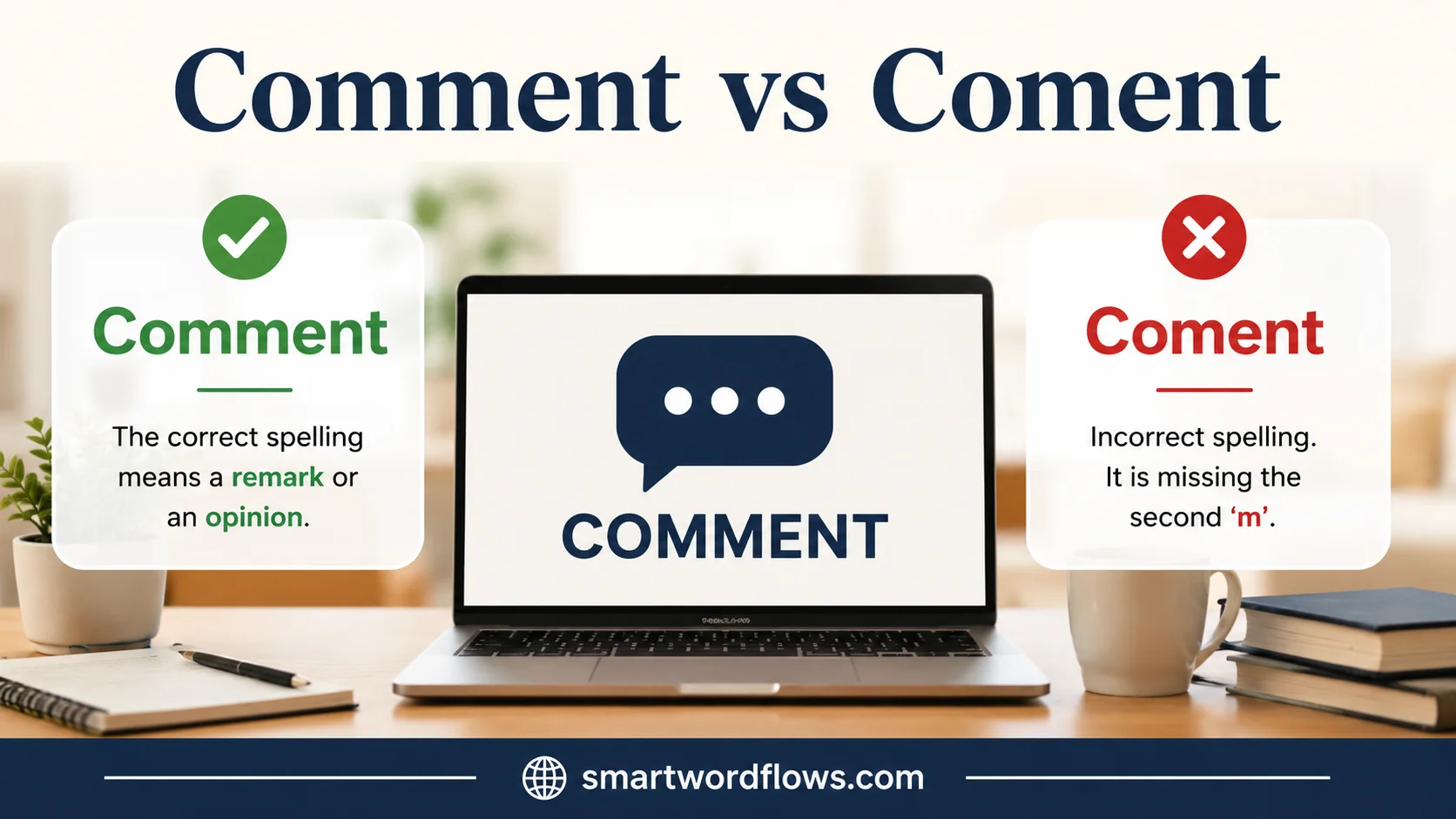

Comment vs Coment can confuse many English learners, students, and writers. The correct English spelling is comment, while coment is a misspelling. This small spelling issue can cause unnecessary confusion and doubts about accuracy, especially in academic writing, professional writing, and everyday typing. The main difference is the two letter ms in comment. When typing quickly, people may accidentally leave out one letter. Learning to spell comment correctly improves clarity, credibility, and presentation.
The meaning and usage of comment are also important. A comment can be an opinion, remark, or response in formal writing or informal writing. You may see it in school assignments, professional emails, social media posts, blog comments, and business communication. In programming, a comment can explain code. Practical examples, grammar rules, and memory tricks can help you remember the correct spelling and avoid common mistakes.
Quick Answer
Comment is the correct spelling. Coment is a misspelling.
Use comment when you mean a spoken or written remark, opinion, observation, or response.
For example:
- Correct: She left a helpful comment on my article.
- Incorrect: She left a helpful coment on my article.
The same rule applies when comment functions as a verb:
- Correct: He commented on the new policy.
- Incorrect: He comented on the new policy.
There isn’t a separate English word coment with a different meaning. If you’re writing in standard English, the form you want is comment.
Easy rule to remember: If you mean a remark or opinion, spell it comment, with two m’s.
Comparison Overview
The quickest way to understand comment vs coment is to put the two forms side by side.
| Feature | Comment | Coment |
| Correct English spelling | Yes | No |
| Standard dictionary word | Yes | No |
| Can be a noun | Yes | No |
| Can be a verb | Yes | No |
| Means a remark or opinion | Yes | No |
| Used in professional writing | Yes | No |
| Used in academic writing | Yes | No |
| Used online | Yes | No |
| Contains two m’s | Yes | No |
Cambridge defines comment as something spoken or written that expresses an opinion. It also recognizes comment as a verb meaning to make such a remark.
Coment, on the other hand, isn’t the standard spelling you should use in English.
Comment vs Coment at a Glance
Comment = correct
Coment = incorrect
Comment = a remark, opinion, observation, or response
Coment = misspelling of comment
Comment = noun and verb
Coment = neither in standard English
That’s really the heart of the matter. The rest comes down to understanding how to use the correct word naturally.
Main Differences Between Comment vs Coment
The biggest difference between comment vs coment is simple: one is correct and the other isn’t.
Comment Is the Correct Spelling
Comment contains two consecutive m’s:
C-O-M-M-E-N-T
That spelling remains consistent whether you’re using the word as a noun or a verb.
Examples:
- Your comment was helpful.
- She made a comment about the proposal.
- He decided to comment on the issue.
- They commented on the results.
- Several people are commenting on the announcement.
The spelling becomes particularly important in related forms because the base word remains easy to recognize.
Coment Is a Spelling Error
Coment contains only one m:
C-O-M-E-N-T
That’s not the standard English spelling of the word.
For example:
- Please leave a coment below.
- Please leave a comment below.
- She made an interesting coment.
- She made an interesting comment.
- He comented on the report.
- He commented on the report.
If a spell checker marks coment as an error, it’s giving you the right signal. Change it to comment.
What Does “Comment” Mean?
The word comment has a fairly broad meaning, but its central idea stays the same: someone expresses something about a person, subject, event, or situation.
As a noun, a comment can be an opinion, observation, remark, or response. Cambridge lists the noun as both countable and uncountable depending on how it’s used.
Consider these examples:
“That was an interesting comment.”
Here, comment means a remark or observation.
“She made several comments about the proposal.”
Here, comments means multiple remarks or opinions.
“The company had no comment.”
Here, comment refers to an official response or opinion.
The word doesn’t automatically mean criticism. A comment can be positive, negative, neutral, helpful, funny, serious, casual, or critical.
For example:
- He made a positive comment about the presentation.
- She made a funny comment during dinner.
- The teacher wrote several useful comments on the essay.
- The manager had a few critical comments about the proposal.
- I didn’t mean my comment to sound rude.
Context determines the tone.
Comment as a Noun
When comment works as a noun, it refers to something someone says or writes.
Common Uses of the Noun “Comment”
You can use comment for:
- An opinion
- A remark
- An observation
- A response
- A criticism
- A suggestion
- An online response
- A statement about a particular subject
For example:
Her comment made everyone laugh.
The word comment refers to something she said.
Another example:
I received several comments on my article.
Here, the comments could include praise, criticism, questions, or suggestions.
The noun also appears in formal contexts. A government agency, company, lawyer, researcher, or journalist might ask someone for comment on an issue.
For example:
The newspaper contacted the company for comment.
That doesn’t necessarily mean the company has already made a statement. It means the newspaper wants the company to respond.
Countable and Uncountable Uses
Comment can be countable when you mean an individual remark:
- She made a comment.
- He made three comments.
- I read your comments.
It can also appear in an uncountable sense, particularly in expressions such as:
- The company declined to comment.
- The politician was unavailable for comment.
- The issue requires no further comment.
Understanding this distinction helps you use the word naturally in formal writing.
Comment as a Verb
Comment can also function as a verb.
As a verb, it means to make a remark or express an opinion about something. Cambridge gives common constructions such as comment on and comment that.
Examples:
- She commented on the quality of the work.
- He commented on the unusual weather.
- The teacher commented that the essays were well written.
- The manager commented on the team’s progress.
- Nobody wanted to comment on the decision.
One of the most important patterns to remember is:
comment on + subject
For example:
She commented on the new design.
Not:
She commented the new design.
That distinction matters because learners sometimes treat comment like a fully transitive verb when the intended structure requires on.
Common Verb Forms
| Verb form | Example |
| Comment | I want to comment on this issue. |
| Comments | She comments on every detail. |
| Commented | He commented on the proposal. |
| Commenting | They are commenting on the results. |
Cambridge confirms commented as the past tense and past participle of comment, while commenting is the present participle.
Why Is “Coment” Incorrect?
The most obvious reason is that coment simply isn’t the standard English spelling of the word.
But why does this mistake happen so often?
The answer is partly pronunciation.
In American English, comment is pronounced approximately KAH-ment. The double m doesn’t sound like two separate, clearly pronounced consonants.
That can make the spelling feel less intuitive.
Think about the difference between hearing and seeing the word:
What you hear: “comment”
What you need to write: comment
The sound doesn’t give you a strong reason to consciously remember two m’s. As a result, someone typing quickly may write coment without noticing.
This is a classic spelling problem: pronunciation doesn’t always reveal every letter in English spelling.
The Origin of the Word “Comment”
The spelling also makes more sense when you look briefly at the word’s history.
The noun comment entered English in the late 14th century. Etymonline traces it to Old French coment or directly to Late Latin commentum, with connections to Latin words associated with thinking, discussing, interpreting, and explaining. The verb appeared in English in the early 15th century.
That history explains something interesting about the word. Comment has long been associated with explanation, interpretation, and remarks about a subject.
Today, its meaning is much more flexible. You can comment on almost anything:
- A book
- A movie
- A political decision
- A photograph
- A meal
- A presentation
- A social media post
- A research paper
- A workplace decision
The basic idea remains remarkably stable: you say or write something about a subject.
How to Pronounce “Comment”
In American English, Cambridge gives the pronunciation as approximately:
/ˈkɑː.ment/
An easy learner-friendly approximation is:
KAH-ment
The stress falls on the first syllable.
The important point for spelling is that the pronunciation doesn’t mean you should write coment.
Think of it this way:
Pronunciation: KAH-ment
Spelling: C-O-M-M-E-N-T
The double m belongs to the written form even though you don’t pronounce two separate /m/ sounds.
Common Phrases and Collocations With “Comment”
Native English speakers frequently use comment in predictable combinations. Learning these phrases can help you sound more natural.
Make a Comment
Make a comment means to say something about a subject.
- She made a thoughtful comment during the meeting.
- He made a brief comment about the results.
Leave a Comment
This phrase is especially common online.
- Please leave a comment below.
- Readers can leave comments after the article.
Post a Comment
This usually refers to publishing a response online.
- I posted a comment on the discussion.
- She posted a thoughtful comment under the video.
Add a Comment
This means to contribute another observation or remark.
- I’d like to add a comment before we finish.
- The editor added a comment to the document.
Comment on Something
This is one of the most important verb patterns.
- Can you comment on the proposal?
- She refused to comment on the allegation.
- The researcher commented on the findings.
No Comment
No comment means someone doesn’t want to provide an answer or opinion. Cambridge identifies it as a standard expression used when someone doesn’t want to answer a question.
For example:
The actor was asked about the rumor but replied, “No comment.”
Read More: Present vs Presant: Differences and Correct Usage
Comment vs Commentary
Although comment and commentary are related, they aren’t interchangeable in every sentence.
A comment is usually a particular remark or observation.
Commentary generally refers to a broader discussion, explanation, or running analysis.
Compare these:
- The professor made a comment about the study.
- The professor provided detailed commentary on the study.
The first sentence points to a specific remark.
The second suggests a more extended discussion.
You might hear commentary during a sporting event when an announcer continuously explains what’s happening. You can also encounter it in books, journalism, politics, film, and academic discussion.
A useful shortcut is:
Comment = one remark or response
Commentary = extended discussion or analysis
Comment vs Remark
Remark is one of the closest alternatives to comment.
In many situations, you can use either word:
- She made a comment about the weather.
- She made a remark about the weather.
However, remark can sometimes emphasize the act of saying something rather than the idea of giving an opinion.
Consider:
He remarked that the room was unusually quiet.
That sounds natural.
You could also say:
He commented that the room was unusually quiet.
That works too, although the tone can differ slightly depending on the context.
Neither word is inherently better. Choose the one that fits the sentence and tone.
Comment vs Opinion
A comment isn’t always an opinion.
An opinion expresses what someone thinks or believes.
A comment can simply describe or observe something.
For example:
“The meeting starts at nine.”
That could be a comment, but it isn’t necessarily an opinion.
By contrast:
“I think the meeting should start later.”
That’s clearly an opinion.
So while comments often contain opinions, the two words don’t have identical meanings.
Comment vs Feedback
The words comment and feedback overlap, but they serve different purposes.
Feedback usually refers to information intended to help someone evaluate or improve something.
For example:
- The manager gave me feedback on my presentation.
- The teacher provided feedback on my essay.
A comment can be much broader:
- She made a funny comment.
- He left a comment online.
- The journalist requested a comment.
- The editor added a comment to the document.
If you’re talking specifically about suggestions for improvement, feedback may be the more precise choice.
Comment in Social Media and Online Discussions
The internet has given comment another extremely common everyday use.
On websites and social platforms, a comment is a written response that someone posts beneath an article, video, photograph, or other piece of content.
For example:
She left a comment under the video.
The phrase comment section is also firmly established in English. Cambridge lists comment section as a common collocation.
Online comments can serve different purposes:
- Asking a question
- Expressing agreement
- Disagreeing with an idea
- Adding information
- Sharing an experience
- Giving feedback
- Starting a discussion
- Making a joke
The tone can range from highly professional to completely casual.
For example:
Professional:
Thank you for your detailed comment. The additional source is helpful.
Casual:
Great post! I really enjoyed this.
Both are comments. The context determines how formal the language should be.
Comment in Workplace Communication
In professional settings, comment can refer to an observation, response, or opinion.
Consider this sentence:
Do you have any comments on the proposal?
Here, the speaker isn’t necessarily asking for criticism. They may simply want the listener to review the proposal and offer thoughts.
Another example:
I’d like to make a brief comment before we move on.
This signals that the speaker wants to contribute a short observation.
Professional Examples
- Please send me your comments on the revised document.
- The director declined to comment on the issue.
- I’d appreciate your comments before the final version is submitted.
- The reviewer made several useful comments.
- Could you comment on the potential risks?
In formal writing, comment can therefore sound perfectly professional without being stiff.
Comment in Academic Writing
Academic writing uses comment in several ways.
A teacher may write comments on a student’s essay. A researcher may invite comments on a draft. A reviewer may make comments about a study’s methodology.
For example:
The reviewer made several comments about the research design.
Or:
The instructor’s comments helped the student revise the paper.
Cambridge’s English corpus examples also show comments used in reports, proposals, academic work, and formal documents.
However, academic writers should choose their words carefully. If you’re making a detailed argument, analysis, evaluation, or discussion may sometimes be more precise than comment.
“No Comment” and “Decline to Comment”
Two expressions deserve special attention because they appear frequently in journalism and public communication.
No Comment
No comment means the person doesn’t want to answer or provide an opinion.
Example:
When reporters asked about the investigation, the spokesperson said, “No comment.”
The phrase can sound neutral, defensive, cautious, or even suspicious depending on the situation.
Decline to Comment
Decline to comment is a more formal expression.
Example:
The company declined to comment on the allegations.
This means the company chose not to provide a statement.
Cambridge specifically lists refuse to comment and decline to comment as common constructions.
There’s a subtle difference in tone:
| Expression | Typical tone |
| No comment | Brief and direct |
| Decline to comment | Formal and professional |
| Refuse to comment | Stronger and potentially more forceful |
| Unavailable for comment | Neutral and often used by journalists |
Common Spelling Mistakes Related to “Comment”
The most common error is dropping one of the two m’s.
Incorrect: Coment
Please add your coment below.
Correct: Comment
Please add your comment below.
Other accidental forms can include:
- comnent
- commment
- comement
- coment
- comment
The correct spelling is:
C-O-M-M-E-N-T
If you remember only one thing from this article, remember those two middle m’s.
How to Remember the Correct Spelling of Comment
A simple memory trick can save you from making the same mistake repeatedly.
Think:
COM + MENT = COMMENT
The word begins with com- and continues with -ment. When those parts meet, the written form contains two m’s:
com + ment → comment
You can also connect it to its related forms:
- comment
- comments
- commented
- commenting
Notice how the double m remains visible in the base spelling.
Another useful trick is to associate the word with communication. When you make a comment, you’re communicating a thought or observation. Both words begin with com.
It isn’t a perfect spelling rule, but visual memory works well for frequently misspelled words.
Comment vs Coment in Different Sentences
Seeing the difference in context makes the rule easier to remember.
| Incorrect | Correct |
| I wrote a coment. | I wrote a comment. |
| She made a nice coment. | She made a nice comment. |
| Please leave a coment below. | Please leave a comment below. |
| He comented on the article. | He commented on the article. |
| They are comenting on the issue. | They are commenting on the issue. |
| The teacher’s coments were useful. | The teacher’s comments were useful. |
Notice something important here: the spelling mistake doesn’t stop with the base word.
If you write coment, you may also accidentally write comented, comenting, or coments. Once you learn the correct base spelling, the related forms become much easier.
Practical Case Study: Correcting a Professional Email
Imagine that an employee writes:
Thank you for your coment on the proposal. I’ll review your sugestions and make the necessary changes.
There are spelling problems in both coment and sugestions. Focusing specifically on our target word, the correct version is:
Thank you for your comment on the proposal.
Why does this matter?
A single spelling mistake won’t normally destroy a professional message. Still, repeated spelling errors can distract the reader and make polished communication look rushed.
Now consider a cleaner version:
Thank you for your comment on the proposal. I’ll review your suggestions and make the necessary changes.
The message is simple. The language is direct. Most importantly, comment is spelled correctly.
Practical Case Study: An Online Comment
Suppose someone wants to write:
I really enjoyed this article. Thanks for sharing it. I also wanted to leave a coment about the final section.
The corrected version is:
I really enjoyed this article. Thanks for sharing it. I also wanted to leave a comment about the final section.
The context doesn’t change the spelling.
Whether you’re writing a social media reply, school assignment, business email, or newspaper response, the word remains comment.
Useful Facts About “Comment”
Here are several facts worth remembering:
- Comment can function as both a noun and a verb.
- The correct spelling contains two m’s.
- Coment is a misspelling in standard English.
- The noun can refer to an opinion, remark, observation, or response.
- The verb commonly appears in the structure comment on something.
- Commented is the standard past tense.
- Commenting is the standard present participle.
- Comments is the standard plural form.
- No comment is a conventional expression meaning someone doesn’t want to answer.
- Decline to comment is common in formal and journalistic contexts.
- Cambridge gives the American English pronunciation as approximately /ˈkɑː.ment/.
FAQs:
1. Is “comment” or “coment” correct?
Comment is the correct English spelling. Coment is a common misspelling caused by leaving out one of the two m letters.
2. What is the meaning of comment?
A comment is an opinion, remark, or response about something. It is commonly used in writing, conversations, social media, and programming.
3. Why do people spell comment as “coment”?
People often write coment when typing quickly or when they are unsure about the spelling. Remembering the two m’s can help prevent this mistake.
4. Can comment be used in formal writing?
Yes. Comment is suitable for formal writing, academic writing, professional emails, reports, and other professional communication.
5. How can I remember the spelling of comment?
A simple memory trick is to remember that comment has two m’s in the middle: co-mm-ent.
Conclusion
The correct spelling is comment, not coment. Although the difference looks small, using the correct spelling improves clarity, accuracy, and credibility. Remember the two m letters, and you can confidently use comment in formal, informal, academic, professional, and online writing.