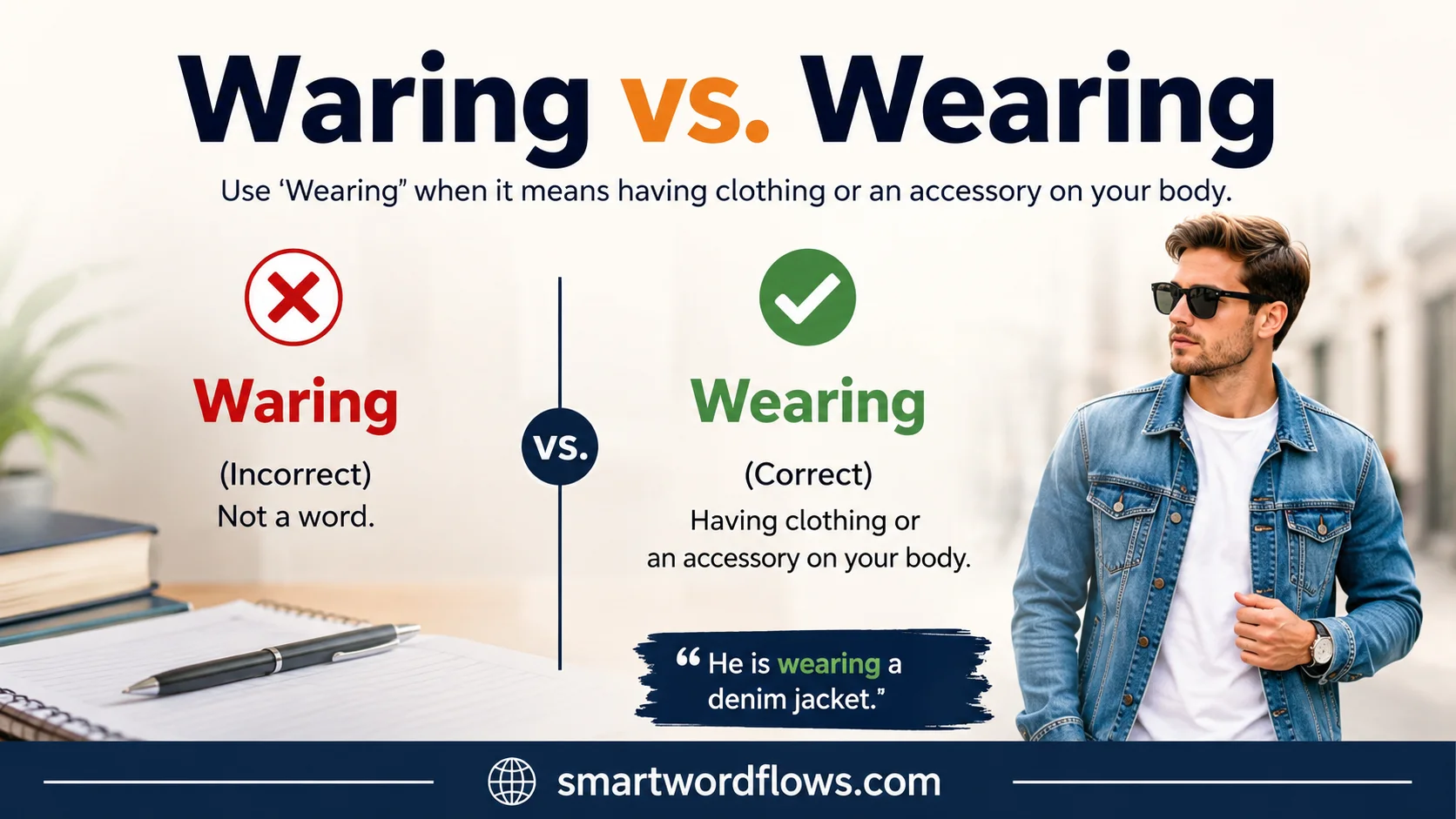

Waring vs. Wearing can confuse English learners because both words have a similar sound, but their meaning and correctness are different. The direct answer is simple: wearing is the standard and widely accepted form for clothes, shoes, and accessories, while waring is usually incorrect. This common mix-up appears in everyday writing, captions, emails, essays, and product descriptions. A small spelling change can cause errors and reduce clarity. When I explain this difference, I advise learners to check the sentence and intended meaning before writing.
When learning a new language online, it also helps to understand commonly confused words such as wear, ware, and where. These homophones have different parts of speech and meanings: wear is a verb, ware is generally a noun, and where is an adverb. English pronunciation can vary, and where may have a slight puff of air at the beginning. A warning is different because its definition is a message or sign about danger or risk. Following British and American rules, using correct usage, and reviewing everyday examples can build confidence, help you hesitate less, and avoid confusion. Professional advice can further prevent common mistakes as you keep moving forward in English writing and English spelling.
Quick Answer
If you are talking about clothes, shoes, jewelry, glasses, uniforms, or anything someone has on their body, the correct word is wearing.
For example:
- She is wearing a blue dress.
- He was wearing sunglasses.
- The children are wearing school uniforms.
Waring is not the standard spelling of wearing in American English, British English, or any other major variety of modern English. It is a rare word connected to an old use of ware, and most readers will never need it in ordinary conversation.
Warring, meanwhile, means fighting or involved in conflict.
- The two warring groups reached an agreement.
Here’s the simplest rule:
If you mean “having something on” or “gradually becoming damaged or tired,” use wearing.
Comparison Overview
The easiest way to understand Waring vs. Wearing is to compare the words side by side.
| Word | Root Word | Main Meaning | Common in Modern English? | Example |
| Waring | Ware | Rare or archaic caution-related use | No | Rarely used in modern writing |
| Wearing | Wear | Having something on or causing gradual change | Yes | She is wearing a coat. |
| Warring | War | Fighting or engaged in conflict | Yes | The warring sides met. |
In modern English, wearing is by far the most common word of the three.
If you write about fashion, clothing, uniforms, jewelry, hairstyles, glasses, shoes, or personal appearance, wearing is the correct choice. You can also use it when something slowly becomes weaker, thinner, damaged, or exhausting.
For example:
- The athlete is wearing a helmet.
- The stress is wearing him down.
- The paint is wearing away.
By contrast, waring is so uncommon that using it in ordinary writing will often look like a typo.
Main Differences Between Waring and Wearing
The main difference between waring and wearing comes down to meaning, spelling, origin, and modern usage.
Wearing is a standard English word that people use every day. Waring exists in limited and rare contexts, but it doesn’t replace wearing.
Waring vs. Wearing: Spelling
The correct spelling for the present participle of wear is:
W-E-A-R-I-N-G
The word waring drops the letter E, which changes the word.
- Correct: She is wearing a jacket.
- Incorrect: She is waring a jacket.
That missing letter may seem small. However, English spelling can be a little like a zipper: remove one piece, and the whole thing stops working properly.
Waring vs. Wearing: Meaning
Wearing has several common meanings. It can describe:
- Having clothes on
- Having accessories on
- Showing an expression
- Having a hairstyle
- Gradual physical damage
- Emotional exhaustion
- Ongoing pressure or irritation
Waring, on the other hand, has a rare connection to the old verb ware, which can mean to beware of or guard against something.
That makes the words very different.
Waring vs. Wearing: Everyday Usage
Modern speakers regularly use wearing.
You might hear:
- What are you wearing tonight?
- She is wearing her new boots.
- The situation is wearing on me.
- The tires are wearing down.
You are highly unlikely to hear waring in normal American conversation.
Waring vs. Wearing: American and British English
There is no American vs. British spelling difference here.
Both varieties use:
wear → wearing
So, these are correct everywhere:
- American English: wearing
- British English: wearing
- Canadian English: wearing
- Australian English: wearing
Waring is not a British alternative spelling for wearing.
What Does “Wearing” Mean?
Wearing is the present participle and gerund form of the verb wear. The word has several meanings, which is one reason English learners often encounter it in many different situations.
Wearing Clothes and Accessories
This is the most familiar meaning.
When someone has clothing or another item on their body, they are wearing it.
Examples:
- She is wearing a red sweater.
- He was wearing a black suit.
- I’m wearing comfortable shoes today.
- They are wearing matching uniforms.
The same rule applies to accessories.
- She is wearing a gold necklace.
- He is wearing a watch.
- The actor was wearing dark sunglasses.
- She wore earrings, but today she isn’t wearing any.
This meaning is simple: if something is physically on a person’s body, wearing usually works.
Wearing an Expression
English also uses wearing in a more descriptive way.
You can wear a smile, wear a serious expression, or even wear a look of surprise.
For example:
- She entered the room wearing a wide smile.
- He was wearing a worried expression.
- The child sat there wearing a look of complete confusion.
Nobody is literally putting a smile on like a hat. Instead, English treats the expression as something visible that a person carries or displays.
It’s a useful example of how language stretches beyond the physical.
Wearing a Hairstyle
You can also use wearing to describe hair.
Examples include:
- She is wearing her hair long.
- He was wearing his hair in a ponytail.
- She’s wearing her hair differently today.
In these sentences, wearing describes how someone presents their appearance.
Wearing Down
The phrase wearing down describes gradual weakening, damage, or exhaustion.
Imagine a rock sitting under flowing water for years. The water doesn’t destroy it in one dramatic moment. Instead, it slowly changes the surface.
That’s the basic idea behind wearing down.
Examples:
- The long hours are wearing her down.
- Constant criticism was wearing him down.
- The brakes are wearing down.
- Years of traffic are wearing down the road.
The phrase can describe both people and physical objects.
Wearing Away
Wearing away means gradually disappearing because of friction, use, weather, or time.
Examples:
- The waves are wearing away the shoreline.
- Years of rain have been wearing away the stone.
- The logo is wearing away from the old shirt.
This phrase creates a picture of slow change. Nothing happens overnight.
Wearing On
When something is wearing on you, it gradually becomes emotionally tiring, stressful, irritating, or difficult.
Examples:
- The uncertainty is wearing on everyone.
- The constant noise is wearing on my nerves.
- The waiting is really wearing on her.
This usage often appears in conversations about stress.
Wearing Thin
Wearing thin means becoming weaker, less convincing, less effective, or increasingly irritating.
Examples:
- My patience is wearing thin.
- His excuse is wearing thin.
- The fabric is wearing thin at the elbows.
The phrase can describe something physical or something abstract. That flexibility makes it especially useful in everyday English.
What Does “Waring” Mean?
The word waring is unusual in modern English.
In ordinary writing, it is usually a misspelling of wearing. However, calling it completely nonexistent would not be accurate.
Waring can appear as a form related to the rare and archaic verb ware, which historically carried meanings connected to being cautious, guarding against something, or being aware.
This usage is not part of normal modern conversation.
You don’t need waring when discussing:
- Clothes
- Shoes
- Jewelry
- Uniforms
- Physical deterioration
- Emotional exhaustion
In all of those situations, you almost certainly need wearing.
When “Waring” Appears as a Proper Name
Waring may also appear as a surname, place name, or company name.
Proper names follow different rules because they preserve specific spellings.
For example, Waring can function as a family name. That doesn’t make it interchangeable with wearing.
Context always decides the meaning.
Why Do People Confuse Waring and Wearing?
The confusion between waring vs. wearing usually comes from a few predictable causes.
Similar Spelling
The two words differ by only one letter.
- Waring
- Wearing
When people type quickly, they may accidentally remove the E.
A single missing letter can create a different word. That’s why proofreading still matters, even with modern spell-check tools.
Similar Sound in Fast Speech
In rapid speech, sounds often blend together.
A listener may hear a word correctly but remain unsure about the spelling. This is especially common for English learners because English pronunciation doesn’t always reveal every letter clearly.
For example, the spoken form of wearing may not make the spelling pattern obvious to someone learning the language.
Autocorrect Isn’t Perfect
Spell-check tools can catch many mistakes. They don’t catch everything.
If a word resembles a surname or rare dictionary entry, software may allow it to remain unchanged.
That’s why grammar tools should help your writing rather than replace your judgment.
How to Use “Wearing” Correctly
The best way to master wearing is to look at common sentence patterns.
Wearing + Clothing
Use wearing before clothing items.
- She is wearing a blue dress.
- He was wearing a gray jacket.
- I’m wearing jeans today.
- They were wearing winter coats.
This is the most common pattern.
Wearing + Accessories
Use wearing with items people put on their bodies.
- She is wearing a diamond ring.
- He is wearing glasses.
- The singer was wearing a silver necklace.
- She isn’t wearing her watch today.
Wearing + Protective Equipment
Safety equipment also follows the same pattern.
- The workers are wearing helmets.
- Everyone should be wearing a seat belt.
- The medical staff were wearing protective gloves.
- Cyclists are wearing reflective gear.
Wearing + Appearance
Use wearing to describe visible expressions or styles.
- She was wearing a confident smile.
- He entered wearing a serious expression.
- The child was wearing a puzzled look.
These phrases often make writing more vivid.
Instead of writing, “She smiled confidently,” you might write, “She walked in wearing a confident smile.”
Both are correct. The second version paints a slightly different picture.
Wearing + Phrasal Expressions
Some of the most useful forms include:
- wearing down
- wearing away
- wearing on
- wearing thin
- wearing out
Here is a quick guide.
| Expression | Meaning | Example |
| Wearing down | Gradually weakening | The stress is wearing him down. |
| Wearing away | Gradually disappearing | Water is wearing away the rock. |
| Wearing on | Becoming emotionally tiring | The delay is wearing on her. |
| Wearing thin | Losing patience or effectiveness | My patience is wearing thin. |
| Wearing out | Becoming unusable through use | My shoes are wearing out. |
Grammar Rules for Wear, Wears, Wore, Worn, and Wearing
One major reason people make mistakes with wearing is that wear is an irregular verb.
Its forms change.
| Verb Form | Word | Example |
| Base form | Wear | I wear glasses. |
| Third-person singular | Wears | She wears glasses. |
| Past tense | Wore | She wore glasses yesterday. |
| Past participle | Worn | She has worn glasses for years. |
| Present participle | Wearing | She is wearing glasses. |
Here’s an important rule:
Wearing is not the past tense of wear.
The correct past tense is:
- Yesterday, I wore a blue shirt.
The correct past participle is:
- I have worn this jacket many times.
The present participle is:
- I am wearing this jacket now.
Once you learn this pattern, the word becomes much easier to use correctly.
Waring vs. Warring vs. Wearing
This comparison is important because all three words can appear in spelling questions.
Waring
Waring is rare and not the word you use for clothing.
Warring
Warring comes from war.
It means fighting or involved in a conflict.
Examples:
- The two warring nations began peace talks.
- The warring groups refused to cooperate.
- Years of conflict divided the warring sides.
Wearing
Wearing comes from wear.
Examples:
- She is wearing a hat.
- The stress is wearing him down.
- The shoes are wearing out.
The difference is easy to remember:
War = fighting, so warring means fighting. Wear = clothing or gradual use, so wearing refers to wearing or wearing down.
Common Mistakes to Avoid
Mistake: Dropping the Letter “E”
Incorrect:
- She is waring a new coat.
Correct:
- She is wearing a new coat.
Mistake: Using “Waring” for Conflict
Incorrect:
- The two waring groups reached an agreement.
Correct:
- The two warring groups reached an agreement.
The extra R matters because the word comes from war.
Mistake: Using “Waring” for Physical Damage
Incorrect:
- The carpet is waring out.
Correct:
- The carpet is wearing out.
Mistake: Thinking “Waring” Is British English
This is incorrect.
Both American and British English use wearing.
Mistake: Trusting Spell-Check Without Reading the Sentence
A spell-checker may not always understand what you intended.
For example, a name can look like a valid word.
Always ask:
Does this word match the meaning of my sentence?
That simple question catches many errors.
Waring vs. Wearing: Real-World Case Studies
Understanding grammar becomes easier when you see how word choice changes real situations.
Case Study: A Clothing Store Product Description
Imagine an online store describing a model.
Incorrect:
The model is waring a black leather jacket.
A customer may still understand the sentence. However, the spelling mistake reduces professionalism.
Correct:
The model is wearing a black leather jacket.
For fashion descriptions, catalogs, product pages, and clothing reviews, wearing is the correct choice.
Case Study: A Workplace Safety Notice
Consider this sentence:
All employees must be waring protective helmets.
This mistake is more noticeable because safety instructions need clear language.
The correct sentence is:
All employees must be wearing protective helmets.
Clear writing helps readers understand instructions quickly.
Case Study: A News Report About Conflict
Now consider:
The waring groups agreed to a temporary ceasefire.
Here, wearing would also be wrong.
The correct word is:
The warring groups agreed to a temporary ceasefire.
This example shows why context matters. Similar spellings can point in completely different directions.
Easy Memory Trick for Waring vs. Wearing
A simple spelling trick can save you from making this mistake.
Remember the Root Word
Wear + ing = wearing
If you start with wear, you keep the full root:
wear → wearing
Think about getting dressed.
You wear clothes.
So you are wearing clothes.
Use the “Having On” Test
Ask yourself:
Can I replace this word with “having on”?
If the answer is yes, use wearing.
For example:
- She is having on a coat. → She is wearing a coat.
- He is having on glasses. → He is wearing glasses.
The replacement sounds awkward in normal conversation, but it works as a quick mental test.
Another Easy Reminder
Clothes need the E.
It’s not a formal grammar rule. Still, the phrase can help you remember that wearing contains the full wear spelling.
Quick Test: Waring, Warring, or Wearing?
Try these sentences before checking the answers.
Choose the Correct Word
- She is ______ a red jacket.
- The constant pressure is ______ on him.
- The two ______ groups refused to compromise.
- Years of use are ______ down the fabric.
- Everyone was ______ formal clothes at the event.
- The old tires are ______ out.
- The ______ sides finally entered negotiations.
- She walked into the room ______ a bright smile.
- The waves are ______ away the coastline.
- The workers were ______ protective helmets.
Answers
- Wearing
- Wearing
- Warring
- Wearing
- Wearing
- Wearing
- Warring
- Wearing
- Wearing
- Wearing
If you chose wearing for clothing, appearance, damage, and gradual exhaustion, you’re on the right track.
When Should You Use “Wearing”?
Use this quick decision guide.
Are You Talking About Clothes or Accessories?
Use wearing.
Examples:
- Wearing a shirt
- Wearing shoes
- Wearing glasses
- Wearing jewelry
Are You Talking About Gradual Damage?
Use wearing.
Examples:
- Wearing down
- Wearing away
- Wearing out
Are You Talking About Stress or Emotional Exhaustion?
Use wearing.
Examples:
- Wearing on someone
- Wearing someone down
- Patience wearing thin
Are You Talking About Fighting?
Use warring.
Examples:
- Warring nations
- Warring factions
- Warring groups
Are You Referring to a Rare Historical Form?
Only then might waring be relevant.
For almost all everyday writing, wearing is the safer and correct choice when discussing clothing or gradual change.
Waring vs. Wearing in Modern English
Modern English favors clarity.
That’s why wearing remains the standard word in everyday communication. People use it in:
- Conversations
- Books
- News reports
- Product descriptions
- Fashion articles
- Workplace rules
- School writing
- Social media
- Professional emails
Waring has little practical use for the average writer outside unusual historical, lexical, or proper-name contexts.
This doesn’t mean rare words are automatically wrong. It simply means writers should choose words that match the intended meaning and modern context.
A dictionary can tell you that a word exists. Context tells you whether you should use it.
Final Comparison: Waring vs. Wearing
Here’s the complete comparison.
| Intended Meaning | Correct Word | Example |
| Having clothes on | Wearing | She is wearing a dress. |
| Having jewelry on | Wearing | He is wearing a ring. |
| Having glasses on | Wearing | She is wearing glasses. |
| Showing an expression | Wearing | He was wearing a smile. |
| Gradual exhaustion | Wearing | The pressure is wearing her down. |
| Gradual physical damage | Wearing | The paint is wearing away. |
| Fighting or conflict | Warring | The warring sides met. |
| Rare archaic context | Waring | Rare and highly context-specific. |
FAQs:
1. Is “waring” or “wearing” correct?
Wearing is the correct word when talking about having clothes, shoes, or accessories on your body. Waring is generally incorrect in this context.
2. What does “wearing” mean?
Wearing means having something such as clothing, shoes, jewelry, or accessories on your body.
3. Is “waring” a real English word?
Waring is not normally used as the spelling for the action of having clothes on. In standard English, use wearing.
4. What is the difference between “wear,” “ware,” and “where”?
Wear relates to putting on or having something on your body. Ware usually refers to manufactured goods or products. Where refers to a place or location.
5. How can I remember “wearing”?
Think of wear as something you do with clothes. Adding -ing gives you wearing, such as “She is wearing a blue shirt.”
Conclusion:
The difference between waring vs. wearing is mainly a matter of correct spelling and meaning. Wearing is the standard word for clothes, shoes, and accessories, while waring is generally incorrect in this context. Remembering this simple rule can help you write with greater clarity, confidence, and accuracy.