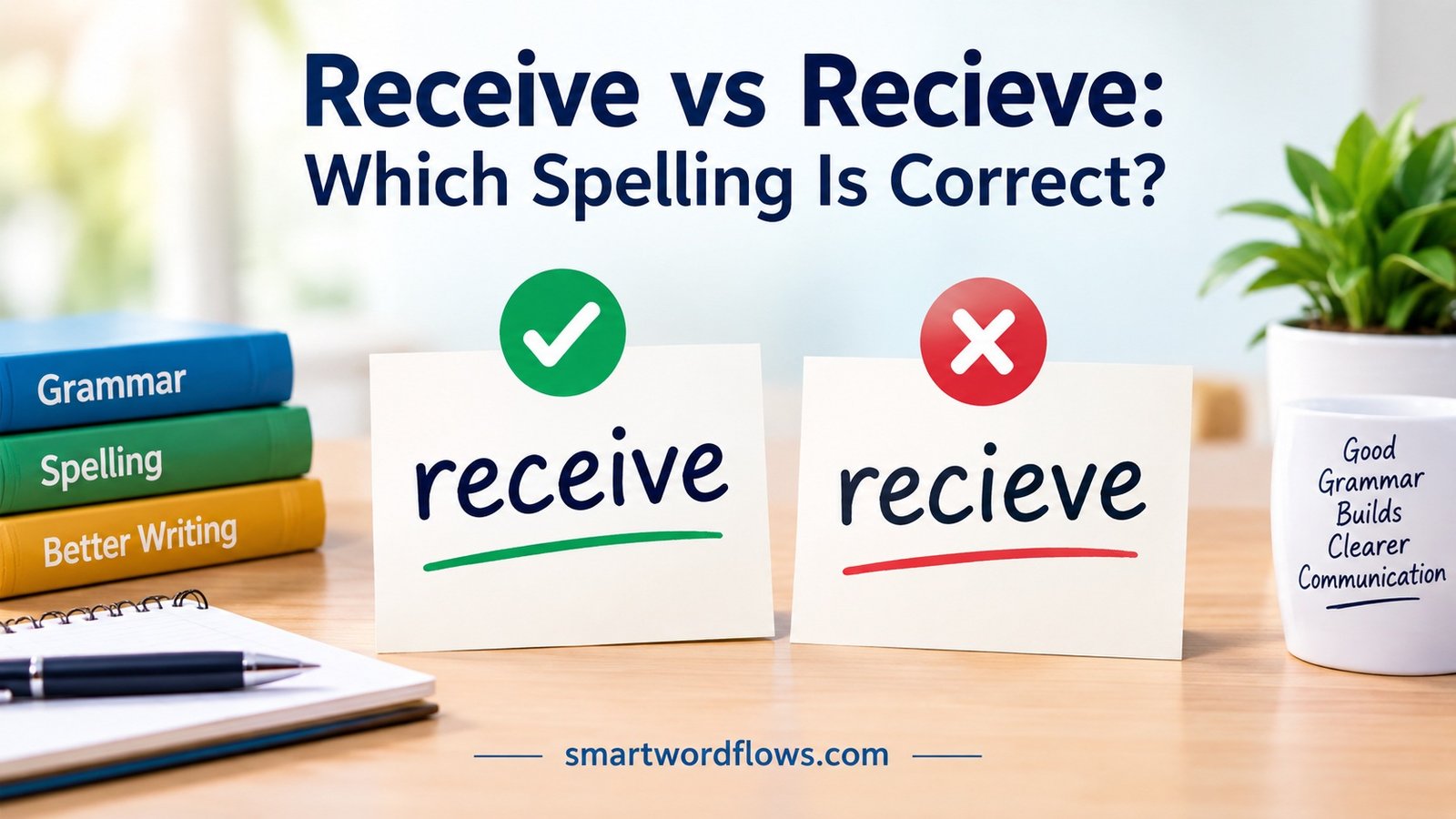

Receive is the correct spelling, while Recieve is a common misspelling that often causes English spelling mistakes for English learners and native speakers. Learn why Receive vs Recieve: Which Spelling Is Correct? and use the right spelling with simple rules, examples, and practical writing tips. The letter order can seem tricky because the brain may follow the familiar pattern of i before e, but receive follows the e before i after c rule. This is an important point for understanding grammar, improving spelling accuracy, and maintaining good writing quality. I’ve seen this spelling confusion appear in emails, essays, social media posts, and everyday conversations, where knowing the correct usage and using practical examples can make the difference much easier to remember.
The mistake happens because Recieve looks believable, especially when your fingers type quickly and you don’t stop to check the error. It may seem funny, but this confusion, doubt, and pattern of common errors can affect confident writers too. The good news is that the problem is easy to fix when you learn the spelling rule instead of thinking the spelling is random or treating it as a trick question. In real-life examples, receive is the correct form in a sentence, whether you’re using it in formal writing, professional messages, or real writing. The clear English pattern helps you spell correctly, avoid the wrong spelling, build confidence, and stop overthinking each word.
For English learners, writers, and other people, simple memory tricks and easy tips can make the spelling easier to remember. Compare the two versions, notice the pronunciation, and connect receive with the letter c. This guide gives you a practical way to forget the common spelling mistakes and use receive with greater accuracy and quality. In everyday English, usage becomes more natural when you connect the word with its spelling instead of relying only on sound. The same approach works for examples, messages, and online writing, where careless spelling can appear unprofessional. Thousands of learners and speakers encounter these spelling problems, but the correct usage becomes straightforward once the pattern is familiar.
Quick Answer: Receive or Recieve?
Receive is the correct spelling.
Recieve is incorrect in standard English and should not be used in formal, academic, business, or everyday writing.
Here’s the difference at a glance:
- Correct: I hope you receive my message.
- Incorrect: I hope you recieve my message.
The same pattern applies to related forms:
- receive — correct
- received — correct
- receiving — correct
- receiver — correct
- recieve — incorrect
- recieved — incorrect
- recieving — incorrect
- reciever — incorrect
A useful memory trick is simple: after the letter c, write ei in receive.
Comparison Overview
| Word | Correct Spelling? | Meaning | Standard Usage |
| Receive | Yes | To get, accept, experience, or be given something | Standard English |
| Recieve | No | No standard meaning as the spelling of “receive” | Common misspelling |
| Received | Yes | Past tense and past participle of receive | Standard English |
| Receiving | Yes | Present participle of receive | Standard English |
| Receiver | Yes | A person or thing that receives something | Standard English |
| Recieved | No | Incorrect spelling of received | Misspelling |
| Recieving | No | Incorrect spelling of receiving | Misspelling |
| Reciever | No | Incorrect spelling of receiver | Misspelling |
The central point is straightforward: receive is the word you want when you mean “get,” “accept,” or “be given.”
For example:
We received your application yesterday.
Here, received is the past tense of receive.
On the other hand:
We recieved your application yesterday.
The meaning is understandable, but the spelling is incorrect.
Main Differences Between Receive vs Recieve
The biggest difference between receive vs recieve is that receive is the correct standard spelling while recieve is a spelling error.
There isn’t a meaningful difference in pronunciation or definition because recieve isn’t a standard alternative spelling. You shouldn’t treat the two forms as American and British variants, either. This isn’t like color/colour or center/centre.
Receive Is the Correct Spelling
Receive follows the spelling pattern used in the standard English word.
Examples include:
- I receive several emails every morning.
- Did you receive the package?
- Students receive feedback from their teachers.
- You’ll receive a confirmation email shortly.
- They receive payment at the end of each month.
Recieve Is a Common Misspelling
Recieve results from switching the positions of i and e.
The incorrect form:
recieve
The correct form:
receive
That tiny letter reversal creates a spelling error even though most readers will understand what the writer means.
This makes recieve a classic example of a spelling mistake that looks plausible. It has the right letters. They’re simply in the wrong order.
What Does Receive Mean?
The verb receive has several related meanings. Its basic idea involves getting, accepting, or experiencing something that comes to you.
Receive Means to Get Something
The most common meaning is to get something that someone gives, sends, or provides.
For example:
- I received a letter this morning.
- She received a gift from her friend.
- We received the documents by email.
- The customer received the package on Monday.
In each sentence, something moves from another source to the person who gets it.
Receive Means to Accept Something
Receive can also describe accepting something that someone offers or gives.
For example:
- The organization received the donation.
- The school received several applications.
- The charity received financial support from local businesses.
The emphasis here isn’t simply on possession. It focuses on the act of taking something that has been offered or sent.
Receive Means to Experience Something
The word can also describe experiencing an action, treatment, or result.
Consider these examples:
- The patient received treatment.
- The employee received training.
- The company received criticism.
- The proposal received strong support.
In these sentences, you aren’t necessarily receiving a physical object. Instead, you’re experiencing or being given something less tangible.
Receive Means to Welcome Someone
In some contexts, receive means to welcome or admit a person.
For example:
The host received the guests at the entrance.
This usage sounds somewhat formal compared with everyday phrases such as “welcomed the guests.”
Examples of Receive in Sentences
Context makes the meaning of receive much easier to understand.
Everyday Examples
- Did you receive my text?
- I didn’t receive the package.
- She received a birthday card.
- We received your invitation.
- He receives mail at his office.
Academic Examples
- Students receive grades after completing the exam.
- The researcher received valuable feedback.
- Applicants receive an email after submitting the form.
- The university received thousands of applications.
Business Examples
- We received your payment.
- The company received the signed contract.
- Customers receive an order confirmation by email.
- The finance department received the invoice this morning.
Digital Communication Examples
- Did you receive the attachment?
- You’ll receive a verification code shortly.
- I haven’t received your email yet.
- Users receive notifications when an account changes.
These examples show why receive is such a useful word. It works naturally in casual conversation as well as formal writing.
Why Is Recieve Incorrect?
The spelling recieve is incorrect because standard English spells the word receive.
The confusion usually comes from the sequence of vowels. English contains many words with ie and ei, so writers can easily hesitate when spelling a word from memory.
Compare these:
- believe → ie
- field → ie
- friend → ie
- receive → ei
- ceiling → ei
- deceive → ei
The difficulty becomes obvious. English doesn’t offer one universal spelling pattern that works perfectly for every word.
That’s why it helps to remember receive as part of the -ceive family rather than trying to guess the vowel order each time.
Why Do People Spell Receive as Recieve?
Several factors can cause this mistake.
The “I Before E” Rule
Many English learners encounter this spelling rule:
“I before e, except after c.”
The rule encourages the ie sequence in many words. But after c, the pattern changes:
- receive
- deceive
- conceive
- perceive
So receive belongs to a recognizable group of words containing -ceive.
However, the rhyme or rule isn’t perfect across the English language. English spelling contains numerous exceptions and historical patterns. Treat the rule as a useful memory aid rather than an absolute law.
The Letters Sound Similar
When you hear receive, the vowel sequence isn’t pronounced as two clearly separated letter sounds.
That means you can’t always rely on pronunciation to determine whether the written form should contain ie or ei.
Spelling memory matters here.
Familiar Words Influence the Spelling
Words such as believe, piece, and field contain ie. When someone has learned those words first, they may instinctively write recieve.
The mistake is understandable. Still, the standard spelling is receive.
Read More:Rumor vs Rumour: What’s the Difference and Which Spelling Is Correct?
How to Remember the Correct Spelling of Receive
The easiest solution is to stop treating the entire word as a mystery.
Remember “C + EI”
Focus on the middle:
c + ei
That gives you:
re + c + ei + ve = receive
A quick memory line is:
After C, use EI in receive.
You can also connect receive with other -ceive words:
- deceive
- conceive
- perceive
- receive
Seeing the same pattern repeatedly makes the spelling easier to remember.
Think of the “CEIVE” Ending
Instead of trying to remember every individual letter, memorize the ending:
-ceive
Then build the word:
re + ceive = receive
This method is often more reliable than trying to remember whether the middle contains ie or ei every time you write it.
Create a Visual Association
Imagine a simple phrase:
C receives EI.
The phrase itself reminds you that ei follows c.
It may sound slightly playful, but memorable associations often work better than repeatedly staring at a misspelled word.
Receive: Different Forms of the Word
The word changes form depending on tense, number, and grammatical function.
| Word Form | Part of Speech | Example |
| Receive | Verb | I receive several messages each day. |
| Receives | Verb | She receives the report every Friday. |
| Received | Past tense/past participle | We received your application. |
| Receiving | Present participle/gerund | They are receiving new orders. |
| Receiver | Noun | The receiver accepted the signal. |
Notice something important: the ei pattern remains visible in these forms.
Receive
Use receive with the base form of the verb.
Customers receive an email after placing an order.
Receives
Use receives with a third-person singular subject in the present tense.
The office receives hundreds of calls each day.
Received
Use received for the past tense and past participle.
We received your letter yesterday.
Receiving
Use receiving when forming the present participle or gerund.
She is receiving medical treatment.
Receiver
A receiver is someone or something that receives.
The radio receiver picked up the signal.
Receive vs Recieve in Common Writing Situations
Because receive appears in many forms of communication, spelling it correctly has practical value.
Emails and Messages
Email writing often uses receive when discussing messages, attachments, or replies.
For example:
Please let us know if you receive this email.
A misspelled version such as “if you recieve this email” can make otherwise clear communication look careless.
School and Academic Writing
Students frequently use receive when discussing grades, feedback, applications, awards, or information.
For example:
Students receive their final grades at the end of the semester.
Academic writing places greater emphasis on spelling accuracy, so recieve should always be corrected.
Business and Professional Writing
Professional communication uses receive constantly.
Common expressions include:
- receive payment
- receive an invoice
- receive an application
- receive confirmation
- receive approval
- receive a request
- receive a response
- receive an order
A simple sentence such as “We received your request” sounds natural and professional.
Online Forms and Applications
Websites frequently use the word in confirmation messages.
For example:
We have received your application.
Or:
You will receive a confirmation email within a few minutes.
Because these messages appear in customer-facing interfaces, correct spelling matters.
Common Mistakes With Receive
Knowing the related mistakes can help you avoid them.
Recieve
Incorrect: I hope you recieve my message.
Correct: I hope you receive my message.
The ie sequence has been reversed.
Recieved
Incorrect: We recieved your application.
Correct: We received your application.
The past-tense form keeps the ei sequence.
Recieving
Incorrect: We are recieving new applications.
Correct: We are receiving new applications.
When -ing is added, the spelling becomes receiving.
Reciever
Incorrect: The reciever accepted the signal.
Correct: The receiver accepted the signal.
The noun still uses the ei pattern.
Receive vs Recieve Examples
A side-by-side comparison makes the distinction easy to spot.
| Incorrect | Correct |
| I will recieve the package tomorrow. | I will receive the package tomorrow. |
| She recieved your message. | She received your message. |
| We are recieving applications. | We are receiving applications. |
| The reciever answered the call. | The receiver answered the call. |
| Did you recieve my email? | Did you receive my email? |
| They recieved an award. | They received an award. |
A Simple Editing Test
When proofreading your writing, search for:
reciev
If you find it, check the word carefully. In standard English, you probably need to change it to receiv.
This works particularly well when proofreading long documents because the incorrect spelling can be easy to overlook during normal reading.
Receive in Different Contexts
The meaning of receive changes slightly depending on what follows it.
Receive a Package
I received my package this morning.
Here, receive means to get something that was delivered.
Receive an Email
Did you receive my email?
In this context, it means that the email reached you and became available to you.
Receive Payment
The contractor received payment after completing the work.
Here, receive means to get money that someone has paid.
Receive an Award
She received an award for her research.
The word describes being given recognition or an award.
Receive Information
Employees receive updated instructions each month.
The information comes from another source and reaches the employees.
Receive Visitors or Guests
The ambassador received the visitors at the official residence.
Here, receive has the sense of welcoming or meeting guests in a formal setting.
Receive vs Accept: Are They the Same?
Receive and accept can overlap, but they don’t always mean the same thing.
Receive generally focuses on getting something.
Accept often emphasizes agreeing to take something or approving something.
Compare:
I received the invitation.
This tells you that the invitation reached you.
I accepted the invitation.
This tells you that you agreed to attend.
You can receive something without accepting it.
For example, you might receive a job offer and decide not to accept it.
That distinction becomes especially useful in professional and formal writing.
Receive vs Get: Are They the Same?
In many everyday sentences, receive and get can express similar ideas.
Compare:
I received your email.
I got your email.
Both sentences can mean that the email reached you. However, receive often sounds more formal and precise.
That’s why business writing commonly uses phrases such as:
- We received your request.
- You will receive confirmation.
- The applicant received an offer.
Meanwhile, casual conversation often favors get:
Did you get my message?
Neither word is inherently better. The best choice depends on context, audience, and tone.
Pronunciation of Receive
In standard US English, receive has two syllables and stress falls on the second syllable.
The word sounds different from how a beginner might expect if they try to pronounce each written letter separately.
The pronunciation doesn’t change the spelling. Even when you know how the word sounds, you still need to remember that its written form is receive, not recieve.
For spelling practice, say the word while writing the middle sequence:
re-ceive
Then connect it with the related forms:
- receive
- receives
- received
- receiving
- receiver
Learning the word as a family can make the spelling much easier to retain.
Etymology of Receive
The history of receive helps explain why its spelling looks the way it does.
The English word developed through Anglo-French and Old French forms and ultimately traces back to the Latin verb recipere, meaning “to take back,” “take in,” or “receive.”
English spelling often preserves traces of older forms even when pronunciation changes over centuries. That’s one reason modern English spelling can seem less predictable than it first appears.
The spelling pattern in receive therefore isn’t an arbitrary modern invention. It reflects the word’s long history and its development through earlier forms of English and French.
Understanding etymology won’t automatically make every spelling mistake disappear. However, it shows why English contains spelling patterns that don’t always match simple pronunciation rules.
A Practical Case Study: Editing a Professional Email
Imagine an employee writes:
“We recieved your request and will send the documents once we recieve approval.”
The meaning is perfectly clear. Yet the same spelling error appears twice.
A corrected version reads:
“We received your request and will send the documents once we receive approval.”
The correction is small, but it makes the message cleaner and more professional.
Now look at another example:
“Thank you for your email. We have received the information and will review it shortly.”
This version uses the correct form naturally without drawing attention to the spelling itself.
The lesson is simple: accurate spelling removes distractions from otherwise good writing.
Why Correct Spelling Matters
A single spelling mistake rarely makes a sentence impossible to understand. However, repeated errors can affect how readers perceive a piece of writing.
Correct spelling helps with:
- Professional credibility
- Academic accuracy
- Clear communication
- Reader confidence
- Search visibility and content quality
- Polished business correspondence
Consider two sentences:
We have received your application.
We have recieved your application.
The first looks finished and professional. The second contains an obvious spelling error.
For an informal text message, the mistake may not matter much. In a job application, customer email, academic paper, or business document, accuracy matters more.
Receive vs Recieve: Quick Grammar and Spelling Check
Before submitting your writing, use this quick checklist:
- Is the word spelled receive?
- Does ei appear after c?
- Is the past tense received, not recieved?
- Is the -ing form receiving, not recieving?
- Is the noun receiver, not reciever?
- Does the word fit the intended meaning?
- Are you using receive rather than a less precise word when the context requires it?
A quick proofreading pass can catch the error before anyone else sees it.
Frequently Asked Questions
Is Receive or Recieve Correct?
Receive is correct. Recieve is a common misspelling and isn’t the standard spelling of the word.
Is Recieve a Word?
Recieve isn’t the standard spelling of the English verb receive. In ordinary modern English writing, use receive.
Why Is Receive Spelled With EI?
The word contains the -ceive spelling pattern. The letters ei follow c, which is why the correct spelling is receive rather than recieve.
What Is the Trick for Spelling Receive?
Remember:
C + EI = CEI
You can also memorize the ending -ceive and connect it with words such as deceive, conceive, and perceive.
Is It Received or Recieved?
The correct spelling is received.
For example:
We received your payment yesterday.
Recieved is incorrect.
Final Takeaway
When choosing between receive vs recieve, the answer is clear: receive is the correct spelling. Recieve is a common spelling mistake caused mainly by confusion over the position of i and e. The correct word appears in countless situations, from receiving emails and packages to receiving payments, information, feedback, awards, and applications.
The easiest way to remember the spelling is to focus on -ceive. Think of receive, deceive, conceive, and perceive as members of the same spelling family. When writing the word, keep ei after c. Once that pattern becomes familiar, forms such as received, receiving, and receiver become much easier to spell correctly.




1 thought on “Receive vs Recieve: Which Spelling Is Correct?”