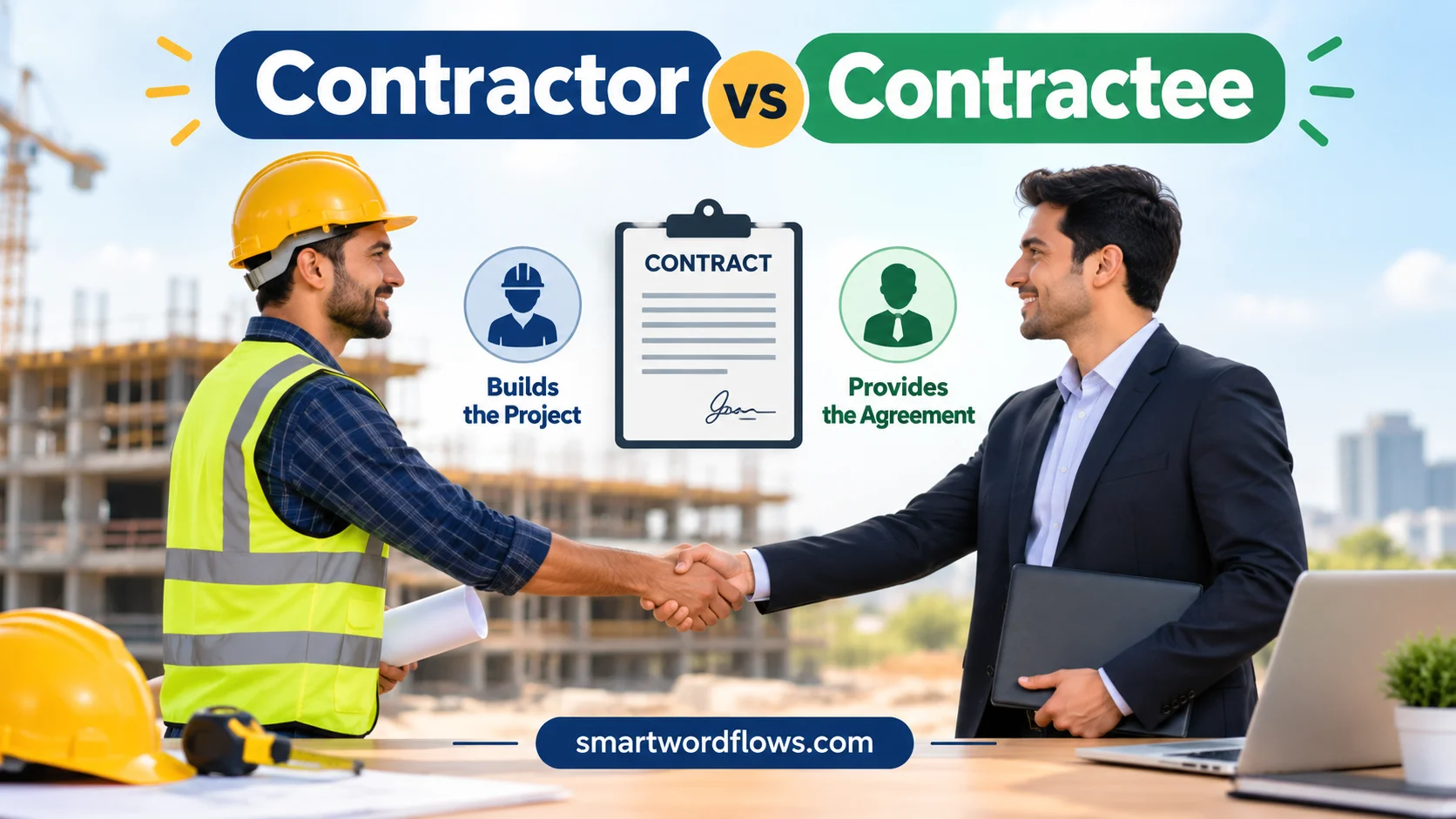

When dealing with contracts, understanding Contractor vs Contractee is important because both terms describe different sides of a legal agreement. A contractor is a person, business, or organization hired to perform specific work, provide services, or complete a project according to agreed terms. The contractee, meanwhile, is the party that hires the contractor and receives the promised services or finished work. Knowing these roles can prevent confusion in business and professional situations.
These terms commonly appear in construction projects, freelance work, service agreements, and other business transactions. The contractor usually handles the assigned work and follows the contract’s requirements, while the contractee provides instructions, agrees to payment, and accepts the completed work. Understanding their responsibilities, definitions, and relationship helps you read legal documents correctly and use both terms confidently in everyday and professional English.
Quick Answer
The simplest way to understand contractor vs contractee is to look at who performs the contracted work and who engages that party.
- A contractor is the person or business that agrees to perform work or provide services under a contract.
- A contractee is generally the person or organization that contracts with the contractor to receive the work, services, goods, or agreed result.
- The contractor usually performs the contractual work.
- The contractee usually receives the performance and provides payment or other consideration, depending on the agreement.
- A contractor can be an individual, company, or other legal entity.
- A contractee can also be an individual, company, government body, nonprofit, or another organization.
- Contractee is a legitimate word, but it’s relatively uncommon outside contractual or specialized contexts.
A useful memory trick is simple:
Contractor = the party carrying out the contracted work.
Contractee = the party contracting with the contractor.
That shortcut works well for ordinary service arrangements. Still, don’t treat it as a substitute for reading the actual contract.
Comparison Overview
The difference between contractor and contractee becomes easier to see when you compare their usual positions side by side.
| Feature | Contractor | Contractee |
| Basic role | Performs contracted work or services | Engages the contractor |
| Typical position | Service provider | Client, owner, customer, or hiring party |
| Main function | Delivers agreed work or results | Receives or benefits from the contracted performance |
| Payment | Usually receives payment | Usually makes payment |
| Deliverables | Creates, supplies, or completes them | Reviews, accepts, or receives them |
| Contractual duties | Defined by the agreement | Defined by the agreement |
| Common examples | Builder, consultant, developer, freelancer | Homeowner, company, client, organization |
| Employment status | May be an independent contractor | Usually the customer or contracting organization |
| Legal terminology | Common and widely understood | Correct but less commonly used |
| Relationship with subcontractors | May hire subcontractors | May have a separate relationship with the main contractor |
The table shows the general pattern, not an absolute legal rule. Contract terminology can vary substantially between industries and jurisdictions.
For example, a government agreement might define one party as the “contractor” and another as the “contracting agency.” A construction agreement might use owner and contractor instead. A consulting agreement may use client and consultant.
That’s why the labels matter less than the actual obligations.
Main Differences Between Contractor vs Contractee
The central difference between contractor vs contractee comes down to their roles in the contractual relationship.
The contractor typically undertakes an obligation to perform. The contractee typically engages that contractor and receives the agreed performance. Each side can have multiple responsibilities beyond those basic roles.
Contractor Performs the Agreed Work
A contractor generally accepts responsibility for completing specified work or providing specified services.
For example, a construction contractor might agree to build a warehouse according to architectural plans. A freelance designer might agree to create a company’s brand identity. A software contractor might develop a mobile application according to documented requirements.
The exact obligation depends on the agreement.
A contractor might promise a specific result, a defined set of services, or ongoing performance over a particular period. Some contracts also establish milestones, quality standards, deadlines, reporting requirements, warranties, and remedies for breach.
The contractor therefore isn’t simply “someone who works.” The important point is that the person or business has undertaken contractual obligations.
Contractee Engages the Contractor
A contractee generally represents the other side of that service arrangement.
Suppose a restaurant hires a construction company to renovate its kitchen. The construction company performs the renovation, while the restaurant engages the company under the agreement.
In ordinary language, the restaurant would probably be called the client or owner, rather than the contractee.
The word contractee becomes useful when the writer needs a neutral label for the party receiving the contractor’s performance.
Payment Usually Moves From Contractee to Contractor
Money often makes the distinction especially easy to understand.
A contractor normally expects compensation for fulfilling the agreement. The contractee normally has a corresponding obligation to pay according to the agreed terms.
That payment might take several forms:
- A fixed project price.
- An hourly rate.
- A daily or weekly rate.
- Milestone payments.
- A cost-plus arrangement.
- A recurring service fee.
- A combination of fixed and variable charges.
However, payment isn’t the only contractual obligation. The contractor may need to supply materials, maintain insurance, meet deadlines, or correct defective work. The contractee may need to provide access, information, approvals, equipment, or other resources.
A contract creates obligations on both sides.
The Contractee Doesn’t Automatically Control How Work Gets Done
One important distinction appears when the contractor is an independent contractor.
In the United States, the IRS looks at the actual relationship between the parties when determining whether someone qualifies as an independent contractor. Relevant factors include behavioral control, financial control, and the overall relationship between the parties.
An independent contractor generally operates with greater control over the means and methods used to accomplish the agreed result.
For example, a company might hire an independent web developer to create a website by a particular deadline. The company can specify what the finished website should accomplish without necessarily dictating every line of code the developer writes.
That distinction matters.
A contractee can define requirements without automatically becoming the contractor’s day-to-day supervisor.
What Does “Contractor” Mean?
A contractor is a person or business that agrees to perform work under contractual terms.
Cornell Law School’s Legal Information Institute describes a contractor as a business or entity that agrees to perform work under a contract. It also notes that contractors generally differ from employees because contractors typically have greater responsibility for determining how the work gets performed.
The term appears across many industries.
Common Types of Contractors
You might encounter contractors in:
- Construction: builders, general contractors, electricians, plumbers, and other specialists.
- Technology: software developers, cybersecurity consultants, system administrators, and technical specialists.
- Marketing: copywriters, designers, SEO specialists, and marketing consultants.
- Professional services: accountants, consultants, engineers, and specialized advisors.
- Maintenance: landscaping, cleaning, HVAC, equipment maintenance, and facility services.
- Creative work: photographers, videographers, illustrators, editors, and freelance writers.
The word doesn’t require the contractor to work with physical materials.
A software developer can be a contractor even though the work produces digital results rather than a physical structure.
Contractor Responsibilities
A contractor’s responsibilities depend on the agreement. Common obligations can include:
- Completing specified work.
- Meeting agreed deadlines.
- Following technical specifications.
- Providing reports or progress updates.
- Supplying required materials or equipment.
- Maintaining required licenses or insurance.
- Correcting work that fails contractual standards.
- Protecting confidential information.
- Following applicable laws and safety requirements.
- Delivering the agreed final product or service.
Not every contractor has every responsibility listed above. The contract controls the details.
Contractor in a Contract
Contracts often define the contractor at the beginning.
For example, an agreement might state that “ABC Construction LLC” will be referred to as the Contractor throughout the document. From that point onward, the capitalized term has the meaning assigned by that agreement.
This approach helps avoid repeatedly writing the company’s full legal name.
The same principle applies to the other party. A contract might call that party the Owner, Client, Customer, Principal, or Contractee.
Defined terms matter because contractual documents can assign specialized meanings to ordinary words.
What Does “Contractee” Mean?
A contractee generally refers to a party that enters into a contract with a contractor.
In construction usage, the term can refer to the party on the other side of the construction contract, frequently the owner. In broader usage, it can refer to a party receiving the contractor’s services or performance.
The word follows a familiar English word-building pattern:
- Contract + or → the party that undertakes the contract.
- Contract + ee → the party on the receiving side of the contractual undertaking.
That pattern can help explain the terminology. However, English doesn’t always use -or and -ee words as perfect opposites.
Contractee Responsibilities
The contractee can have significant obligations.
Depending on the agreement, those obligations may include:
- Paying the contractor.
- Providing access to a property.
- Supplying necessary information.
- Reviewing submitted work.
- Approving milestones.
- Providing specifications.
- Making timely decisions.
- Supplying owner-furnished materials.
- Cooperating with the contractor.
- Following notice and dispute procedures.
Consider a homeowner hiring a builder.
The builder can’t reasonably complete certain work if the homeowner refuses property access. Likewise, the homeowner can’t reasonably expect the project to continue if required payments never arrive.
Both parties contribute to successful contract performance.
Contractee Is Not Always the Best Word
Here’s an important usage point: contractee is correct, but it isn’t always the clearest choice.
If a company hires a marketing agency, client usually sounds more natural than contractee. If a property owner hires a builder, owner may be clearer. If a business purchases services, customer might fit better.
Use contractee when you need a broad contractual label or when the agreement itself uses that terminology.
Otherwise, a more specific noun can make the writing easier to understand.
Contractor vs Contractee in a Contract
A contract usually establishes a relationship of reciprocal obligations.
Think of it as two sides of a bridge.
The contractor walks toward the promised deliverable. The contractee supplies whatever the agreement requires from its side and receives the promised performance.
A simplified relationship looks like this:
Contractee → contract, requirements, access, payment → Contractor
Contractor → services, work, deliverables, performance → Contractee
Real agreements become more complicated because each side can have several obligations.
For example, a software development contract might require the contractor to:
- Design the application.
- Write the code.
- Test the software.
- Fix defined defects.
- Deliver documentation.
Meanwhile, the contractee might need to:
- Provide business requirements.
- Supply test data.
- Review prototypes.
- Approve milestones.
- Pay invoices.
Neither party’s role exists in isolation.
Contractor vs Contractee Examples
Construction Project
Imagine a homeowner hires a construction company to remodel a kitchen.
The construction company is the contractor because it undertakes the renovation work.
The homeowner is the contractee in the general sense because the homeowner engages the contractor and receives the completed renovation.
The agreement could specify:
| Contractor | Homeowner / Contractee |
| Remove existing cabinets | Provide property access |
| Install new cabinets | Approve selected materials |
| Complete electrical work | Make scheduled payments |
| Meet agreed specifications | Make required decisions |
| Complete work by the deadline | Inspect and accept completed work |
The homeowner might simply be called the owner in the actual contract. That doesn’t change the underlying relationship.
Freelance Writing
A company hires a freelance writer to create ten blog articles.
The writer acts as the contractor.
The company acts as the client and can generally be described as the contractee if that term fits the agreement.
The writer might promise to deliver ten articles by specified dates. The company might promise to pay a fixed amount after receiving each approved article.
The relationship becomes contractual because both parties have made enforceable commitments.
Software Development
A startup hires a development firm to build an online booking platform.
The development firm is the contractor.
The startup is the client or contractee.
The contract could establish milestones such as:
- User-interface prototype.
- Database development.
- Payment integration.
- Testing.
- Production deployment.
The startup might pay after each milestone. The contractor might have to meet technical specifications and fix defects covered by the agreement.
Consulting Services
A manufacturing company hires an engineering consultant to evaluate production efficiency.
The consultant becomes the contractor under the service agreement.
The manufacturing company becomes the client, and potentially the contractee in terminology that uses that label.
The consultant provides the agreed analysis. The company provides access to relevant information and pays according to the contract.
Read This: Writing vs Writting: Which Is the Correct Spelling?
Contractor vs Contractee vs Employee
One of the biggest mistakes people make involves treating contractor and employee as interchangeable terms.
They’re not.
An independent contractor generally operates as a separate business or self-employed professional. An employee works within an employment relationship.
For U.S. federal tax purposes, the IRS examines the actual relationship, including behavioral control, financial control, and the type of relationship between the parties. Simply calling someone a contractor in a written agreement doesn’t automatically settle their classification.
The IRS specifically states that labels alone don’t determine worker status. The substance of the relationship matters.
Key Differences
| Factor | Independent Contractor | Employee |
| Control | Generally greater independence | Employer generally controls work details |
| Business risk | May have profit or loss opportunity | Usually receives wages or salary |
| Tools | Often supplies own tools | Employer often supplies workplace resources |
| Benefits | Generally doesn’t receive employee benefits | May receive employee benefits |
| Taxes | Generally handled as self-employment | Payroll withholding generally applies |
| Relationship | Often project-based or business-to-business | Often ongoing employment |
| Classification | Depends on actual facts | Depends on actual facts |
The IRS explains that businesses generally don’t withhold federal income, Social Security, and Medicare taxes from payments to independent contractors in the same way they do for employees.
That distinction can have significant financial consequences.
Contractor vs Contractee vs Subcontractor
A subcontractor adds another layer to the relationship.
Suppose a property owner hires a general contractor to construct a building. The general contractor then hires an electrical company to perform electrical work.
The relationships might look like this:
Property Owner → General Contractor → Electrical Subcontractor
The general contractor may be the contractor under the main agreement.
The electrical company may be the subcontractor under a separate agreement with the general contractor.
The property owner may be the owner, client, or contractee, depending on the terminology used.
| Party | Typical role |
| Property owner | Engages the main contractor |
| General contractor | Performs the main contracted project |
| Subcontractor | Performs specialized work for the contractor |
| Employee | Works within an employment relationship |
The subcontractor’s contractual rights and duties can differ from those of the main contractor.
That’s why it’s dangerous to assume that everyone working on one project has the same legal relationship.
Is “Contractee” a Correct Word?
Yes. Contractee is a legitimate English noun.
It can refer broadly to a party to a contract. In construction contexts, it can refer specifically to the party opposite the contractor, often the owner.
However, correctness and frequency aren’t the same thing.
Contractor is common in ordinary business English. Contractee appears much less often in everyday conversation.
A person might naturally say:
“The client hired a contractor.”
They probably wouldn’t say:
“The contractee hired a contractor.”
The second sentence isn’t necessarily wrong. It simply sounds more technical and less natural.
Why “Contractee” Sounds Unusual
English has many pairs formed using -or and -ee, such as:
- Employer / employee.
- Lessor / lessee.
- Licensor / licensee.
- Assignor / assignee.
That pattern makes contractee easy to understand once you’ve encountered it.
Still, everyday language usually favors specific role names over generic contractual labels.
Contractor vs Contractee: Which Word Should You Use?
Choose the word according to the relationship you actually need to describe.
Use contractor when you’re referring to the party performing contracted work or providing contracted services.
Use contractee when you need a general term for the party contracting with the contractor.
However, choose a more precise term when one exists.
For example:
- Use homeowner when discussing a homeowner.
- Use client when discussing a professional services relationship.
- Use customer when discussing a commercial purchase.
- Use owner when discussing a construction project owner.
- Use principal when the legal relationship specifically supports that term.
- Use contractee when the agreement or context specifically calls for it.
The best terminology isn’t always the most technical terminology.
Clarity wins.
Common Mistakes With Contractor and Contractee
Several misunderstandings repeatedly appear when people compare these two words.
Assuming the Contractor Is Always a Builder
A contractor can work in construction, but construction isn’t the only context.
Software developers, consultants, writers, engineers, designers, and other professionals can provide services as contractors.
Assuming the Contractee Has No Responsibilities
A contractee isn’t simply a passive recipient.
The contractee may have payment, cooperation, approval, access, confidentiality, notice, or information-sharing obligations.
Treating Contractor and Employee as Synonyms
A contractor can be an independent contractor rather than an employee.
However, calling someone a contractor doesn’t automatically make them one. Worker classification depends on applicable law and the facts of the relationship.
Assuming the Contractee Is Always the Customer
Often, yes. Always, no.
Different contracts use different structures. The relevant agreement may identify the other party as an owner, principal, agency, purchaser, employer, client, or another defined role.
Thinking Labels Override the Actual Relationship
This mistake can become especially important in employment classification.
The IRS explains that the actual relationship matters rather than merely the label appearing in a contract.
Contractor vs Contractee in Legal and Business Writing
Legal and business documents benefit from precise terminology.
A poorly drafted agreement might repeatedly switch between client, customer, owner, and contractee without explaining whether those terms mean the same party.
A carefully drafted agreement usually defines the parties clearly.
For example, an agreement might identify:
- The full legal name of each party.
- Each party’s role.
- The services involved.
- Payment obligations.
- Delivery requirements.
- Deadlines.
- Acceptance standards.
- Confidentiality obligations.
- Termination rights.
- Dispute procedures.
Once the agreement defines the parties, those definitions should remain consistent.
Why Defined Terms Matter
Suppose a contract says:
“XYZ LLC, hereafter referred to as the Contractor…”
Later, the agreement repeatedly uses Contractor.
The capitalized word isn’t simply a dictionary term anymore. It operates as a defined contractual label.
The same document might define the other party as Client rather than Contractee.
That’s perfectly normal.
The document’s definitions matter more than assumptions based on word endings.
Contractor vs Contractee: Grammar and Word Usage
Both contractor and contractee function as nouns.
Contractor as a Noun
Examples include:
- “The contractor submitted the proposal.”
- “The contractor completed the repairs.”
- “The contractor hired a subcontractor.”
Here, contractor identifies the party performing contractual work.
Contractee as a Noun
Examples include:
- “The contractee must provide access to the premises.”
- “The contractee approved the final deliverables.”
- “The contractor submitted an invoice to the contractee.”
Here, contractee identifies the other contractual party.
Still, natural American English often favors a more specific noun.
Instead of saying:
“The contractee approved the renovation.”
A writer might say:
“The property owner approved the renovation.”
The second sentence immediately tells the reader who the person actually is.
Contractor and Contractee Sentence Examples
Understanding contractor vs contractee usage becomes easier when you see the terms in context.
- The contractor agreed to complete the office renovation within twelve weeks.
- The contractee agreed to provide access to the building during scheduled work hours.
- The software company hired a contractor to develop its customer portal.
- The client, acting as the contractee, agreed to pay each approved milestone.
- The contractor must correct defects covered by the service agreement.
- The contractee must provide the information necessary for the contractor to perform the work.
- The construction contractor hired an electrical subcontractor for specialized work.
- The agreement identifies the property owner as the contractee and the construction company as the contractor.
Notice how the roles remain distinct even when the specific labels change.
A Practical Case Study
Consider a small business that hires a web development agency for $30,000.
The business wants a new e-commerce website with product pages, checkout functionality, customer accounts, and an administrative dashboard.
The contract states that the development agency will deliver the website in three milestones.
Contractor’s Role
The agency must:
- Design the agreed interface.
- Build the required functionality.
- Test the website.
- Correct covered defects.
- Deliver the final website.
The agency acts as the contractor.
Contractee’s Role
The business must:
- Provide product information.
- Supply branding materials.
- Review milestone submissions.
- Provide timely feedback.
- Pay according to the payment schedule.
The business acts as the contractee in the general terminology of the agreement.
What Happens if Something Goes Wrong?
Suppose the business delays providing product information for six weeks.
The contractor might argue that the delay affected the delivery schedule.
Now suppose the contractor delivers a checkout system that fails to meet a clearly written contractual requirement.
The contractee might have a claim based on the contractor’s failure to meet its contractual obligations.
This example illustrates an important point:
Contract disputes aren’t simply about who hired whom. They’re about whether each party fulfilled its contractual promises.
Facts to Remember About Contractor vs Contractee
Here are the most useful points to keep in mind:
- Contractor normally identifies the party undertaking contracted work or services.
- Contractee generally identifies the party contracting with the contractor.
- A contractor can be an individual or organization.
- A contractee can also be an individual or organization.
- A contractee may have substantial contractual obligations.
- The contractor’s duties depend on the agreement.
- The contractee’s duties depend on the agreement.
- Contractee is a valid word, but it isn’t especially common in everyday American English.
- More specific terms can often communicate the relationship better.
- Contractor status and employee status aren’t automatically interchangeable.
- U.S. worker classification depends on the actual relationship and relevant facts, not merely the label used by the parties.
- A subcontractor can have a separate contractual relationship with the main contractor.
FAQs:
1. What is a contractor?
A contractor is a person, company, or organization hired to perform specific work or provide services under the terms of a contract. Contractors may work in construction, freelancing, technology, maintenance, and many other fields.
2. What is a contractee?
A contractee is the person, business, or organization that hires a contractor to complete a specific task or provide agreed services. The contractee generally receives the completed work and pays according to the contract.
3. What is the main difference between a contractor and a contractee?
The main difference is their role. The contractor performs the agreed work, while the contractee hires the contractor and receives the service or completed project.
4. Can a company be both a contractor and a contractee?
Yes. A company can be a contractee when it hires another party for a project and a contractor when it provides services to another client under a separate contract.
5. Are contractor and contractee used only in construction?
No. These terms are also used in freelance projects, consulting, IT services, maintenance, business agreements, and other professional arrangements where two parties have contractual responsibilities.
Conclusion:
Understanding Contractor vs Contractee becomes simple when you remember their basic roles. The contractor performs the agreed work or provides services, while the contractee hires the contractor and receives the completed work. Knowing this distinction can help you understand contracts, avoid misunderstandings, and use both terms correctly in professional and everyday situations.