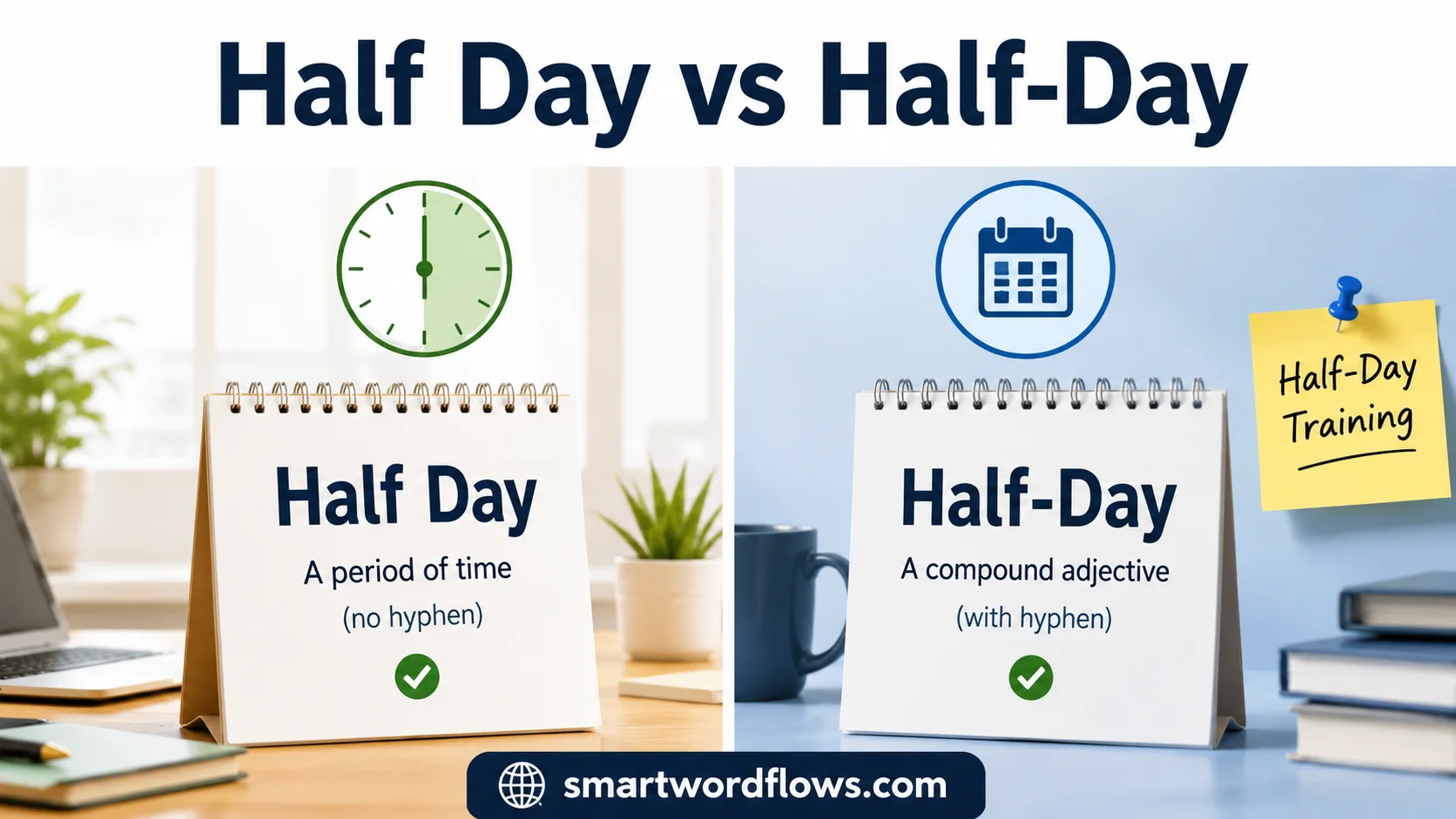

When choosing Half Day vs Half-Day, the small hyphen can cause confusion. Learn how half day, half-day, and half a day work in English.
The correct form depends on the grammar and its position in a sentence. Half-day commonly works as a compound adjective before a noun, such as a half-day meeting or workshop. Half day can function as a noun phrase, while half a day usually describes duration. Knowing these differences helps you write accurate emails, reports, assignments, schedules, and professional documents with confidence.
Quick Answer
Half-day is generally the best choice when the expression directly modifies a noun.
For example:
- We attended a half-day workshop.
- She signed up for a half-day course.
- The company scheduled a half-day training session.
When you simply mean half of a day as a period of time, half a day is usually the clearest construction.
For example:
- The repairs took half a day.
- We spent half a day exploring the museum.
- The project required half a day of work.
However, half day also exists as an established noun expression, especially when referring to a day on which someone works or attends school for only part of the day. The Oxford Advanced American Dictionary lists half day as a noun, while Cambridge lists half day as a noun and half-day as an adjective.
The simplest rule is this:
Use “half-day” when it acts as a compound modifier before a noun. Use “half a day” when you mean a duration.
That rule handles most everyday writing without forcing you to memorize dozens of exceptions.
Comparison Overview
| Form | Main function | Typical use | Example |
| half-day | Compound modifier | Describes a following noun | We joined a half-day workshop. |
| half day | Noun expression | Describes a shortened work or school day | Friday is a half day. |
| half a day | Duration expression | Means approximately one-half of a day | The job took half a day. |
| half-days | Plural noun | Refers to multiple shortened days | The school has several half-days. |
| half-day’s | Possessive form | Refers to something belonging to or associated with a half-day | The employee completed a half-day’s work. |
This comparison reveals why the debate cannot be solved by simply declaring one spelling correct.
Half-day and half day can both appear in legitimate English. Their roles and the style being followed matter. Cambridge explicitly gives examples of both forms, including “half day” as a noun and “half-day” as an adjective.
Main Differences Between Half Day and Half-Day
The biggest difference comes from grammar rather than pronunciation.
Half-Day as a Compound Modifier
When half-day appears directly before another noun, the hyphen joins the words into a single descriptive unit.
Consider this sentence:
We attended a half-day seminar.
Here, half-day describes the seminar. The reader immediately understands that the seminar lasts for approximately half a day.
The same pattern appears in:
- half-day workshop
- half-day course
- half-day program
- half-day session
- half-day appointment
- half-day trip
- half-day conference
- half-day shift
Chicago Manual of Style guidance generally supports hyphenating compound modifiers before nouns when the combination needs to function as one descriptive unit. Chicago also emphasizes that hyphens can improve readability and prevent momentary confusion.
Half Day as a Noun
Half day can function as a noun phrase, particularly when you’re talking about a shortened workday or school day.
For example:
Friday is a half day at our office.
Here, half day identifies the type of day rather than modifying another noun immediately afterward.
Another example is:
The students have a half day on Friday.
This construction appears naturally in American English. The Oxford Advanced American Dictionary specifically lists half day as a noun for a day when people work or attend school only in the morning or afternoon.
Half a Day as a Duration
If you’re talking about how long something takes, half a day often sounds most natural.
For example:
The installation took half a day.
You aren’t naming a particular kind of day. Instead, you’re measuring time.
That distinction becomes much easier when you compare these sentences:
- The workshop was a half-day event.
- The workshop lasted half a day.
The first sentence labels the event.
The second sentence describes its duration.
That small grammatical difference explains much of the confusion surrounding half day vs half-day.
What Does “Half Day” Mean?
Half day refers to a day or working day that covers only part of the normal day.
Cambridge defines a half day as a day when people work during only the morning or afternoon. It also gives examples involving workplaces, businesses, and scheduled activities.
In American English, the phrase commonly appears when discussing:
- Work schedules
- School schedules
- Office hours
- Early closing
- Shortened business days
- Appointments
- Employee leave
For example:
The office will operate for a half day on Friday.
The phrase describes the shortened schedule.
Likewise:
Students will attend school for a half day tomorrow.
The phrase tells you that students won’t follow the normal full-day schedule.
The exact number of hours doesn’t always have to equal four hours. A normal working day might differ from one organization to another. Therefore, half day describes a portion of the usual schedule rather than guaranteeing a universal number of hours.
What Does “Half-Day” Mean?
Half-day commonly functions as a compound adjective that describes something lasting for half a day or covering part of a day.
For example:
The organization hosted a half-day workshop.
The word half-day modifies workshop, creating one descriptive idea.
Oxford lists half-day as a noun as well as a term meaning half a working day. Its examples include “a half-day workshop,” showing how naturally the hyphenated form works before a noun.
Cambridge similarly identifies half-day as an adjective meaning something that lasts for a morning or afternoon instead of an entire day.
This makes half-day especially common in descriptions of scheduled services and events.
When Should You Use “Half-Day”?
Use Half-Day Before a Noun
The most useful rule is simple: hyphenate the compound when it directly modifies a noun.
Examples include:
- We booked a half-day tour.
- She attended a half-day seminar.
- The manager arranged a half-day meeting.
- They offer a half-day training course.
- We planned a half-day excursion.
The hyphen tells the reader that half and day work together as one modifier.
Without the hyphen, the phrase can become less immediately clear.
Use Half-Day in Program Descriptions
Businesses frequently use half-day when describing programs, classes, and services.
For example:
The museum offers a half-day educational program for local schools.
Here, half-day tells readers something specific about the program.
Travel companies use the same construction:
The agency offers several half-day sightseeing tours.
Course providers may write:
This half-day workshop covers workplace communication skills.
These examples are straightforward because the compound directly modifies the noun.
Use Half-Day in Professional Labels
Schedules and event listings often favor compact descriptive phrases.
You might see:
- Half-day training
- Half-day workshop
- Half-day leave
- Half-day conference
- Half-day appointment
- Half-day orientation
The hyphen keeps the phrase visually compact while showing that the two words belong together.
When Should You Use “Half Day”?
Use Half Day as an Open Noun Expression
When half day operates as a noun phrase, the open form can be appropriate.
For example:
The company gives employees a half day before the holiday.
Here, half day refers to the shortened work period itself.
Another example:
Friday is a half day for students.
The phrase identifies the type of school day.
This usage has dictionary support. Oxford’s American entry gives half day as the noun form, while Cambridge also records half day as a noun.
Don’t Force “Half Day” When “Half a Day” Is Better
A common mistake involves using half day when the sentence really describes elapsed time.
For example:
The repairs took half day.
This sounds incomplete in standard everyday American English.
A more natural sentence is:
The repairs took half a day.
The article a matters because the expression identifies one day as the unit being divided in half.
You can also say:
We worked for half a day.
That sentence clearly describes duration.
Examples of Half Day
Here are practical examples showing the open form:
- Friday is a half day at the elementary school.
- The office has a half day before the annual holiday.
- Employees receive a half day off after the event.
- The final day of the program is a half day.
- The clinic operates on a half day schedule every Wednesday.
In some of these sentences, alternative editorial styles may prefer half-day in certain positions. The key is to identify the grammatical function and follow the chosen style consistently.
Why Does “Half-Day” Have a Hyphen?
A hyphen can connect multiple words that function together before a noun.
Consider:
a half-day workshop
The phrase half-day acts as one modifier for workshop.
This is similar to other compound modifiers such as:
- full-time employee
- long-term project
- two-hour meeting
- five-year plan
- high-quality report
Chicago’s hyphenation guidance explains that compound modifiers before nouns commonly receive hyphens when the combination needs to be understood as a unit.
However, hyphenation isn’t a mechanical process where every two-word phrase automatically receives a hyphen.
Context controls the punctuation.
Compare:
a half-day workshop
with:
The workshop lasted half a day.
The first construction needs a compact modifier.
The second construction uses a normal time expression.
Is “Half a Day” More Natural Than “Half Day”?
For many sentences describing duration, yes.
English speakers commonly use half a day when they mean approximately one-half of a day.
Examples include:
- The repair took half a day.
- We spent half a day at the beach.
- She completed the assignment in half a day.
- They traveled for half a day.
- The inspection lasted half a day.
The phrase works naturally because half determines the amount of the noun day.
Think of it like other fractional expressions:
- half an hour
- half a week
- half a month
- half a year
- half a mile
The same structure applies to half a day.
Read This: Stigmatism vs Astigmatism: Difference, Meaning, Usage, and Examples
Half-Day vs Half a Day
These two forms often describe the same basic amount of time. However, they occupy different grammatical positions.
| Sentence | What the phrase does |
| We attended a half-day workshop. | Describes the workshop. |
| The workshop lasted half a day. | Describes the duration. |
| It was a half-day event. | Labels the event. |
| The event lasted half a day. | Measures elapsed time. |
| She booked a half-day tour. | Describes the tour. |
| She spent half a day touring the city. | Describes the time spent. |
This distinction gives you a reliable editing shortcut.
Before a noun: consider half-day.
After a verb describing duration: consider half a day.
When referring to a shortened work or school day: half day can function as the noun.
Half Day vs Half-Day in American English
American English recognizes both half day and half-day, although dictionaries can classify and present them differently.
The Oxford Advanced American Dictionary lists half day as a noun. Cambridge’s US dictionary presents half day as a noun and half-day as an adjective.
That difference matters because online grammar advice sometimes turns a flexible usage pattern into an absolute rule.
A better approach looks at sentence structure.
Chicago’s current guidance also stresses that hyphenation depends on compounds and readability rather than one universal rule for every phrase. Its 18th edition includes specific guidance on compound modifiers and notes that hyphens can prevent confusion.
Therefore, writing “half-day is always correct” would oversimplify the issue.
Writing “half day is always wrong” would also be inaccurate.
Common Half-Day Expressions
Certain combinations appear frequently in American writing.
| Expression | Correct example | Why the hyphen works |
| half-day workshop | We joined a half-day workshop. | Modifies “workshop.” |
| half-day course | She enrolled in a half-day course. | Modifies “course.” |
| half-day program | The center offers a half-day program. | Modifies “program.” |
| half-day session | The conference includes a half-day session. | Modifies “session.” |
| half-day trip | They planned a half-day trip. | Modifies “trip.” |
| half-day shift | He works a half-day shift. | Modifies “shift.” |
| half-day event | The organization hosted a half-day event. | Modifies “event.” |
| half-day appointment | I scheduled a half-day appointment. | Modifies “appointment.” |
These aren’t merely theoretical examples. Cambridge’s dictionary examples include combinations such as half-day program, half-day seminar, and half-day workshop.
Half Day vs Half-Day in Workplace Writing
Workplace writing creates many opportunities for confusion because schedules often use both noun phrases and compound modifiers.
Consider these examples:
The office will have a half day on Friday.
Here, half day identifies the shortened workday.
Now compare:
The company scheduled a half-day training session.
Here, half-day modifies training session.
You can also use half a day when describing an employee’s time:
The employee spent half a day completing the audit.
Each sentence communicates a similar time frame, yet the grammar changes.
Workplace Case Study
Imagine an office manager preparing a Friday schedule.
The manager might write:
Friday will be a half day for all employees.
That statement identifies Friday as a shortened working day.
The same manager could write:
The team will attend a half-day training session.
The second sentence identifies the duration of the training session.
Finally, an internal report might say:
The team spent half a day reviewing the new procedure.
The third sentence describes elapsed time.
One schedule can legitimately contain all three forms. That’s why context beats a one-size-fits-all punctuation rule.
Half Day vs Half-Day in School Writing
Schools frequently use these expressions when describing shortened schedules.
For example:
Friday will be a half day for students.
Here, half day functions as a noun phrase.
A school website could instead say:
Students will attend a half-day program on Friday.
Now half-day modifies program.
Another sentence could read:
Students will spend half a day in class.
This version describes duration.
These distinctions become especially useful in newsletters, calendars, parent notices, and school handbooks. Clear wording matters because schedule information should never make readers stop and decode punctuation.
Half Day vs Half-Day in Travel and Activities
Travel descriptions often use half-day because tour operators package activities according to duration.
Common examples include:
- half-day tour
- half-day excursion
- half-day hike
- half-day safari
- half-day city tour
- half-day sightseeing trip
For example:
The guide offers a half-day city tour.
The phrase functions as a compact product description.
However, once the sentence focuses on time spent, half a day becomes natural:
We spent half a day exploring the old city.
This difference is especially useful for travel writers because product descriptions and narrative sentences have different grammatical needs.
Common Mistakes to Avoid
Mistake: Hyphenating Every Use
Don’t assume that every appearance of half day needs a hyphen.
The trip lasted half a day is already clear.
Adding a hyphen to create half-a-day would generally be unnecessary in this ordinary duration expression.
Mistake: Removing the Hyphen From Every Compound
The opposite mistake can also hurt readability.
We booked a half day tour is less clear than:
We booked a half-day tour.
The hyphen shows that half-day describes the tour as one compound modifier.
Mistake: Confusing “Half Day” With “Half a Day”
These expressions can describe related ideas without performing the same grammatical job.
Friday is a half day.
The work took half a day.
The first identifies a shortened day.
The second measures duration.
Mistake: Treating Dictionary Labels as Universal Rules
Different dictionaries and style references may classify the expression differently.
Oxford’s American dictionary uses half day as a noun. Cambridge uses half-day as an adjective while also recognizing half day as a noun.
That variation reflects real English usage.
It doesn’t mean writers can place hyphens randomly. It means grammar and context should guide the choice.
Half Day vs Half-Day Before and After a Noun
One of the fastest ways to make the distinction is to compare position.
Before a Noun
Use the hyphenated compound when it functions as a modifier.
Correct:
- a half-day workshop
- a half-day course
- a half-day appointment
- a half-day conference
The compound tells you what kind of workshop, course, appointment, or conference you mean.
When Describing Duration
Use half a day when the expression answers a duration question.
Correct:
- The workshop lasted half a day.
- The course takes half a day.
- The appointment lasted half a day.
- The conference occupied half a day.
This pattern is remarkably consistent.
Half-Day as a Noun
There is another wrinkle worth knowing: dictionaries also recognize half-day as a noun in some varieties and contexts.
Oxford’s entry lists half-day as a noun meaning a day when people work only during the morning or afternoon. It also defines it as half a working day.
Collins likewise lists half-day as a noun and notes half day as an alternative form.
This means the statement “half-day is only an adjective” isn’t accurate.
Likewise, the statement “half day is never correct” doesn’t reflect actual dictionary usage.
English has room for both forms.
The best choice depends on function, context, and the style guide you follow.
Is “Half-Day” Professional and Correct?
Yes. Half-day is completely appropriate in professional writing when it functions as a compound modifier or when your chosen style treats it as an established compound noun.
You can confidently write:
- half-day workshop
- half-day training
- half-day conference
- half-day appointment
- half-day program
Professional writing benefits from clarity and consistency, not from adding hyphens wherever possible.
Chicago even advises writers to be economical with hyphens because unnecessary punctuation can create visual clutter. At the same time, it notes that a hyphen added for clarity can be useful.
That is a useful principle beyond this one phrase.
How to Choose the Right Form
When you’re editing a sentence, ask three quick questions.
Is It Modifying a Noun?
If half-day directly describes a noun, the hyphenated form is usually appropriate.
Example:
a half-day workshop
Does It Describe How Long Something Took?
If you’re expressing duration, half a day will usually be the natural choice.
Example:
The workshop lasted half a day.
Are You Naming a Shortened Work or School Day?
If you’re identifying a day with a shortened schedule, half day can work as a noun phrase in American English.
Example:
Friday is a half day.
This three-question test resolves most practical cases.
Practical Editing Examples
| Less suitable wording | Better wording | Reason |
| The seminar lasted a half-day. | The seminar lasted half a day. | Duration is expressed naturally with “half a day.” |
| We attended a half day workshop. | We attended a half-day workshop. | The compound modifies “workshop.” |
| Friday is a half-day at school. | Friday is a half day at school. | “Half day” functions as a noun phrase here. |
| They booked a half day tour. | They booked a half-day tour. | The compound modifies “tour.” |
| The repairs took half-day. | The repairs took half a day. | The duration expression needs “a.” |
| The school has several half days. | The school has several half days. | Plural noun phrase remains open in this construction. |
These examples show why simply searching for every occurrence and adding a hyphen can create new errors.
A Simple Rule Worth Remembering
If you remember only one idea from this article, remember this:
“Half-day” commonly modifies a noun, while “half a day” commonly expresses duration.
Then keep half day in your vocabulary for noun uses involving shortened work or school days.
For example:
The company has a half day on Friday.
The company scheduled a half-day workshop.
The workshop will take half a day.
Three sentences. Three slightly different grammatical structures.
FAQs:
1. Is “half day” or “half-day” correct?
Both can be correct. Half-day is usually used as a compound adjective before a noun, while half day can function as a noun phrase.
2. Is “half-day” hyphenated?
Yes, when it works as a compound modifier before a noun. For example: “We attended a half-day workshop.”
3. Should I write “half day off” or “half-day off”?
Half day off is generally preferred because “half day” functions as a noun phrase. Example: “I’m taking a half day off tomorrow.”
4. What does “half a day” mean?
Half a day refers to a duration of approximately half of a full day. Example: “The project took half a day to complete.”
5. Is “half-day” common in professional writing?
Yes. Half-day is common in professional writing when it modifies a noun, such as half-day training, half-day meeting, or half-day session.
Conclusion:
Understanding Half Day vs Half-Day becomes easier when you identify the phrase’s role in the sentence. Use half-day as a compound adjective before a noun, half day as a noun phrase, and half a day when talking about duration. Using each form correctly makes your writing clearer, more polished, and grammatically accurate.