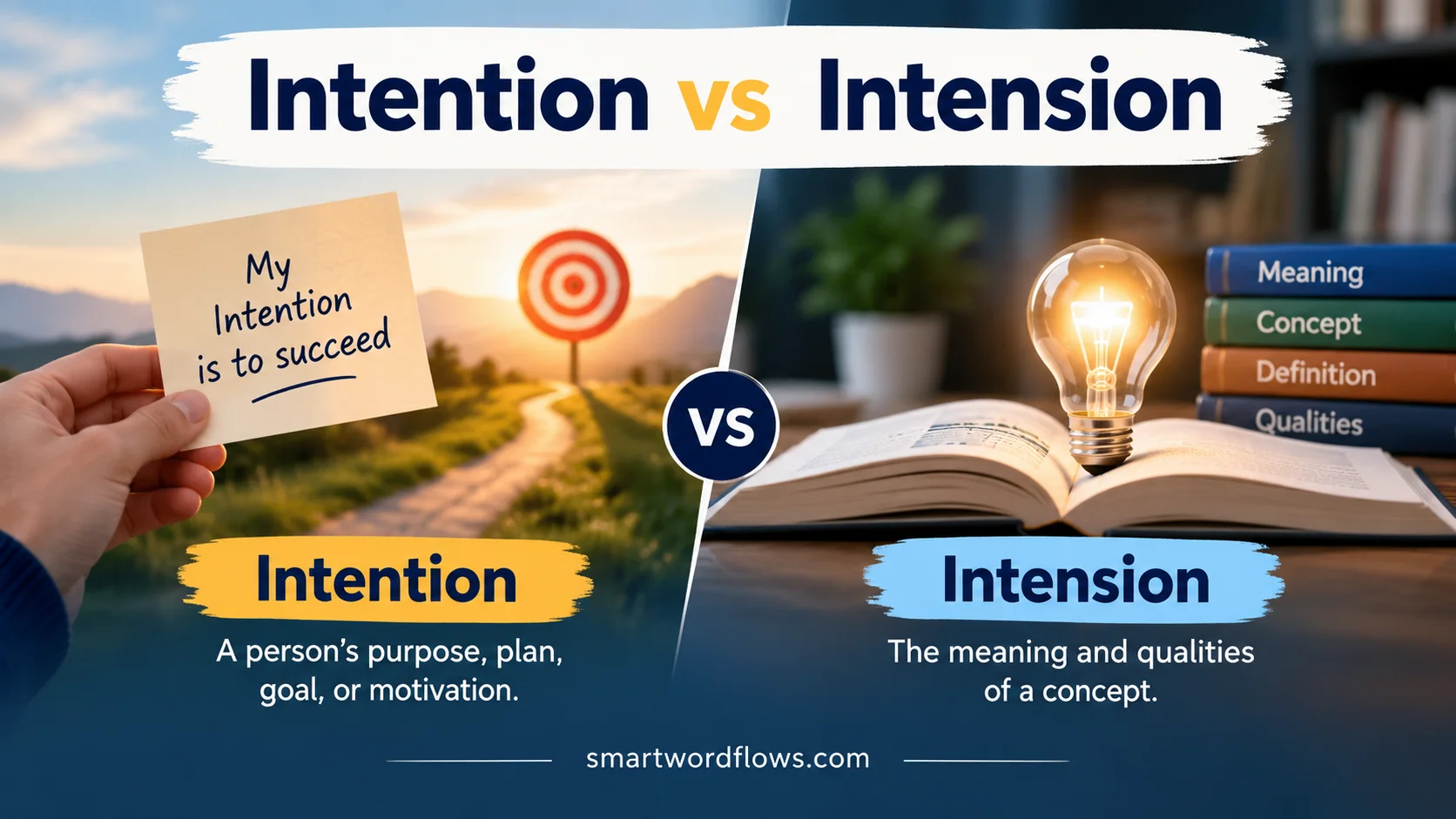

Confused about Intention vs Intension? These words look and sound almost identical, but their meanings are quite different. Intention refers to a person’s purpose, plan, goal, or motivation behind an action, while intension is a specialized term related to the meaning and qualities of a concept.
The difference becomes easier to understand when you consider their usage. Intention is widely used in everyday conversations, professional communication, and formal writing. Intension, however, mainly appears in philosophy, logic, linguistics, and semantics. Learning their definitions, examples, and proper context can help you avoid common English vocabulary mistakes and choose the correct word with confidence.
Quick Answer: Intention vs Intension
Intention means a plan, purpose, aim, or intended action.
Example: My intention is to finish the assignment tonight.
Intension is a specialized term describing the defining characteristics or conceptual content of a word or idea. It commonly appears in logic, philosophy, and semantics.
Example: In semantics, the intension of a concept concerns the properties associated with its meaning.
The easiest way to remember them
- Intention → what you intend to do
- Intension → the defining content of a concept
In normal everyday English, intention is almost always the word you need.
Comparison Overview
| Feature | Intention | Intension |
| Basic meaning | A plan, purpose, or aim | Defining qualities or conceptual content |
| Common context | Everyday English | Logic, philosophy, linguistics, semantics |
| Part of speech | Noun | Noun |
| Commonness | Very common | Relatively uncommon |
| Related word | Intend, intent, intentional | Intensional |
| Example | Her intention was to apologize. | The intension of a concept concerns its defining properties. |
| Everyday use | Yes | Rarely |
| Meaning connected to action? | Usually | No |
| Often contrasted with | Intent, purpose | Extension |
The biggest difference is what each word describes. Intention concerns a person’s plan or purpose. Intension concerns the content or characteristics associated with a concept.
What Does “Intention” Mean?
Intention is a noun that refers to something you plan, aim, or mean to do.
When someone has an intention, they have some purpose behind a future action or behavior. The action might happen later, or the person might already have acted with a particular purpose.
For example:
I had the intention of calling you yesterday.
The sentence tells us about a plan or purpose. The speaker intended to call, regardless of whether the call actually happened.
Common meanings of intention
The word intention can describe several closely related ideas:
- A plan to do something
- A purpose behind an action
- An aim or objective
- Something someone means to accomplish
- A desired result
- The purpose behind someone’s behavior
These meanings overlap considerably.
Examples of intention
- My intention is to improve my writing.
- She had no intention of causing trouble.
- His intention was to help the team.
- What was your intention when you said that?
- They announced their intention to move abroad.
- I never intended to offend anyone.
Each example deals with a person’s purpose, plan, or aim.
Intention in Everyday English
You’ll encounter intention constantly in ordinary conversations and writing.
People talk about intentions when discussing relationships, plans, decisions, promises, work, and behavior.
Consider this sentence:
He apologized because his intention wasn’t to hurt anyone.
Here, intention explains the purpose behind his behavior. It doesn’t describe a dictionary definition or the characteristics of a concept.
Similarly:
Our intention is to launch the project next month.
The word describes a planned action.
Intention vs intent
Intent and intention are closely related.
Both can refer to a purpose or plan. However, intent can sometimes sound more direct or formal, especially when discussing the purpose behind an action.
For example:
- What was your intention?
- What was your intent?
- She acted with good intentions.
- The intent behind the policy was to reduce costs.
The exact choice depends on the sentence and context.
What Does “Intension” Mean?
Intension is a real English word. It isn’t simply a misspelling of intention.
However, it’s much less common.
In technical contexts, intension refers to the set of qualities, characteristics, conditions, or conceptual content associated with a term or idea.
This concept becomes especially important in logic, philosophy, linguistics, and semantics.
For general readers, the easiest way to understand it is to think about the meaning inside a concept rather than the collection of things that concept applies to.
A simple example
Imagine the concept triangle.
Its defining characteristics include things such as:
- A closed geometric figure
- Three sides
- Three angles
These characteristics help describe what the concept means.
In a technical discussion, those defining characteristics relate to the concept’s intension.
The term therefore deals with the properties or conceptual content that make an idea what it is.
Intension in Logic and Philosophy
The distinction between intension and extension has an important place in philosophical and logical discussions.
A concept’s intension concerns the characteristics or meaning associated with that concept.
Its extension, by contrast, concerns the objects or things that fall under the concept.
Consider the concept “bird.”
Its intension might involve characteristics associated with being a bird. Its extension would include the actual members of the category, such as:
- Eagles
- Sparrows
- Penguins
- Robins
- Ostriches
The distinction can be summarized like this:
| Conceptual side | What it concerns |
| Intension | Characteristics or meaning |
| Extension | Objects or members covered by the concept |
This distinction becomes useful when analyzing how words and concepts relate to the world.
Intension in Linguistics and Semantics
Linguistics and semantics also use intension when discussing meaning.
Semantics examines how language carries meaning. Within formal approaches to semantics, scholars may distinguish between the intensional content of an expression and the things to which that expression refers.
For example, two expressions could potentially refer to the same object while carrying different conceptual content.
That distinction matters because meaning isn’t always identical to reference.
A word can evoke a particular concept or set of properties even when its actual referents change according to context.
This is one reason intension belongs mainly to specialized academic vocabulary.
Main Differences Between Intention vs Intension
The spelling difference is only one letter. The meaning difference is much larger.
Meaning
The clearest distinction is:
Intention = a plan, purpose, or aim.
Intension = the defining conceptual content or characteristics associated with an idea.
Compare these sentences:
My intention is to become a better writer.
This describes a personal goal.
The intension of the concept concerns its defining properties.
This discusses conceptual meaning.
The first sentence belongs to ordinary communication. The second belongs to a technical discussion.
Context
Context usually makes the correct choice obvious.
Use intention when you’re talking about:
- Personal plans
- Goals
- Purposes
- Motives
- Future actions
- What someone means to do
Use intension when you’re talking about:
- Concepts
- Definitions
- Properties
- Logical analysis
- Semantics
- Philosophy
- Linguistic meaning
A useful shortcut
If a person could say “I intend to…”, intention is probably correct.
For example:
I intend to study tonight.
Therefore:
My intention is to study tonight.
You wouldn’t normally use intension here.
Everyday Use
Intention dominates everyday English.
You might hear:
“What are your intentions?”
Or:
“I had good intentions.”
Or:
“That wasn’t my intention.”
These sentences are completely natural.
By contrast, intension would sound unusual in an ordinary conversation unless the speaker were discussing a technical subject.
That’s an important distinction for writers. A word can be correct in the dictionary yet inappropriate for the context.
Academic Use
Intension becomes more relevant in specialized academic writing.
You may encounter it in discussions about:
- Formal semantics
- Philosophy of language
- Logic
- Concept analysis
- Meaning and reference
- The relationship between concepts and objects
Meanwhile, intention also appears in academic writing when researchers discuss people’s plans, purposes, or intended behavior.
For example:
The researchers examined participants’ intention to adopt the new technology.
Here, the word describes what participants plan or aim to do.
Intention vs Intension Pronunciation
The two words are pronounced differently enough to help distinguish them when spoken.
Intention is generally pronounced:
in-TEN-shun
Intension is generally pronounced:
in-TEN-shun
Interestingly, they are commonly pronounced the same way or very similarly in English.
That makes the distinction particularly tricky in speech.
The spelling and context therefore do most of the work.
Intention vs Intension Examples
Examples make this difference much easier to remember.
Examples Using “Intention”
Personal goal
My intention is to exercise every morning.
The speaker describes a planned activity.
Purpose
Her intention was to help her friend.
The sentence explains the purpose behind her action.
Future plan
They announced their intention to expand the business.
Here, intention means a planned future action.
Lack of purpose
I had no intention of interrupting you.
The speaker says that interruption wasn’t part of the plan.
Interpreting behavior
His intention wasn’t clear from the message.
The word refers to the purpose behind his communication.
Examples Using “Intension”
Conceptual meaning
The intension of a concept consists of characteristics associated with that concept.
Semantics
Linguists may analyze the intension of an expression rather than focusing only on its referents.
Logic
The theory distinguishes between the intension of a term and its extension.
Philosophy
Philosophers have used the distinction between intension and extension when analyzing concepts.
These examples demonstrate why intension generally appears in technical writing rather than casual conversation.
Also Read This: Ladel vs Ladle Difference: Meaning, Spelling, and Correct Usage
Intention vs Intension: Side-by-Side Examples
| Sentence | Correct Word | Why? |
| My ___ is to study harder. | Intention | It describes a personal plan. |
| She had no ___ of leaving early. | Intention | It describes what she planned to do. |
| His ___ was to apologize. | Intention | It describes his purpose. |
| The ___ of the concept involves defining properties. | Intension | It concerns conceptual content. |
| The philosopher examined a term’s ___ and extension. | Intension | This is technical terminology. |
| They expressed their ___ to continue the project. | Intention | It describes a future plan. |
How to Remember Intention vs Intension
The spelling can trip you up because both words contain inten-.
Fortunately, one simple association can save you from most mistakes.
Remember “Intention” With “Intend”
Look at the relationship:
intend → intention
If you can replace the idea with intend, you probably need intention.
For example:
I intend to travel.
Therefore:
My intention is to travel.
Another example:
She intends to apologize.
Therefore:
Her intention is to apologize.
This trick works especially well in everyday writing.
Remember “Intension” With Concepts
Think of intension as a technical word connected with the content or characteristics of a concept.
It’s not about what a person plans to do.
For example:
The intension of a concept describes its relevant defining characteristics.
If the sentence discusses concepts, meanings, properties, logic, or semantics, intension becomes a possibility.
Common Mistakes With Intention and Intension
Using “Intension” for a Personal Plan
This is one of the most common mistakes.
Incorrect
My intension is to become a doctor.
Correct
My intention is to become a doctor.
The sentence describes a personal goal. Therefore, intention is the correct word.
Assuming “Intension” Is Always Wrong
The opposite mistake also happens.
Someone may see intension and assume that the writer made a spelling error.
That’s not necessarily true.
Intension is a legitimate technical term.
For example:
The philosopher discussed the intension of the concept.
If the surrounding discussion involves logic or semantics, the spelling may be completely intentional.
Confusing Intension With Extension
Another common source of confusion involves extension.
The two terms often appear together in technical discussions.
A simplified distinction looks like this:
Intension → the characteristics or conceptual content.
Extension → the things or objects that fall under the concept.
For example, consider the concept “planet.”
The intension concerns the characteristics associated with the concept. The extension concerns the actual objects that satisfy the relevant definition.
This distinction is useful because it separates what a concept means from what belongs to that concept.
Intention vs Intension in Different Contexts
Everyday English
Choose intention almost every time.
Examples include:
- “What are your intentions?”
- “I had good intentions.”
- “My intention was to help.”
- “She intends to return tomorrow.”
Using intension in these sentences would normally be incorrect.
Business and Professional Writing
Intention frequently appears in professional communication.
For example:
The company announced its intention to enter a new market.
Here, the word clearly refers to a planned action.
You might also see:
The organization has no intention of changing the agreement.
Again, intention refers to a plan or purpose.
Intension generally doesn’t belong in this kind of writing unless the document specifically discusses technical theories of meaning.
Academic Writing
Academic writing requires more attention to context.
A psychology or business paper might discuss people’s intentions.
A philosophy or linguistics paper might discuss intensions.
The subject matter determines the word.
That’s why memorizing the spelling alone isn’t enough. You need to understand what the sentence actually means.
Intension vs Intentional
These words look related because they are related in form. Their meanings differ significantly.
Intentional
Intentional means deliberate or done on purpose.
The change was intentional.
The person deliberately made the change.
Intensional
Intensional relates to intension, especially the conceptual or semantic characteristics of an expression.
The paper presents an intensional analysis of meaning.
So:
- Intention → plan or purpose
- Intentional → deliberate
- Intension → conceptual content or defining characteristics
- Intensional → relating to intension
Don’t treat intentional and intensional as interchangeable.
Intention vs Intension vs Extension
These three terms can appear confusing when they sit together.
| Term | Basic idea |
| Intention | A person’s plan or purpose |
| Intension | The conceptual content or defining characteristics of a term |
| Extension | The objects or things covered by a concept |
Here’s an easy illustration:
Intention
I intend to learn Spanish.
This describes a person’s plan.
Intension
The concept has certain defining characteristics.
This describes conceptual content.
Extension
The concept applies to particular objects or members.
This describes what falls within the concept’s scope.
The first term belongs to ordinary discussions of human plans. The latter two belong mainly to technical discussions of concepts and meaning.
A Practical Case Study: Choosing the Correct Word
Imagine you’re writing this sentence:
“The company’s ______ is to open three new stores.”
Which word should you choose?
The answer is intention.
Why?
Because the sentence describes a planned action.
Now consider a different sentence:
“The philosopher examined the ______ of the term.”
Here, intension could be appropriate if the discussion concerns the term’s conceptual characteristics or meaning.
The decision process
Ask these questions:
Is someone planning or aiming to do something?
→ Use intention.
Are you discussing the characteristics or conceptual content of an idea?
→ Consider intension.
This simple test handles most situations.
Facts About Intention vs Intension
- Intention is vastly more common in general English.
- Intension is a legitimate word rather than a simple spelling error.
- Both words function primarily as nouns.
- The two words are commonly pronounced alike or nearly alike.
- Intention connects directly with the verb intend.
- Intension commonly appears alongside extension in technical discussions.
- Logic, philosophy, linguistics, and semantics are important contexts for intension.
- Most everyday references to plans or purposes require intention.
When Should You Use “Intention”?
Use intention when you’re discussing:
- A personal plan
- A future action
- A goal
- A purpose
- An aim
- The reason behind an action
- What someone means to do
- A planned decision
Quick examples
My intention is to save money.
She had no intention of quitting.
They announced their intention to relocate.
His intention was to make things easier.
When Should You Use “Intension”?
Use intension when you’re discussing:
- The conceptual content of a term
- Defining characteristics
- Logic
- Philosophy
- Semantics
- Linguistics
- The relationship between meaning and reference
Quick examples
The intension of the term depends on its defining characteristics.
The study compares the intension and extension of several concepts.
The philosopher examined the intension of the expression.
If you’re writing a normal email, essay, conversation, or social post about someone’s plans, intention is almost certainly the appropriate choice.
Faqs :
1. What is the difference between intention and intension?
Intention means a person’s purpose, plan, or aim behind an action. Intension refers to the set of qualities or characteristics that define a concept, especially in logic, philosophy, and linguistics.
2. Is “intension” a correct English word?
Yes, intension is a correct word, but it is much less common than intention. It is mainly used in specialized academic fields such as semantics, philosophy, and logic.
3. How do I use intention in a sentence?
You can use intention when talking about someone’s purpose or plan. For example: “My intention is to improve my English writing skills.”
4. How do I use intension in a sentence?
Intension is used when discussing the defining properties or qualities of a concept. For example: “The intension of a term includes the characteristics that determine its meaning.”
5. Which word is more common: intention or intension?
Intention is far more common in everyday and professional English. Intension is a specialized term and usually appears in academic discussions involving meaning, concepts, and definitions.
Conclusion :
Understanding Intention vs Intension becomes much easier once you remember their different meanings and contexts. Intention describes a person’s purpose, plan, or aim, while intension describes the defining qualities or characteristics of a concept. For everyday English, intention is almost always the word you need. Use intension mainly in specialized fields such as philosophy, logic, linguistics, and semantics. Keeping this simple distinction in mind can help you avoid confusion and use both words correctly.