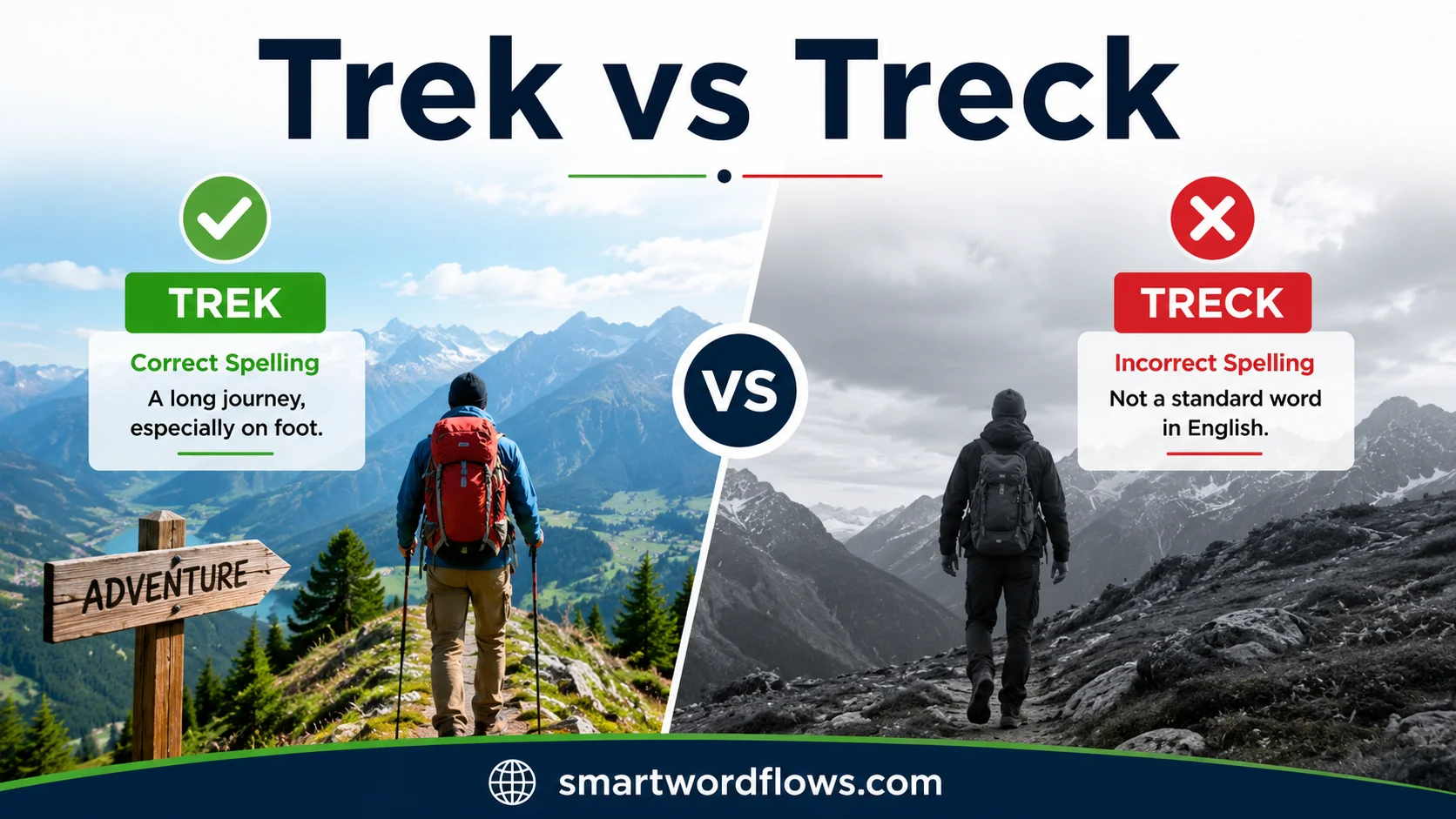

Trek vs Treck is a common spelling confusion for English learners. In modern English, trek is the correct English word, standard English word, and accepted form. It means a long journey, difficult journey, or journey on foot. Treck is an incorrect spelling, spelling mistake, and misspelling. In everyday English, trek can be a noun or verb related to travel, hike, mountain trek, forest, hikers, trip, and distance.
The meaning becomes clear through contextual meaning, sentence usage, and examples. The common mistake of writing treck may come from sound rules or the spoken word, but grammar rules and language rules favor trek. This matters in professional writing, travel writing, travel blogs, academic content, social media, and content creation. Bloggers, students, and travel writers should use proofreading, editing, and writing accuracy to maintain credibility, communication, text clarity, and linguistic accuracy.
Quick Answer: Trek vs Treck
Trek is the standard spelling in modern English.
Treck is generally not the correct spelling when you mean a long or difficult journey. In ordinary writing, use trek, whether you’re using the word as a noun or a verb.
| Spelling | Correct modern English? | Meaning |
| Trek | ✅ Yes | A long or difficult journey; to travel a long distance |
| Treck | ❌ Generally no | Usually a misspelling of trek |
| Treks | ✅ Yes | Plural noun or third-person verb |
| Trekked | ✅ Yes | Past tense |
| Trekking | ✅ Yes | Present participle/gerund |
So, if you’re writing about a difficult hike, a long journey, or traveling across challenging terrain, trek is the spelling to choose.
Comparison Overview
The easiest way to understand trek vs treck is to compare their status and function rather than treating them as two separate modern English words.
| Feature | Trek | Treck |
| Standard spelling | ✅ | ❌ |
| Used as a noun | ✅ | ❌ |
| Used as a verb | ✅ | ❌ |
| Common in American English | ✅ | ❌ |
| Past tense | trekked | Not standard |
| -ing form | trekking | Not standard |
| Pronunciation | /trek/ | Usually intended to sound like trek |
| Meaning | Long or difficult journey | Usually intended as trek |
| Recommended in formal writing | ✅ | ❌ |
There is one historical wrinkle worth knowing. Treck has appeared as an archaic form of trek, so calling it “a word that has never existed” would be too absolute. In modern standard English, however, trek is the form you should use.
Main Differences Between Trek vs Treck
The biggest difference is simple: trek is the established modern spelling, while treck is generally a spelling error in contemporary English.
Trek Is the Standard Word
You’ll find trek in modern English dictionaries as a noun and a verb.
As a noun, it describes a long or difficult journey:
“The trek through the mountains took three days.”
As a verb, it means to travel or walk a long distance, particularly when the trip requires effort:
“They trekked through the forest before sunset.”
The word can describe literal travel as well as an everyday trip that feels unusually long.
Treck Usually Represents a Spelling Mistake
When someone writes treck, they usually mean trek.
For example:
- ❌ “We went on a long treck.”
- ✅ “We went on a long trek.”
The mistake doesn’t normally create a new meaning. It simply adds an unnecessary c.
The Pronunciation Doesn’t Rescue the Spelling
Both spellings are likely to be pronounced the same when someone intends treck as a variant of trek. That makes the error easy to overlook in conversation.
You can hear the difference between correct and incorrect spelling only when you see the words written down. That’s why proofreading matters with short words that have familiar spelling patterns.
What Does Trek Mean?
Trek refers to a long, difficult, or tiring journey. It often suggests that reaching the destination requires considerable effort.
The journey might involve walking through rough terrain. However, the word can also describe a less literal trip.
For example:
- A trek through the Himalayas involves demanding physical travel.
- A trek across the desert suggests distance and difficulty.
- A trek to the grocery store might simply mean the store feels inconveniently far away.
- A long trek home can describe an exhausting journey after a busy day.
That flexibility gives trek more range than simply saying walk.
Trek as a Noun
As a noun, trek names the journey itself.
Examples:
- “The hikers prepared for a difficult trek.”
- “Their trek lasted nearly a week.”
- “The village was at the end of a steep trek.”
- “It was quite a trek from the parking lot.”
The noun commonly appears with adjectives such as:
- long trek
- difficult trek
- challenging trek
- mountain trek
- overnight trek
- exhausting trek
- remote trek
Trek as a Verb
As a verb, trek describes the act of traveling a considerable distance, usually on foot.
Examples:
- “We trekked through the woods.”
- “They trekked across the valley.”
- “She trekked to the remote village.”
- “The group trekked for six hours.”
The verb often appears with a preposition that tells the reader where or how the journey happened.
Trek vs Treck Examples
Seeing the spelling in context makes the distinction much easier.
Correct Uses of Trek
- “We planned a trek through the national park.”
- “The final trek to the summit was exhausting.”
- “They trekked through the snow.”
- “She enjoys trekking in mountainous areas.”
- “The hikers completed several difficult treks.”
- “He trekked across the valley before nightfall.”
Incorrect Uses of Treck
- ❌ “We went on a long treck.”
- ❌ “They were trecking through the forest.”
- ❌ “The group trecked across the desert.”
Correct them this way:
- ✅ “We went on a long trek.”
- ✅ “They were trekking through the forest.”
- ✅ “The group trekked across the desert.”
Trek, Treks, Trekked, and Trekking
One of the most useful things to understand about trek vs treck is what happens when you add grammatical endings.
Trek
The base form is:
trek
Example:
“We plan to trek through the wilderness.”
Treks
Add -s when the word is plural or when a third-person singular subject takes the verb.
Examples:
“The company organizes guided treks.”
“He regularly treks through the countryside.”
Trekked
For the past tense, the final consonant is doubled before -ed:
trek → trekked
Example:
“They trekked across the region last summer.”
Trekking
The same doubling occurs before -ing:
trek → trekking
Example:
“She loves trekking in the mountains.”
This is an important spelling distinction. The base word has one k, while trekked and trekking have two k’s.
Why Is Trek Spelled With One K?
At first glance, trek can feel unusual because English contains many words ending in -ck, including back, check, deck, and neck.
That familiar pattern can make treck look reasonable.
But English spelling doesn’t work by simply attaching c whenever a word ends with a /k/ sound. Many words use k directly.
Compare:
- trek
- desk
- risk
- milk
- task
- mask
The spelling of a word needs to be learned as part of the word itself. In this case, the established spelling is trek.
Why Do People Spell Trek as Treck?
The confusion usually comes from the way English spelling patterns interact with pronunciation.
Familiar Words Can Influence Spelling
Writers often rely on visual patterns they’ve seen repeatedly. Because -ck is common in English, treck can look convincing at first glance.
That doesn’t make it correct.
Pronunciation Offers Little Help
Trek is pronounced with a short e sound followed by the /k/ sound.
The pronunciation doesn’t tell you whether the final sound should be represented by k, ck, or another spelling pattern.
This is similar to many English words where pronunciation alone cannot reliably determine spelling.
Typing Can Make the Error Invisible
Short spelling mistakes are especially easy to miss during casual writing. A person may type treck, read it quickly, and mentally process it as trek.
That matters when you’re writing:
- Articles
- School assignments
- Business documents
- Travel descriptions
- Resumes
- Social media posts
- Website copy
When accuracy matters, trek is the safe and standard choice.
Is Treck Ever a Correct Word?
This question deserves a more careful answer than a simple “no.”
Treck isn’t the standard modern spelling of the English word meaning a long or difficult journey. However, historical sources have recorded treck as an archaic form of trek.
That means the word has historical evidence behind it, but this doesn’t make it the preferred spelling today.
There’s also another distinction worth remembering: a word can appear as part of a proper name, username, title, or creative spelling without becoming the standard dictionary spelling.
For ordinary modern writing, the rule remains straightforward:
Use trek.
Trek vs Treck in American English
For American readers, trek is the standard spelling.
You might encounter the word in several contexts:
- Hiking and outdoor recreation
- Travel writing
- Adventure descriptions
- Everyday conversation
- Fiction
- Sports and entertainment
- Figurative descriptions of long trips
For example:
“The drive to the cabin was a real trek.”
Here, trek doesn’t necessarily mean that the person walked. It emphasizes the distance or inconvenience of the journey.
That’s one reason the word appears frequently in casual American English.
Trek vs Hike vs Journey vs Trip
These words overlap, but they don’t carry exactly the same emphasis.
| Word | Basic Meaning | Main Emphasis |
| Trek | A long or difficult journey | Distance or effort |
| Hike | A walk, usually outdoors | Walking activity |
| Journey | Travel from one place to another | The process of traveling |
| Trip | Travel away from a usual location | General travel |
Consider this example:
“We went on a hike.”
This tells you that walking was central to the activity.
Now compare:
“We went on a trek.”
This suggests that the journey itself was substantial, demanding, or lengthy.
Finally:
“We took a trip to Colorado.”
That statement tells you about travel but doesn’t necessarily suggest difficulty.
A Simple Way to Remember the Difference
Think of these words as highlighting different parts of the experience:
Hike → walking
Trek → effort or distance
Journey → travel
Trip → an outing or period of travel
There can certainly be overlap. A challenging hike can also be a trek.
Also Read This: Wise vs Wize: Spelling, and Common Mistakes Explained
Common Phrases With Trek
Learning common combinations can help you use the word naturally.
A Long Trek
This is one of the most straightforward combinations.
“It was a long trek to the nearest town.”
A Difficult Trek
This emphasizes the challenge.
“The climbers faced a difficult trek through rough terrain.”
Mountain Trek
This describes a trek involving mountainous areas.
“The group planned a mountain trek for the summer.”
Trek Through the Forest
Here, trek functions as a verb.
“They trekked through the forest for several hours.”
Trek Across the Desert
This emphasizes crossing a large, demanding area.
“The explorers trekked across the desert.”
A Trek to Somewhere
This construction can also describe ordinary travel.
“It was quite a trek to the other side of town.”
That last example demonstrates how trek can shift from an outdoor adventure term to a casual expression for an inconvenient journey.
Common Trek vs Treck Mistakes
The most common error is simply adding c to the base word.
Mistake 1: Treck
❌ “The trek was difficult.”
The sentence above is correct.
But:
❌ “The treck was difficult.”
should be:
✅ “The trek was difficult.”
Mistake 2: Trecking
The correct form is:
✅ trekking
Not:
❌ trecking
Mistake 3: Trecked
The correct past-tense form is:
✅ trekked
Not:
❌ trecked
Mistake 4: Treating Trek and Treck as Different Words
In modern standard English, you shouldn’t assume that treck represents another type of journey.
If you mean the common word describing a long or difficult journey, use trek.
A Useful Spelling Rule: Trek → Trekking
The transition from trek to trekking can initially look strange.
Why does one k become two?
English spelling rules often double a final consonant before certain endings when particular conditions are met. The important practical point here is to remember the established forms:
- trek
- treks
- trekked
- trekking
Notice the pattern:
One k in the base word. Two k’s before -ed and -ing.
This gives you a reliable way to avoid forms such as trecked and trecking.
Trek vs Treck Pronunciation
The standard pronunciation of trek is /trek/.
For American English, it sounds like the vowel in check followed by the k sound.
The spelling is therefore not something you can reliably determine by listening. English has many cases where one sound corresponds to several possible spellings.
For example, the /k/ sound appears in:
- cat
- king
- school
- back
- trek
The sound stays similar while the spelling changes.
That’s why memorizing trek as a complete word is more useful than trying to derive its spelling from pronunciation.
The Origin and History of Trek
The history of trek helps explain why the word doesn’t follow the spelling pattern some readers might expect.
English borrowed trek from South African usage. The word is associated with Afrikaans and Dutch, where trek relates to travel or movement.
Historically, the term became particularly associated with long journeys undertaken by people moving through the South African interior.
Over time, English adopted the word more broadly. Its meaning expanded beyond its historical setting and eventually became a familiar English term for a long or difficult journey.
Today, an American writer can use trek without referring to its South African historical context at all.
That evolution is common in English. Words travel between languages, cultures, and regions, then acquire broader meanings in their new linguistic homes.
Case Study: Choosing Trek in Everyday Writing
Imagine you’re describing a vacation.
Version A
“We took a treck through the mountains.”
The meaning is understandable, but the spelling is incorrect for standard modern English.
Version B
“We took a trek through the mountains.”
This is the standard form.
Now imagine a more casual situation:
“Getting to that restaurant was a trek.”
Here, trek isn’t describing a wilderness expedition. It’s simply emphasizing that the restaurant required a long or inconvenient journey.
This demonstrates an important point: context changes how strongly the word suggests physical difficulty, but it doesn’t change its spelling.
How to Remember Trek vs Treck
A simple memory trick works well:
Take a trek, not a treck.
You can also remember the word family:
- trek
- treks
- trekked
- trekking
Notice that none of the standard forms introduces a c.
If you see treck, pause and ask yourself whether you actually mean trek. In most modern English writing, the answer will be yes.
Quick Grammar Guide to Trek
| Grammar point | Correct form | Example |
| Base verb | trek | We will trek tomorrow. |
| Singular noun | trek | It was a difficult trek. |
| Plural noun | treks | They completed several treks. |
| Third-person verb | treks | He treks every summer. |
| Past tense | trekked | We trekked through the valley. |
| Present participle | trekking | She is trekking in the mountains. |
The key spelling pattern is easy once you see it:
trek → trekked → trekking
Not:
treck → trecked → trecking
FAQs:
1. Is Trek or Treck the correct spelling?
Trek is the correct and standard English spelling. Treck is an incorrect spelling and should be avoided in formal and everyday writing.
2. What does Trek mean?
Trek means a long or difficult journey, especially one made by walking. It can also refer to hiking or traveling across a challenging distance.
3. Is Treck a real English word?
No, treck is generally considered a misspelling of trek in modern English. When you mean a long journey or hike, use trek.
4. Why do people spell Trek as Treck?
People may write treck because of the way trek sounds when spoken. However, standard English spelling rules recognize trek as the correct form.
5. How can I remember the correct spelling?
A simple way to remember it is: Trek has one “c” and ends with “k.” Use trek in travel writing, academic content, blogs, social media, and professional communication.
Conclusion:
Trek vs Treck is an easy spelling confusion once you know the correct form. Trek is the correct English word and can work as both a noun and a verb for a long, difficult journey or hike. Treck is a misspelling and shouldn’t be used in standard English. Remembering the correct spelling helps improve writing accuracy, text clarity, and professional communication. Whether you’re writing about a mountain trek, hiking trip, or difficult journey, always choose trek.