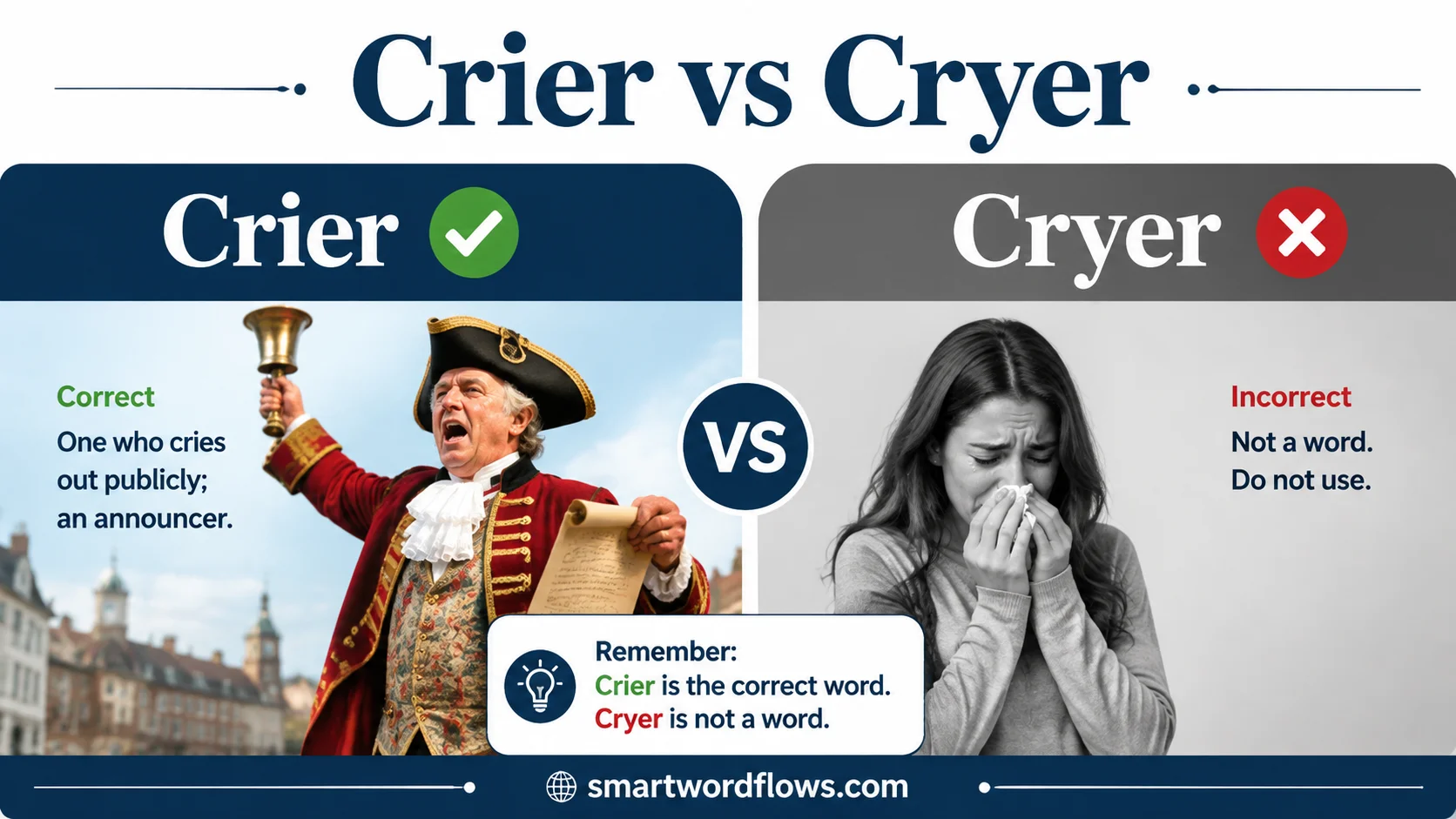

Crier vs Cryer: The Correct Usage Explained Clearly can help English learners, students, and writers understand this common spelling confusion. At first glance, crier and cryer look similar because both come from the verb cry. However, crier is the preferred spelling in modern English. It can mean one who cries or a person who makes announcements in public places. Understanding the grammar rule, context, and correct usage makes the difference easier to remember.
In practical terms, crier is commonly used for someone who makes public announcements, especially in historical settings such as town squares. Cryer may appear in old books, old texts, or historical writing, but it is less common in modern English. When choosing between these words, consider the meaning, context, and established English spelling. Using crier in modern writing helps avoid mistakes, improves clarity, and supports accurate and professional writing.
Quick Answer: Crier vs Cryer
The simple answer is:
- Crier means a person who cries out, shouts, announces, or makes a public call.
- Cryer means a person who cries emotionally or sheds tears.
Here is a quick comparison:
| Word | Meaning | Example |
| Crier | Someone who calls out or announces something | The town crier announced the king’s arrival. |
| Cryer | Someone who cries or becomes emotional easily | The child was a frequent cryer during bedtime. |
A simple way to remember the difference:
A crier uses their voice. A cryer uses their emotions.
Comparison Overview: Crier vs Cryer
Although these words share the same root, they developed different meanings because the verb “cry” has multiple definitions.
The word cry does not only mean shedding tears. It can also mean shouting, calling out, or making a loud announcement. This explains why English has both crier and cryer.
| Comparison Point | Crier | Cryer |
| Root word | Cry | Cry |
| Main meaning | A person who calls out or announces | A person who cries emotionally |
| Common usage | Historical titles and announcements | Informal descriptions of emotional behavior |
| Popular phrase | Town crier | Frequent cryer |
| Action involved | Speaking loudly | Shedding tears |
| Tone | Formal or historical | Casual or personal |
The difference depends completely on context. The spelling changes because the meaning changes.
For example:
- The crier announced the town meeting.
Here, the person is making an announcement. - The movie made him a cryer.
Here, the person becomes emotional and cries.
Both sentences are correct because each word matches its meaning.
Main Differences Between Crier vs Cryer
The biggest difference between crier and cryer comes from the type of “crying” involved.
A crier is connected with the older meaning of cry: to call loudly or proclaim something. A cryer is connected with the modern emotional meaning of cry: to shed tears or express sadness.
Meaning of Crier
A crier refers to someone who makes a loud announcement or public declaration. The word became popular because people once depended on spoken announcements before newspapers, radio, television, and the internet existed.
A town crier, for example, would walk through streets and share important information with citizens. They might announce:
- Royal announcements
- New laws
- Public events
- Market information
- Community news
The famous phrase “Hear ye, hear ye” is strongly associated with traditional town criers. This phrase was used to grab people’s attention before delivering a message.
Today, the word crier appears less often in everyday conversation. However, it still exists in historical discussions, literature, ceremonies, and some official roles.
Examples:
- The town crier announced the arrival of the visitors.
- The royal crier delivered important news to the villagers.
- The market crier attracted customers with loud calls.
Meaning of Cryer
A cryer refers to someone who cries, especially someone who cries easily or frequently.
This usage is less common than “crier,” but it is still grammatically correct. People often use other expressions instead, such as:
- Someone who cries easily
- A sensitive person
- An emotional person
- A person who tears up quickly
For example:
- My little brother was always a cryer when he was tired.
- She is not a big cryer, but emotional movies make her tear up.
- The baby is a loud cryer during the night.
The word cry er focuses on emotional reactions rather than announcements.
What Does Crier Mean?
The word c rier comes from the verb cry, which historically meant “to call out loudly.” It is related to the Old French word crier, meaning “to shout” or “to proclaim.”
A crier is someone who uses their voice to communicate with others, usually in a loud and noticeable way.
Historical Role of a Town Crier
Before modern communication systems existed, towns needed reliable ways to spread information. A town crier served as a human news system.
Imagine a small village hundreds of years ago. There were no smartphones, newspapers were limited, and many people could not read. When leaders needed to share information, they depended on someone with a strong voice.
The town crier would:
- Walk through public areas
- Ring a bell to attract attention
- Announce official messages
- Repeat important information several times
Town criers became symbols of public communication.
Famous Facts About Town Criers
| Fact | Detail |
| Origin | Town criers became common in medieval Europe |
| Main purpose | Sharing public announcements |
| Communication method | Loud voice and repeated messages |
| Famous phrase | “Hear ye, hear ye” |
| Modern use | Ceremonies, festivals, historical events |
Even today, some communities continue the tradition of town criers during special events.
Modern Uses of Crier
The word crier is not limited to town criers. It can also describe someone who calls something out loudly.
Examples include:
- A person announcing information
- Someone shouting a warning
- A person promoting goods loudly
Example sentences:
- The crier warned people about the approaching storm.
- The street crier advertised fresh fruit in the marketplace.
- The event crier called guests into the hall.
What Does Cryer Mean?
A cryer describes someone who cries tears or expresses emotions through crying.
Unlike a crier, who uses their voice to communicate information, a cryer expresses feelings.
People may describe someone as a cryer when they:
- Cry often
- Become emotional quickly
- React strongly to sad situations
Examples of Cryer in Everyday Language
Consider these examples:
- The toddler became a cryer after starting school.
- He is a movie cryer because emotional scenes always affect him.
- She was a quiet cryer who preferred to hide her feelings.
The word often appears in casual conversations rather than formal writing.
Why Do People Confuse Crier and Cryer?
The confusion happens because both words come from the same verb. They also look almost identical when written.
The problem becomes clearer when we understand that “cry” has multiple meanings.
| Meaning of Cry | Example |
| To shed tears | She cried after hearing the news. |
| To shout loudly | The child cried for help. |
| To announce publicly | The crier cried the message throughout the town. |
English often creates different words from the same root by adding endings. The ending “-er” usually means “a person who does an action,” but the meaning depends on the original action.
In this case:
- Cry + er = someone who cries.
- Cry + er = someone who calls out.
The context decides the meaning.
Is Crier or Cryer the Correct Spelling?
Both c rier and cry er are correct spellings. Neither word is a mistake.
The correct choice depends on what you want to say.
Use c rier when talking about:
- Announcements
- Public calls
- Historical figures
- Someone shouting information
Use cry er when talking about:
- Tears
- Emotional reactions
- Someone who cries often
Examples:
Correct:
- The town crier announced the news.
Correct:
- The baby was a constant cryer.
Incorrect:
- The town cryer announced the news.
The last sentence changes the meaning because it suggests the person cries emotionally rather than announces information.
Read More: Present vs Presant: Differences and Correct Usage
Crier vs Cryer in American English
In modern American English, c rier appears much more frequently than cry er, mainly because of the well-known phrase “town crier.” Most people recognize this term because it connects with history, public announcements, and traditional storytelling.
The word cry er, although correct, appears less often in everyday writing and conversation. Native speakers usually choose simpler phrases instead, such as:
- Someone who cries easily
- A very emotional person
- A sensitive person
- Someone who tears up quickly
For example, instead of saying:
“She is a cryer.”
Many speakers might say:
“She cries easily.”
or:
“She gets emotional during movies.”
This does not mean cry er is wrong. It simply means that English speakers often prefer more natural phrases in casual conversations.
Examples of Crier in American English
- The town crier announced the opening of the festival.
- The official crier read the statement to the crowd.
- The historical character worked as a royal crier.
Examples of Cryer in American English
- The baby is a frequent cryer when she misses her nap.
- He admits he is a cryer during emotional films.
- She was never a big cryer, even during difficult times.
The main difference remains the same:
Crier announces. Cryer expresses emotion.
Crier vs Cryer vs Cry: Understanding the Word Family
To fully understand c rier vs cry er, it helps to look at the word family behind them.
The base word is cry. Over time, English developed different meanings from this simple word.
The Different Meanings of Cry
The verb cry can mean several things:
| Meaning | Explanation | Example |
| Cry with tears | To show sadness, pain, or strong emotion | The child cried after falling. |
| Cry out | To shout or call loudly | She cried out for help. |
| Cry publicly | To announce something loudly | The crier cried the news across the town. |
Because “cry” has more than one meaning, words created from it can also have different uses.
Related Words From Cry
| Word | Meaning | Example |
| Cry | To shed tears or call loudly | The baby began to cry. |
| Crier | Someone who announces or calls out | The town crier shared the message. |
| Cryer | Someone who cries emotionally | He is a sensitive cryer. |
| Crying | The act of crying | Crying can release emotions. |
Understanding the root word makes the difference much easier to remember.
Common Mistakes When Using Crier and Cryer
Even experienced writers sometimes confuse these words because they look almost identical. However, a few simple rules can prevent mistakes.
Mistake: Using Cryer for Town Crier
The phrase “town crier” is fixed in English. It refers to someone who makes public announcements.
Incorrect:
The town cryer announced the new law.
Correct:
The town crier announced the new law.
The person is not crying tears. They are calling out information.
Mistake: Using Crier for Someone Who Cries Often
If you describe a person who becomes emotional easily, cry er fits better.
Incorrect:
My sister is a crier because she cries during every movie.
Better:
My sister is a cryer because she cries during every movie.
However, in natural conversation, many people would simply say:
My sister cries during almost every movie.
Mistake: Ignoring Context
The biggest mistake happens when people focus only on spelling instead of meaning.
A word does not become correct because it looks right. It becomes correct because it communicates the intended idea.
Compare these sentences:
- The street crier attracted customers with loud announcements.
- The street cry er attracted attention because he was crying.
The spelling changes the entire image in the reader’s mind.
How to Remember the Difference Between Crier and Cryer
Remembering the difference does not require memorizing complicated grammar rules. A simple association works well.
Memory Trick for Crier
Think:
Crier = Calls.
A crier uses their voice to reach people.
Example:
The town crier called out the important news.
Memory Trick for Cryer
Think:
Cryer = Cries.
A cryer shows emotion through tears.
Example:
The child became a cryer whenever the toy broke.
Another easy comparison:
| Word | Memory Tip |
| Crier | “A crier calls.” |
| Cryer | “A cryer cries.” |
This small difference can help you choose the right word quickly.
Crier vs Cryer Examples in Sentences
Seeing both words in real sentences makes the difference clearer.
Examples Using Crier
- The town crier walked through the village announcing the news.
- The royal crier delivered the king’s message to citizens.
- The crier shouted the instructions so everyone could hear.
- The festival hired a historical crier for the opening ceremony.
- The courtroom crier called everyone to attention.
These examples show that c rier connects with speaking, announcing, and calling.
Examples Using Cryer
- The young child was a frequent cryer during the first weeks of school.
- He is a movie cryer because emotional scenes affect him deeply.
- The baby became a louder cryer when she felt uncomfortable.
- She was not usually a cryer, but the farewell made her emotional.
- The actor joked that he was a happy cryer after winning the award.
These examples show that cry er connects with feelings and tears.
Real-Life Case Study: Why Context Changes Meaning
Imagine two people at a large community event.
The first person stands on a platform and loudly announces:
“The ceremony will begin in ten minutes!”
This person is a crier because they communicate information through their voice.
The second person watches an emotional farewell ceremony and starts crying.
This person could be described as a cryer because they express emotions through tears.
The action is different even though both words come from the same root.
| Situation | Correct Word | Reason |
| Announcing a public event | Crier | The person calls out information |
| Crying during an emotional moment | Cryer | The person sheds tears |
| Sharing official news | Crier | The person makes an announcement |
| Becoming emotional easily | Cryer | The person cries frequently |
Professional and Formal Usage of Crier vs Cryer
In professional writing, choosing the right word matters because small mistakes can affect credibility.
The word c rier works well in:
- Historical articles
- Literature
- Cultural discussions
- Event descriptions
Example:
The medieval town crier played an important role in spreading information.
The word cry er is less common in professional writing because it can sound informal.
Instead of:
John is a cryer at work.
A professional writer may say:
John becomes emotional easily.
or:
John is highly sensitive to emotional situations.
This does not make cry er incorrect. It simply means writers often choose clearer alternatives depending on the audience.
FAQs
1. Is “crier” or “cryer” correct?
Crier is the preferred and more common spelling in modern English. Cryer may appear in older texts, but it is much less common today.
2. What does “crier” mean?
A crier can mean one who cries or a person who makes public announcements, especially in historical settings.
3. Why is “cryer” sometimes used?
Cryer developed from the verb cry and can be found in some old books and historical writing. However, crier is generally preferred today.
4. Should I use “crier” in modern writing?
Yes. In most modern English writing, use crier when you mean someone who cries or makes public announcements.
5. Is “crier” pronounced differently from “cryer”?
They are generally pronounced very similarly. The main difference is their spelling, usage, and historical development.
Conclusion
Crier is the standard spelling to use in modern English, while cryer is an older and less common form. Remembering the preferred spelling can help you avoid spelling mistakes and write with greater clarity and accuracy.