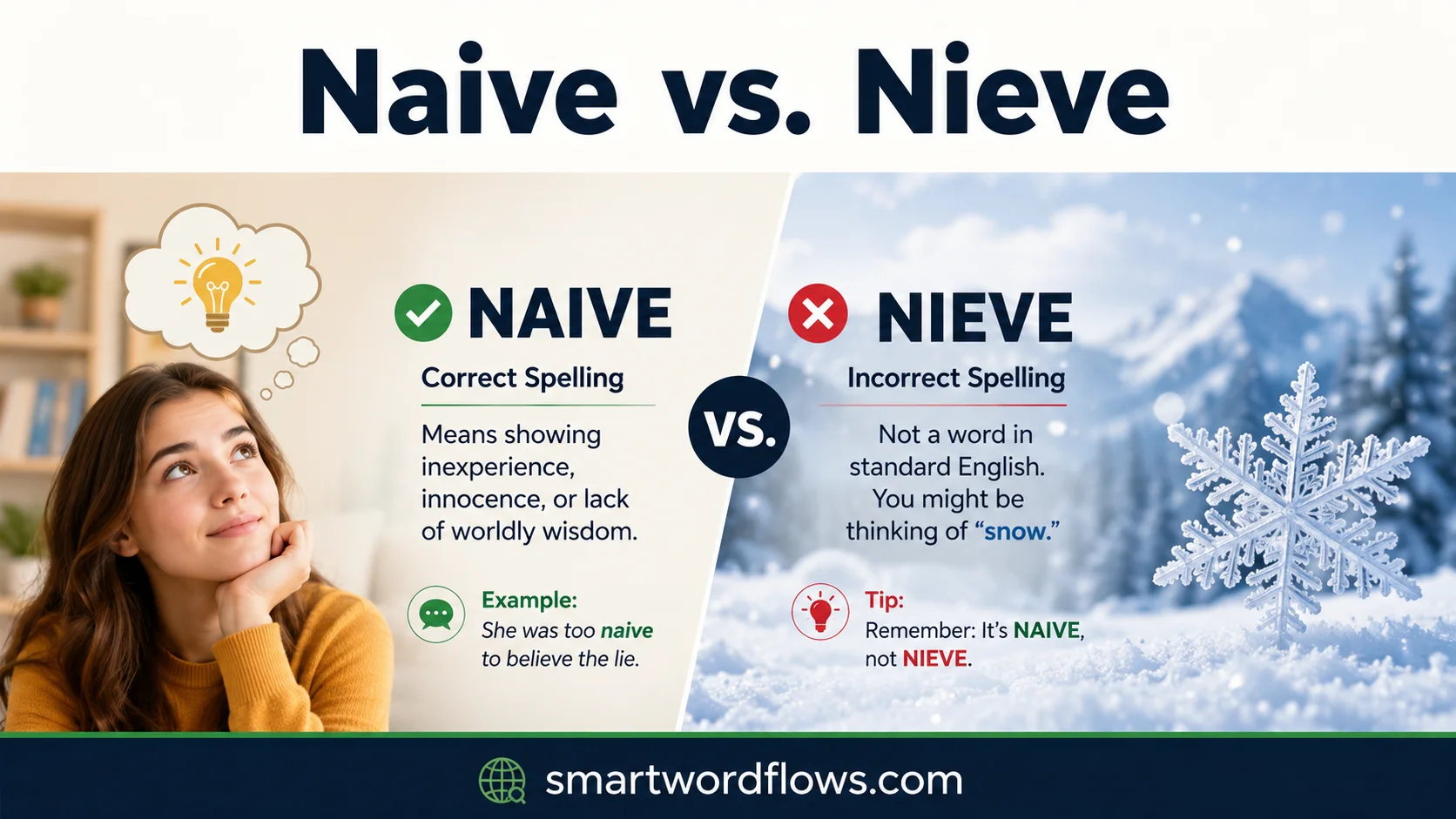

Naive vs. Nieve is a common spelling question. Naive is the correct spelling in English. It is an adjective used to describe someone who lacks experience, knowledge, or worldly wisdom. A naive person may be innocent, simple-minded, or overly trusting. They may believe things without questioning them and fail to notice potential dangers or deceit. Such people may be easily influenced, gullible, or overly optimistic because they have limited experience in certain specific situations or aspects of life.
Nieve is not the correct English spelling for this meaning. It is the Spanish word for snow. Naive is French-derived, while naif is its masculine form in French. The related noun Naïveté keeps the French spelling, and naivety is an acceptable nativized spelling in English. Understanding this difference helps writers avoid a spelling slip and prevents a mistake in emails, essays, and professional writing.
Quick Answer
The correct spelling is naive or naïve.
Nieve is not the standard English spelling when you mean someone who lacks experience, knowledge, or practical judgment.
Correct: She was naive about the risks.
Also correct: She was naïve about the risks.
Incorrect: She was nieve about the risks.
Both naive and naïve have the same basic meaning and pronunciation. The difference is mainly spelling. The version with the two dots over the i preserves a traditional form associated with the word’s French origin, while naive is now a fully established English spelling. Oxford lists naïve as an alternative spelling, while Merriam-Webster lists naïve as a variant of naive.
For ordinary American English, naive is a simple and safe choice.
Comparison Overview
The quickest way to understand naive vs. nieve is to compare the words directly.
| Feature | Naive | Naïve | Nieve |
| Standard English spelling | Yes | Yes | No |
| Standard dictionary entry | Yes | Listed as a variant | No, for this meaning |
| Meaning | Lacking experience or judgment | Same as naive | Not the intended English word |
| Pronunciation | /naɪˈiːv/ | /naɪˈiːv/ | Not the standard spelling |
| Used in American English | Very common | Accepted | Incorrect for this meaning |
| Example | He was naive about the deal. | He was naïve about the deal. | He was nieve about the deal. |
Oxford’s American English dictionary specifically gives naive and naïve as alternative spellings. It defines the word as lacking knowledge, life experience, or good judgment and notes that it can also describe innocent or simple behavior.
So, if you’re deciding between naive vs. nieve, don’t overthink it. Choose naive.
Main Differences Between Naive vs. Nieve
The main difference is simple: naive is correct, while nieve is incorrect when you intend the English adjective.
The spelling naive contains the letters n-a-i-v-e. The commonly mistaken form nieve changes the order of the middle vowels to i-e.
That may seem like a tiny difference, but spelling depends on exact letter order. Compare these:
- naive
- nieve
Think of naive as having a recognizable visual pattern: NAI + VE. Remembering that pattern can make the spelling easier when you’re writing quickly.
Why “Nieve” Is a Common Mistake
The mistake probably feels natural because English spelling doesn’t always give you a reliable pronunciation guide. The sequence of vowels in naive looks unusual to many English learners and writers.
Someone who hears the word may also have difficulty deciding whether the middle should be ai, ie, or ï. That uncertainty can produce forms such as nieve.
The safest solution isn’t to spell the word according to how it sounds. Instead, remember its written form:
NAIVE
If you want the traditional accented version, use:
NAÏVE
Don’t use nieve as a substitute.
What Does “Naive” Mean?
Naive is an adjective that usually describes someone who lacks experience, knowledge, or practical judgment. It can also describe an idea or belief that doesn’t account for the complexity of a situation.
Oxford defines the word in one sense as showing insufficient knowledge, judgment, or experience and being too willing to believe that people tell the truth.
For example:
It was naive to assume that everyone would agree.
The sentence doesn’t necessarily mean the person was stupid. Instead, the assumption failed to recognize that people have different interests, opinions, and motivations.
That’s an important distinction.
Calling someone naive doesn’t automatically mean calling them unintelligent. A highly intelligent person can make a naive decision when they enter an unfamiliar situation.
Naive Can Describe People
You can describe a person as naive when that person has limited experience or an overly simple view of a situation.
Examples include:
- She was naive about the realities of running a business.
- He was naive enough to believe every promise he heard.
- The young employee wasn’t foolish. He was simply naive about office politics.
- Her naive optimism helped her stay positive during a difficult period.
The tone can vary. Sometimes naive sounds critical. In other situations, it can suggest innocence or simplicity.
Naive Can Describe Ideas
The word doesn’t have to describe a person.
You can also call an idea, assumption, expectation, or approach naive.
For example:
The proposal was based on a naive assumption about consumer behavior.
Here, the word criticizes the assumption rather than the person who made it.
Other examples include:
- a naive assumption
- a naive belief
- a naive approach
- a naive expectation
- a naive question
- a naive interpretation
- a naive solution
Is “Naïve” the Same as “Naive”?
Yes. Naive and naïve generally mean the same thing.
The two dots above the i are called a diaeresis. In this word, the spelling helps show that the vowels should be pronounced separately rather than treated as one combined vowel sound.
Modern English commonly writes the word without the diacritic:
naive
However, the accented form remains completely legitimate:
naïve
Oxford lists naïve as an alternative spelling, and Merriam-Webster likewise identifies it as a variant.
Which Form Should You Use?
For most American English writing, naive is the easiest choice.
Use naïve if the style guide, publication, or personal preference calls for the traditional form.
The important point is consistency. If you choose naive, there’s no need to switch between the two forms throughout the same article or document without a reason.
For example:
The student made a naive assumption about the experiment.
There’s nothing missing from that sentence. The spelling is correct without the diaeresis.
How to Pronounce “Naive”
The standard pronunciation is approximately ny-EVE.
Oxford gives the pronunciation as /naɪˈiːv/.
The word has two main sound parts:
naɪ + iːv
This is one reason the spelling can confuse people. The written sequence naive doesn’t look as straightforward as many English words.
The spelling naïve makes the separation between the vowels more visually obvious. Still, both spellings represent the same word.
Is “Nieve” Pronounced Differently?
It shouldn’t be treated as an alternative pronunciation of naive.
If you’re trying to express the English adjective meaning inexperienced or overly trusting, write naive or naïve.
Examples of “Naive” in Sentences
Seeing the word in context makes its meaning much easier to understand.
Everyday Conversation
I was naive enough to believe that everything would work out immediately.
This sentence suggests a lack of realistic expectations.
Don’t be naive about how difficult the process will be.
Here, naive warns someone that they may be underestimating the situation.
Work and Business
It would be naive to assume that every customer will respond positively.
The word points to an unrealistic expectation.
His first business plan was somewhat naive, but he learned from the experience.
This usage focuses on limited practical experience rather than intelligence.
Education
The student asked a naive question, but it led to an interesting discussion.
A naive question can actually be useful. Sometimes a person unfamiliar with a subject notices an issue that experienced people overlook.
Relationships
She was naive about how quickly trust could disappear.
The sentence suggests that she lacked experience or realistic awareness.
Technology
It’s naive to assume that every website is safe simply because it looks professional.
Here, naive describes an assumption rather than a person.
Formal Writing
The argument relies on a naive understanding of the economic conditions involved.
This construction works well in academic or analytical writing because it identifies a simplistic understanding of a complex issue.
How “Naive” Works as an Adjective
Naive is primarily an adjective. It modifies a noun or follows a linking verb to describe a person, thing, idea, or approach.
Consider these examples:
- a naive student
- a naive assumption
- a naive question
- a naive approach
- a naive investor
- a naive interpretation
It can also follow forms of be:
He was naive about the risks.
Their expectations were naive.
A particularly common structure is:
It is naive to + verb
Examples:
It is naive to assume that the problem will disappear.
It would be naive to expect immediate results.
Another useful structure is:
naive about + noun
Examples:
She was naive about the industry.
They were naive about the potential consequences.
Common Collocations With “Naive”
Learning common combinations is one of the best ways to make your English sound natural.
| Collocation | Example |
| naive person | He was a naive person when he first entered the industry. |
| naive assumption | The plan depends on a naive assumption. |
| naive belief | She rejected the naive belief that success comes overnight. |
| naive approach | That naive approach ignored several important risks. |
| naive idea | It sounds like a naive idea at first. |
| naive question | His naive question exposed an important problem. |
| naive expectation | The team had naive expectations about the schedule. |
| naive optimism | Her naive optimism eventually gave way to realism. |
| naive understanding | The argument reflects a naive understanding of the issue. |
| naive view | That’s a naive view of how the market works. |
These combinations are useful because they show that naive can modify both people and abstract concepts.
Naive vs. Innocent
Naive and innocent overlap, but they aren’t interchangeable.
Innocent often relates to a lack of guilt, wrongdoing, or harmful intent. Naive, by contrast, usually focuses on a lack of experience or realistic judgment.
Compare these examples:
The child was innocent and didn’t understand that the game was dangerous.
The child was naive about the dangers of trusting strangers.
The first sentence emphasizes innocence. The second focuses on limited understanding and experience.
| Word | Main idea | Example |
| Naive | Lacking experience or realistic judgment | He was naive about the risks. |
| Innocent | Not guilty or not intending harm | She was innocent of the crime. |
A person can be innocent without being naive. Likewise, someone can be naive without being morally innocent.
Naive vs. Inexperienced
These two words are even closer.
Inexperienced simply means someone hasn’t gained much experience in a particular area.
Naive can go one step further. It may suggest that someone has an unrealistic, overly simple, or overly trusting understanding of a situation.
Consider this comparison:
She was inexperienced at managing a team.
This is a fairly neutral statement. It tells us that she hadn’t managed a team before.
Now consider:
She was naive about managing a team.
This suggests that she misunderstood what managing a team would involve.
The first statement describes a lack of experience. The second can imply a mistaken understanding that resulted from that lack of experience.
Naive vs. Gullible
Gullible has a more specific meaning.
A gullible person is too ready to believe things that other people tell them, especially when those claims aren’t trustworthy.
A naive person may lack experience or judgment without necessarily believing every false claim.
For example:
He was naive about how competitive the industry would be.
This doesn’t mean people easily trick him.
Compare:
He was gullible enough to believe the fake offer.
Now the focus is on being easily deceived.
A useful rule is:
Naive = inexperienced or unrealistic.
Gullible = too easily deceived.
The two qualities can overlap, but they’re not identical.
Naive vs. Unsophisticated
Unsophisticated can refer to a lack of refinement, complexity, knowledge, or experience.
That makes it another near-synonym of naive, but the words carry different shades of meaning.
The software uses an unsophisticated security system.
This means the system isn’t advanced or complex.
The software’s security assumptions are naive.
This suggests that the assumptions fail to account for real-world risks.
The difference becomes clearer when you think about what each word emphasizes.
Unsophisticated often describes something that isn’t advanced.
Naive often describes thinking that doesn’t recognize complexity.
Is “Nieve” Ever Correct in English?
When you’re trying to write the English adjective meaning inexperienced or overly trusting, nieve is not the correct spelling.
That doesn’t mean the sequence of letters could never appear anywhere. Names, foreign-language terms, and specialized uses can have their own spelling rules. But those possibilities don’t make nieve an alternative spelling of the English adjective.
For standard English writing, the choice is straightforward:
- naive
- naïve
- nieve
If you’re writing an essay, email, article, report, or social media post and you mean “lacking experience or good judgment,” use naive.
Read More: Realist vs Realest Correct Usage
Common Mistakes With “Naive”
Writing “Nieve”
This is the central spelling error.
Incorrect:
He was nieve about the contract.
Correct:
He was naive about the contract.
The middle vowels are ai, not ie.
Thinking “Naïve” Is a Different Word
It isn’t.
Naive and naïve represent the same adjective. The difference is orthographic rather than a difference in meaning.
Assuming “Naive” Means “Stupid”
That’s too strong.
A person can be highly intelligent yet naive about a subject they’ve never encountered.
Imagine a brilliant engineer entering the restaurant business for the first time. The engineer may understand mathematics, engineering, and complex systems perfectly well while still being naive about restaurant operations.
Experience matters.
Using “Naive” When You Mean “Innocent”
Sometimes innocent is the better choice.
If you’re talking about whether someone committed a crime, innocent is the appropriate word.
If you’re talking about someone’s lack of practical knowledge, naive is usually more precise.
Using “Naive” as an Insult
Context matters.
Oxford recognizes both a disapproving sense and an approving sense. In the approving sense, naive can describe someone or their behavior as innocent and simple.
For example:
Her naive enthusiasm made the project feel exciting again.
Here, the word doesn’t necessarily attack her intelligence. It can suggest refreshing simplicity or innocence.
How to Remember the Correct Spelling
A simple memory trick can save you from the naive vs. nieve mistake.
Remember:
NAI-ve
The first three letters are NAI.
Don’t rearrange them into NIE.
You can also connect the spelling to its related forms:
- naive
- naively
- naivety
- naïveté
Oxford lists naively as the adverb and gives naivety as a related noun.
A Quick Spelling Test
Fill in the blank:
It would be ___ to believe that every plan works perfectly.
The answer is:
naive
Not:
nieve
And not:
neive
That little spelling pattern becomes easier to recognize once you’ve seen it repeatedly.
Related Forms of “Naive”
The adjective has several related forms that are worth learning.
| Word | Part of speech | Meaning | Example |
| naive | Adjective | Lacking experience or practical judgment | He was naive about the situation. |
| naïve | Adjective | Same meaning as naive | She had a naïve view of the world. |
| naively | Adverb | In a naive manner | They naively assumed everything would work. |
| naivety | Noun | Lack of experience or sophistication | His naivety was obvious. |
| naïveté | Noun | Alternative form of naivety | Her naïveté surprised the team. |
Merriam-Webster also gives naiver and naivest as comparative and superlative forms of the adjective.
For example:
He was naiver than his colleagues expected.
That was the naivest assumption in the entire proposal.
In everyday writing, however, many speakers prefer constructions such as more naive and most naive.
Naive in American English
For American English readers, naive is a particularly practical spelling.
The Oxford Advanced American Dictionary lists the headword as naive and identifies naïve as an alternative spelling. It also gives the American pronunciation as /naɪˈiv/.
That means writers don’t need to worry that removing the diaeresis makes the word incorrect.
Both are legitimate:
naive
naïve
For a standard American English article, business document, school assignment, or general website content, naive is an uncomplicated choice.
Naive in Specialized Contexts
The word has meanings beyond ordinary descriptions of inexperienced people.
Merriam-Webster notes a specialized use in experimental contexts. For example, a naive subject or animal may be one that hasn’t previously been exposed to a particular experimental situation or treatment.
This specialized sense is important because context can change what naive means.
For example:
Researchers compared experienced subjects with naive subjects.
Here, naive doesn’t necessarily mean gullible or foolish. It can mean that the subjects haven’t previously encountered the relevant experimental condition.
The word also appears in discussions of art. Oxford describes naive art as a style that deliberately uses a very simple approach, often resembling children’s art.
So the word isn’t limited to personality or everyday behavior.
A Practical Case Study: “Naive” in Real-World Writing
Consider a new entrepreneur who believes that a good product automatically guarantees sales.
The statement:
The entrepreneur was inexperienced.
is accurate if the person has never run a business.
But:
The entrepreneur had a naive view of the market.
adds more information. It suggests that the person didn’t fully understand competition, customer behavior, pricing, marketing, or other complications.
Now change the situation.
Suppose someone sends the entrepreneur a message promising guaranteed profits, and the entrepreneur immediately sends money.
In that situation:
The entrepreneur was gullible.
may be more precise.
If the entrepreneur simply didn’t understand the complexity of the market, naive works better.
This small distinction makes writing more precise. Good vocabulary isn’t about choosing the fanciest word. It’s about choosing the word that fits the idea.
Facts About the Word “Naive”
Here are several useful facts that help explain why the word looks and behaves the way it does:
- Naive is an adjective.
- Naïve is an accepted alternative spelling.
- The standard pronunciation is approximately ny-EVE.
- Oxford traces the word to French naïve, the feminine form of naïf, with an earlier connection to Latin nativus, meaning “native” or “natural.”
- The word can have a negative or disapproving sense, especially when it describes poor judgment or excessive trust.
- It can also have a more positive sense, referring to innocent or simple behavior.
- In specialized fields, naive can describe someone or something that hasn’t previously been exposed to a particular condition or experience.
- The adverb is naively or naïvely.
- The noun can be naivety or naiveté.
- Nieve should not replace naive when writing standard English.
Naive vs. Nieve: At-a-Glance Guide
| Question | Answer |
| Is naive correct? | Yes. |
| Is naïve correct? | Yes. |
| Is nieve correct for this meaning? | No. |
| What does naive mean? | Lacking experience, knowledge, or realistic judgment. |
| Can naive describe an idea? | Yes. |
| Can naive describe a person? | Yes. |
| Is naive the same as gullible? | No. They overlap but aren’t identical. |
| Is naive the same as innocent? | No. Their meanings differ. |
| Is naive the same as inexperienced? | Not exactly. Naive often suggests unrealistic judgment as well. |
| Which spelling is easiest for American English? | Naive. |
| How is naive pronounced? | Approximately ny-EVE. |
FAQs:
1. Is “naive” the correct spelling?
Yes, naive is the correct spelling in English when describing someone who lacks experience or knowledge.
2. Is “nieve” a correct English word?
No. Nieve is not the correct English spelling of naive. In Spanish, nieve means snow.
3. What does “naive” mean?
Naive describes someone who is innocent, inexperienced, overly trusting, or easily influenced because they lack knowledge or worldly experience.
4. Is “naivety” an acceptable spelling?
Yes. Naivety is an acceptable English spelling of the noun related to naive. Naïveté is the French-derived form.
5. What is the difference between “naive” and “nieve”?
Naive describes a person who lacks experience or understanding, while nieve is the Spanish word for snow.
Conclusion
Naive is the correct English spelling, while nieve should not be used when describing an inexperienced or overly trusting person. Remembering this simple difference can help you avoid spelling mistakes in everyday and professional writing.